I can’t remember when Brooks came out with an entirely new shoe model since before the Pure Project series. That’s the kind of cool thing about Brooks, they don’t go chasing the newest fad just because everyone else is doing it. Case in point: Brooks hasn’t yet joined the max cushion movement, especially in trail shoes. Here is the Cascade, they tell you, it will get you there. We worked long and hard on it, we stand by it. Something to respect about that.
So I was surprised when I heard about the Neuro, a new neutral trainer (some have called a racer) that introduces a little bit of everything new, from “propulsion pods” to a new style of upper (Hammock System) that wraps the feet to a Gearing Mechanism that allows for more foot flexibility, a more natural experience.
It looks unlike anything Brooks has produced in the past few year. A neutral trainer that successfully maintains responsiveness without sacrificing cushion. You could go long miles (20+) in this shoe while also using it as your track session go to.
I like these shoes a lot. To be honest, I like a lot of what Brooks does with their shoes. If you’ve read my past Brooks reviews you know that I’ve worn more Brooks shoes than any other brand and that’s because, with the exception of few misses for me, they do their craft well. They don’t make drastic changes for the sake of making change. And when they do introduce something new, like with the Neuro, then it is well worth the wait.
Out of the box:
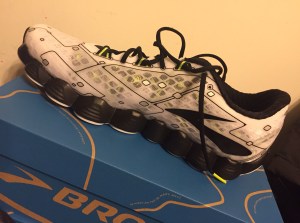
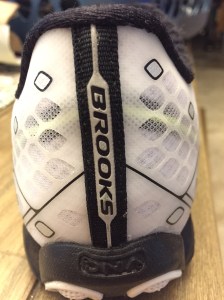
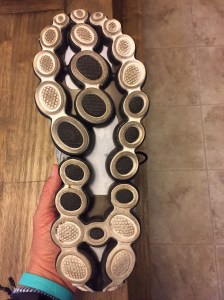
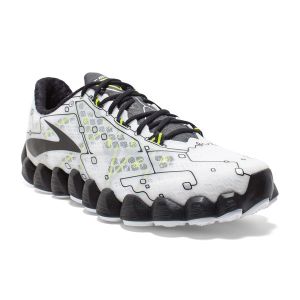
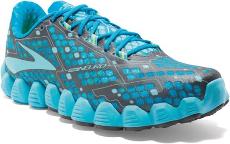
Brooks sent me the white/black color way and they were bright and unlike any Brooks shoe I’ve seen before. Brooks is giving us a few new terms with regard to its shoes, or at least this model. Propulsion Pods allow for responsiveness without sacrificing cushioning.
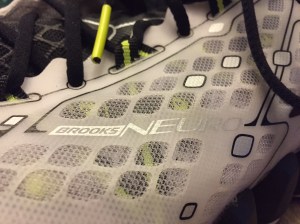
Nice view of the Propulsion Pods
The sole is a little less than a typical Brooks shoe. If you see the image above, you see theres a lot of “unfilled” space in the middle of the sole which allows for lower weight but also, which I think is more important to Brooks here, more flexibility. They also introduce the Gearing Mechanism that allows the forefoot and heel to move separately. For all the new jargon, the Neuro gives you a good ride. These pods allow the foot to move more naturally and not feel restricted by the construction of the sole. In sort, the foot determines the movement, not the sole.
The upper is a multilayer design which features the Brooks Hammock system which is a series of cords or laces that wrap the foot and connect to the laces. The tighter the laces, the higher the hammock around the foot. Over all this is an layer of sheer PVC type material.
A good look at the outside layer of he upper and you can see the laces that make up the Hammock just below
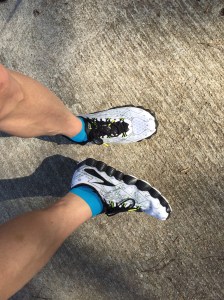
I like the feel of the shoe. The ride is smooth and the ability to tighten laces for a custom feel around the foot is nice. I’ve not run longer than about 10 miles in these since I was tapering for a 100 miler, but I don’t see how you couldn’t go at least 20 or more.
Details: Brooks Neuro 11.5 D Men’s. The 11.5 weighs 11.1 ounces.
“If something is easy how much reward is there?” –David Horton, Barkleys Finisher
“You can’t really tell how much you can do until you try to do something that’s more.” –Lazarus Lake, Barkleys Founder
“I will never ever do a 100 mile race. Nothing will change my mind.”– Gordon Harvey (July 2010)
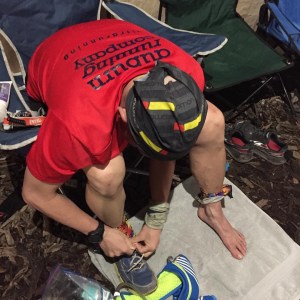
Loads of gear and planning go into a 100
When I first began running, I was sure that I would never run farther than a 5K. Then not farther than a half marathon. Then no farther than a marathon. Then 50K was my limit. Then maybe multi-day stage races would be all I needed. Lo and behold, last weekend found me running through the night at mile 75 of a 100 mile race that I had sworn to all who would listen that I would never do.
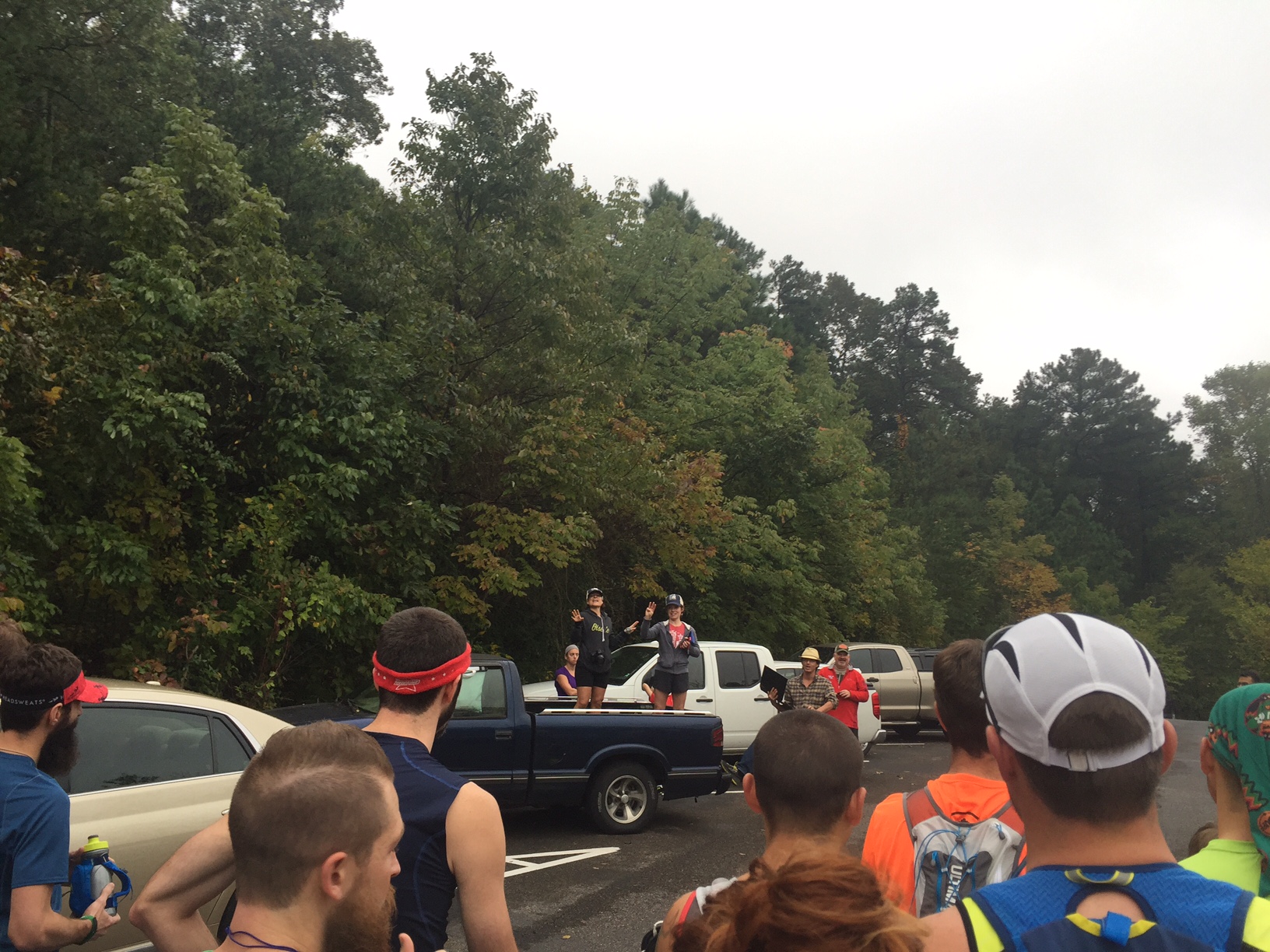
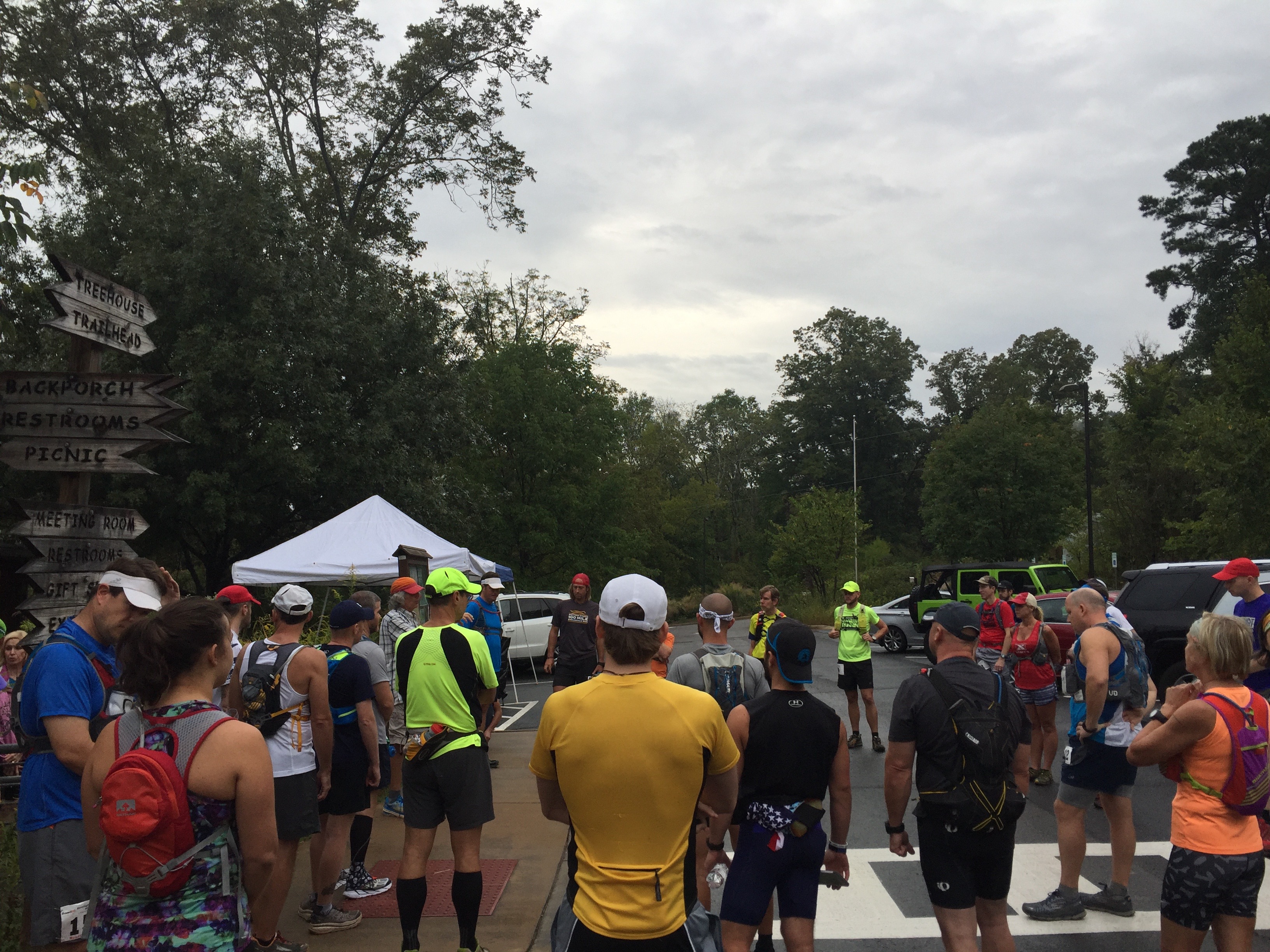
Start line chatter
(Sidenote: in July 2010 I was helping a couple of friends of mine run Burning River 100 in Ohio. Sitting on a covered bridge in Ohio in the middle of a cool summer night, I made a pledge with my friend Megan. We were seated next to a man who was running the 100, who had come into the aid station where we awaited our friends. The guy was delirious. He was loopy. And, to be honest, he smelled horrible. Megan and I looked at each other and made a solemn pledge to never ever run a 100 mile race. Last November she ran her first. This weekend I ran mine. Never say never.)
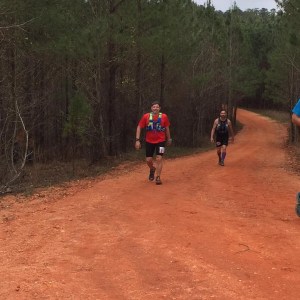
The fateful shoe change at mile 50Approaching Heaven Hill with friend Tim who finished his first 50
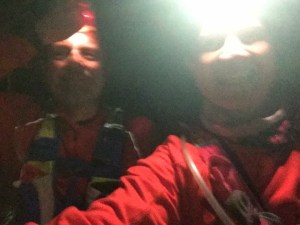
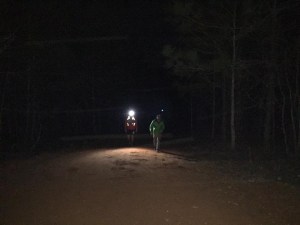
What went wrong? I don’t know, really. But I know that each distance in my running life has been about testing my will to go just a little farther. Part of it was to exorcise the demons of my “just good enough” adolescent sports years. Or my “average” high school and college grades. And my habit of sometimes just doing enough to complete a task with minimal pain and challenge. Then came running. No matter how fast or slow you run, you must go the entire distance. You must commit to the whole, to the end goal. To fail is to publicly admit to the world that, absent some injury or illness, I quit. I failed. So each distance in my running life has been about this. How much do I want that distance? The 100 was the brass ring. The ultimate test. You can’t fake a 100. You can’t train halfway and wing a 100. You can’t go out and just do a 100 without a great deal of planning and preparation. The 100 will eat you up and spit you out in a way that you’ll never forget. No, with he 100 you have to want all of the process, all of the training, all of the miles. This is why I found myself running a 100 on a moonlit trail in the middle of the night with only a few deer and one freaked out armadillo near me.
My smile masks my deep desire to lie down and sleepMile 25
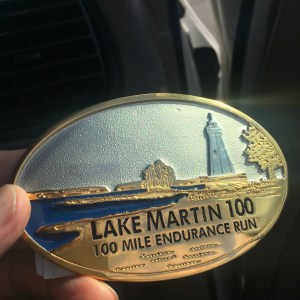
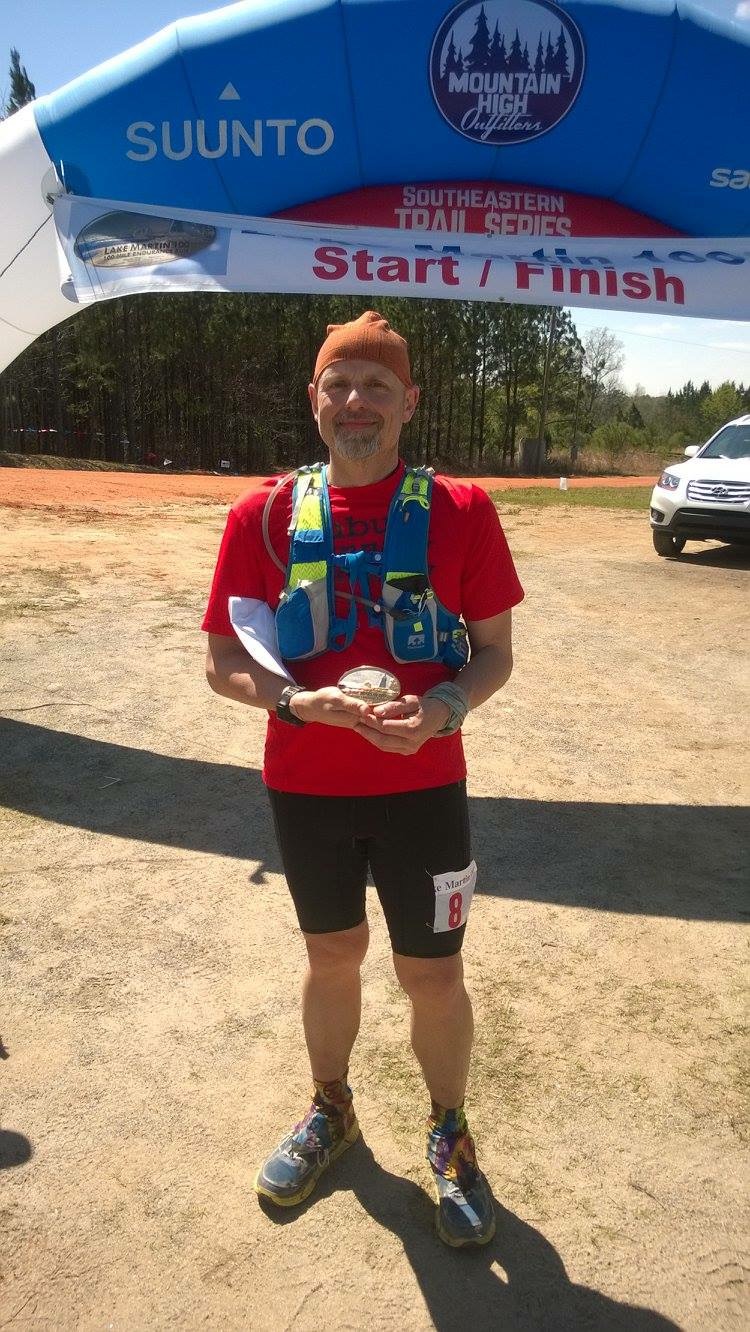
Let’s start at the end. The end of this race, crossing that line to complete the distance and earn that belt buckle reminded me of a feeling that I hadn’t felt in almost 7 years: finishing my first marathon. I haven’t felt that “I can’t believe I just did this” feeling since January of 2009. I’ve run 50Ks, half-iron triathlons, multi-day stage races. But none of that gave me the anxiety and nervousness that my first marathon did, or that the 100 gives me now. I felt it Sunday at noon as I jogged toward the finish, with cowbells ringing and friends and family cheering me on. Here’s the spoiler: we are imminently capable of doing more than we can ever imagine. I forget this when things get difficult or tedious. I forget this when the night drags on and I have 50 miles to go. I forget this when I’m at mile 82 and my overnight pace has set me behind schedule to finish. I forget this until I’m reminded with a verbal kick in the pants by someone who gets this. I forget this until I remember that what I want is slipping from my grasp because I had started to settle for “almost good enough.”
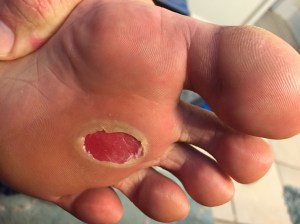
For me, the race began after mile 50. The first 50 is a long day through the woods with many other people. After 50 all the 27 mile runners and 50-milers have finished. What’s left is the overnight hours, 50 miles, and your mind. The trail clears out and you find yourself alone in the dark with a headlamp with they eyes of animals whose homes you are invading reflecting the light from your headlamp. Adjusting to the night takes time. Your pace slows, small rocks and stumps become hazards. And it is inevitable that you start to do math. At mile 50 you are still lucid enough to make simple numerical calculations. This is the biggest mistake you can make, thinking about the whole. There’s nothing more dispiriting than feeling the accomplishment of the 50-mile mark only to realize that you have another 50 to go. I was warned not to look at the whole, to not consider how far I had left to run. Be in the moment, friends said. Be present. That was the hardest part of the race, staying cognizant of the moment and the mile I was in and not dwelling on the miles to come. (Well, that and the blister on the ball of my left foot that I ran on for the last 18 miles).
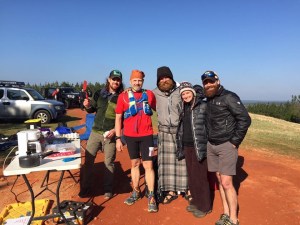
The Heaven Hill gang
Around mile 57 at the Heaven Hill aid station I told the crew there to make sure I savored all of this process. This is what I wanted out of my 100. There was something romantic to me about rolling into a late night aid station, getting encouraged from the folks there, and heading back out into the dark and on to the next location. That was the most romantic part of all this, the solo journey of a man on a mission to accomplish the unimaginable. But as fatigue weighs heavy and sleep seems so far away the doubts and the negativity enter the mind easily and push out the greater, more rewarding feelings from these races. It was a big moment for me to realize I was slipping away and to call for help. I didn’t want to lament for the rest of the race that I was tired and in pain. I wanted to know and to feel and to savor the experience.
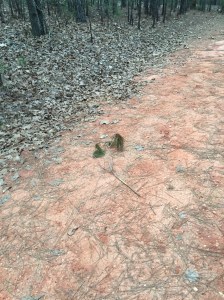
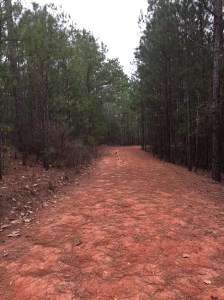
From afar this piece of bush looked like a tiny man standing next to another tiny man who kneeled on the ground. This was around mile 50.Some of the red dirt trail. This was a smooth portion. Not all was like this
I can’t say enough about Heaven Hill. That aid station was a bright shining oasis that boomed music all through the day and night, that you could hear echo through the valley, beckoning you to push on and come refuel body and mind. The folks there got it. They’ve run these, they’ve crewed and paced these races. They met you at the bottom go the hill. They jogged you in. They lifted the soul. It was during the night, with many miles to go, and more than a little doubt rising in me that I implored them to help me. “Don’t let me not savor all of these moments. I want to remember and soak this in.” I wanted to leave this race knowing that I was there, in the moment, appreciating every step, every mile, every hour, every hill. And to their credit they reminded me. Even as I set off on mile 88, in the midst of the darkest period of the race for me, behind schedule, needing to run harder than I had all race just to catch up that Kyle Stichtenoth called out to me, “12 more to go. Savor them all!” That memory tears me up. And I have a thousand memories just like that.
Moon over Lake Martin
My friend Megan flew from California to pace and crew me, repaying my pacing and crewing her during her first 100 last November. You need a good friend who understands your running mind. She ran a tight ship. And she gave me a swift kick in the pants at mile 82 when our overnight pace had slowed such that if I didn’t get it together, I wouldn’t finish in time. We had talked to each other before each of our races promising that nothing we said to each other during the race would affect or damage the friendship away from the race. This is key. Because I was a crab and she had to get in my face. It worked. There were moments when I lost the desire. There were moments where I literally slept as I hiked through the woods only able to focus on her feet as they struck the path before me. If she hadn’t intervened I wouldn’t have finished in time to earn my buckle. Runners have to do the miles for themselves, but they will never be successful without good friends who understand them and the sport. My gratitude runs deep.
Running toward the finish line on Sunday
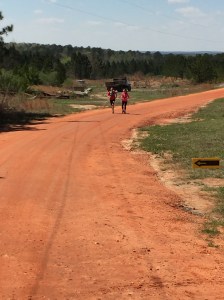
Hustling for the last 18 miles gained my time back. I would finish with at least 20 minutes to spare. And as I reached the final approach, a red-clay road that started about 3/4 of a mile from the finish line, it hit me. A mixture of disbelief, of wonder; a surreal awareness that I would join a small group of people who had completed a 100 mile race in under 30 hours. Mary Jo and David Tosch (the RD) rang cowbells and blew a vuvuzela. My family cheered. Running friends who waited around to see me finish applauded and yelled. I didn’t want that moment to end. The finish line moment after a life-changing running experience can never be rebottled. You can try to replicate it in subsequent races, but it never feels like the first. Emotions made raw from exhaustion and success overwhelm you. These are the moments where we reify our ability to do more than we can ever imagine. In those times the failures of the past fade away and our soul is lifted by the realization that our limits are ill-defined by our mind’s inability to let go of pain and fear and just do the thing ahead of us. We have to force the mind to let it all go and just move. I had seen the literal and figurative darkness. I had struggled and overcame. I had been transformed.
Random notes
Things you think you see when exhausted during a 100: 1)a tree stump looked like a panda bear head. 2) A mossy rock was I thought for sure a sleeping duck. 3)My headlamp would shine on leaves and as I moved past so would the shadow, scaring me that some animal as running at me. 4)The pack of Coyotes howling all night long was slightly unsettling. 5) a rock formation with mud on it looked like an old woman standing along the trail. 5)For some reason late in the evening hours, I became fixated on the term “animal husbandry” for reasons I cannot explain.
David and Mary Jo Tosch/Southeastern Trail Runs.
I’ve run more Southeastern Trail Run races than any other. David and Mary Jo Tosch are the gentlest, kindest, cheeriest souls I’ve come across in my running life. With a David Tosch race course you will earn your miles. They are rarely easy (even if he says so) and LM 100 was no different. Four 25-mile loops aren’t easy. And I think that hardest segment of the race is the last 7 miles of each loop. Running in a Tosch race is like being part of a loving family. I’ve jokingly complained about David’s infatuation with trying to build a course where you climb 100% of the time, but I’m proud to know these two wonderful souls and I’m proud that my first 100 was a race put on by David Tosch.
Coming into Heaven hill. Kyle is guiding me in. Around mile 57
Gear notes: Nathan 2L hydration pack, Buff headwear, Lululemon Short tights, Asics run shirt bought from Auburn Running Company in California. I rotated between the Hoka Challenger (last year’s model) and the newest Altra Olympus. My biggest mistake was changing shoes AND socks at mile 50. This would result in a major blister on the balls of both feet, especially my left foot which tormented me for 18 miles at the end of the race. The Altras caused blisters on the side of both big toes (something that had happened before but I had thought I had solved in training). This made me change socks and shoes at 75. I should have kept my socks and changed back to the Hokas instead of changing into a thicker Drymax sock which caused the big blisters. Next time I stay in the Hokas and get a solid sock that won’t blister me like the drymax did. (Funny, Drymax has always been good to me until this training cycle).
18 miles on this blister. I learned I have a new threshold for pain
Nutrition: Dates stuffed with almonds (2-3 an hour through mile 50), aid station fruit, and some skittles between miles 40 and 50. A PBJ every 25 miles. A tortilla with hummus, avocado and tofu at 50 and 57. I ate a Lenny and Larry’s Complete Vegan Lemon Poppyseed cookie sometime around mile 75. After mile 80 I lost my appetite. But I forced a tortilla, some oranges, a banana, and some candy and random gel into my mouth so I wouldn’t fall apart at the end.
There was a period about two years ago, when iPad was booming and everyone had to have one, where I decided I’d go all in on the digital lifestyle. I’d leave pen and paper behind and have all my notes and information at my fingertips. That worked for a while, but I soon found that my analog-trained mind needed to feel the paper and pencil. And as much as wanted to preserve and have available all the info all the time, I couldn’t process information as efficiently in digital as I could in analog format. I had to see it on paper.
A year ago, I rediscovered my love of notebooks and paper. I found the Field Notes brand notebooks. I started carrying one around everywhere. Notes, thoughts, ideas jotted down. I also recalled that my dad always had his small pad and pencil in his shirt pocket all the time. The nostalgia of my dad’s analog life spurred me to come back to my roots. I embraced the idea of writing information, of being able to remember better what I wrote and what I was thinking. The process of just writing it on the paper assisted my memory. In fact, studies have shown that the process of writing notes by hand facilitates better retention of the information.
Last spring, I tried to keep a running log for the first time in my life using a small notebook. I fell behind. I couldn’t keep up. I didn’t know exactly what to record or how to put it on paper.
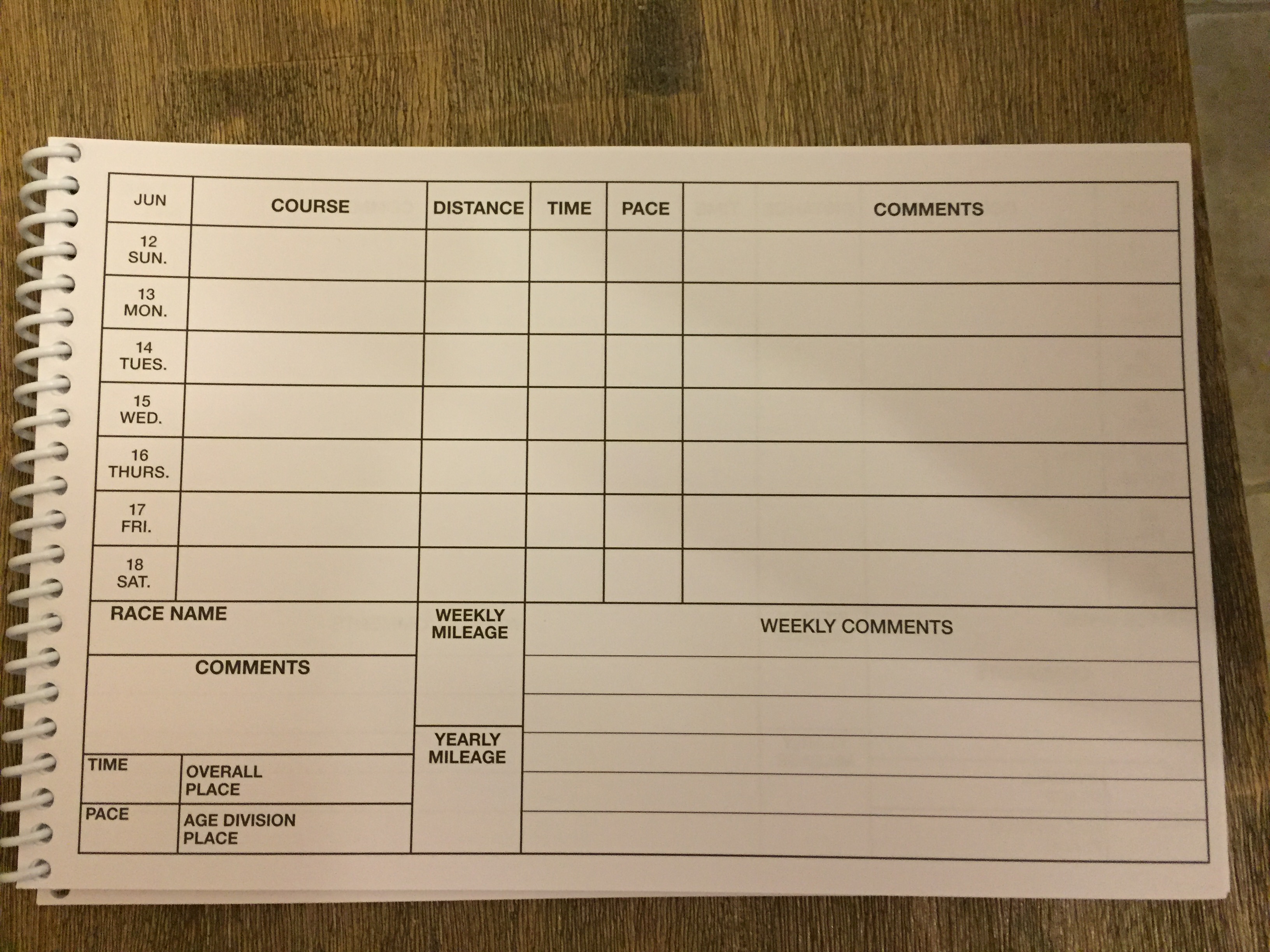
I don’t do resolutions. But this year I’d like to be better about keeping a running log. I want to be able to look back at how I felt on a certain day. I think this will help me in the long run. Too often I find myself struggling on a humid summer day wondering if I have acquired some sort of disease, failing to remember that it is merely summer that is affecting me. It would help if I could look back and see that every summer since I’ve been a runner I have felt this way: leaden legs, inoperative lungs.
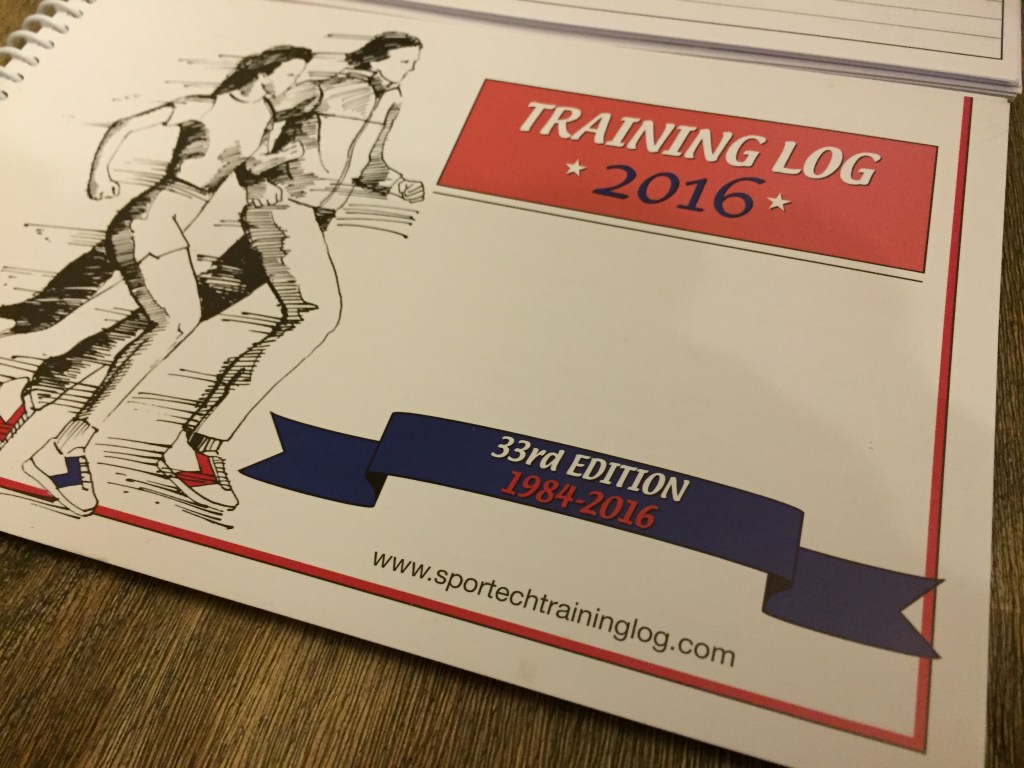
One day last October, I ran across the Facebook feed of Phil Kasunick. He had posted an image of his running logs. I’ve long followed him on twitter and added him on Facebook about a year ago. Phil has published the Runner’s Training Log for years. I’ve seen it but never took logging my runs seriously until now. Phil was kind enough to send a log for review and I told him I planned to make it part of this post and my new year’s plan to better reflect on each run. My challenge is to note more than the distance and the time, but to record my feelings, mental and physical. I want to look back and see my whole self, not just the numbers that, for better or for worse, we allow to define us.
No, its not, Google Maps, there is no destination on my right. Only a field, I think. I can’t see farther than 15 feet outside the car because I’m atop some random California mountain at 11 o’clock on a Saturday night. I forgot my wallet. I’m driving the car of someone I met only an hour ago. I’m from Alabama. I have a slight southern accent. There’s no way this gets explained if I get pulled over.
I’m alone, save for the small fox standing defiantly in the middle of the road staring at my car. I’ve no cell service. I’m in a Stephen King novel.
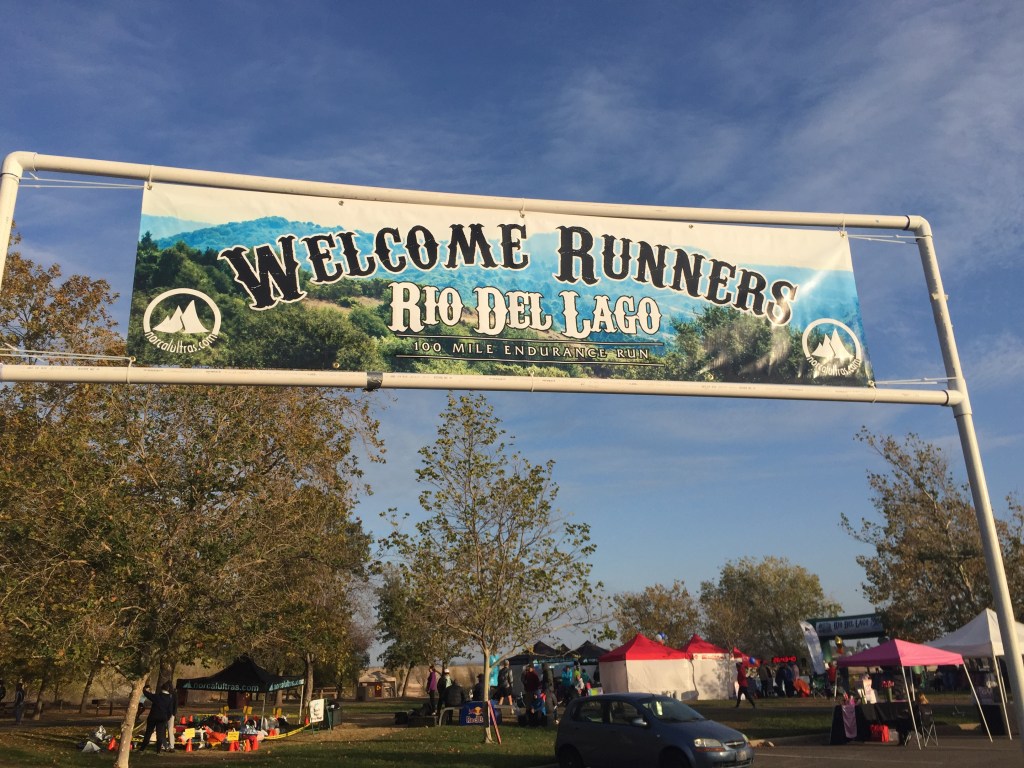
Funnily, this was not the first challenge of my weekend crewing and pacing at the Rio Del Lago 100. Just getting there was an adventure. Storms rolling across Texas diverted what should’ve been a quick flight from Birmingham to Dallas for the connection to SF. Our small commuter jet lacked sufficient fuel to circle Dallas awaiting for the airport to reopen after the storms, so we landed in Shreveport for what the pilot terms as a quick fuel grab. No deplaning, only fuel. Ninety minutes later we deplaned. Three hours after that we were back in the air each one of us fearing missed connections.
I grabbed a later flight from DFW in anticipation of a later arrival and thought I had pulled off an escape form travel nightmare alley when my later flight was canceled, having me stranded at DFW. Quick phone work while others were still stunned by the cancellation allowed me to grab the next available flight to San Francisco. The only problem was it departed the next morning at 7:15. I was stranded, along with hundreds of others who also had fallen victim to weather delays and cancellations.
The customer service line extended to Arkansas, it seemed. And I reasoned that had I even made the front of the line within an hour and secured hotel credit for a room for the night, there was no way I’d get more than 2 hours sleep before having to return to the airport for the flight. The smart play was to sleep at my departing terminal. Thankfully, the airline left cots and blankets strewn about the airport for anyone to use. I grabbed mine and settled in for a horrible night’s sleep with all the lights on and listening to the continuous loop of CNN airport news (CNN is pretty lame these days, but airport CNN is a whole new level of horrible) while fearing that I would awake totally naked, the victim of theft of all my bags and clothes as I slept.
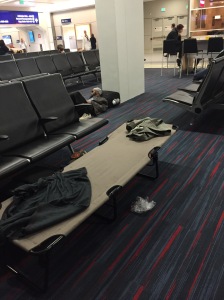
How I looked overnight at the airport.
This was but ONE of the customer service lines on a stormy night of canceled flights and mixed connections
The storms cleared, morning came, and my fight arrived in SF in mid morning, just in time for my friend Megan to pick me up, get her friend Dave, and travel to Folsom, California for the pre-race briefing and to set up our camp for the night.
Base camp at DFW
After my night on the Dallas airport floor, exhausted from travel and stress, I saw sleeping in a tent with two other people on a cold California night as a treat. An early race start and the early Autumn darkness left us little to do that night other than sleep at 6:30. I mean, really, you can stare at a fire only for so long.
Crew life on a hundred mile race is at times equal amounts boredom and excitement. There’s the thrill of your runner arriving at an aid station and your crew snaps into support mode like a Formula One pit crew. Checking nutrition, racing to re-fill the hydration pack: “look out you jerks, I’m a crew member, gimme some water for my runner!” I felt like like Joan Cusack’s character in Broadcast News as she breathlessly delivers a news story videotape for the national news broadcast with seconds to spare.
This is followed by the inevitable letdown as you runner moves on and you pack up and find some way to spend the next few hours as they move to the next aid station. The excitement fades and the boredom grows.
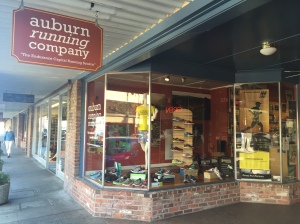
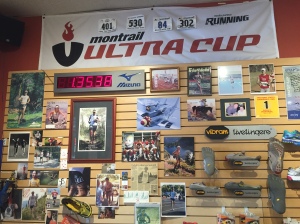
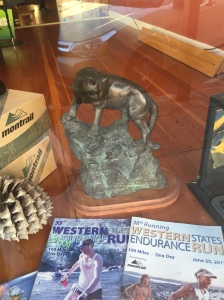
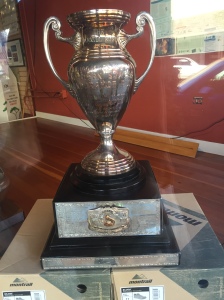
Crew downtime allows you to visit ultra runners Mecca: Auburn and the Auburn Running Company.Some of the stuff in the window at Auburn Running Co.Some of the stuff in the window at Auburn Running Co.
The day gives way to evening and darkness falls over crew life. Headlamps abound and one learns pretty quickly how to instinctively point the head away from the eyes of an oncoming runner or crew member lest you blind them with your beam. This is perhaps one of the more important pieces of new etiquette: don’t blind runners for crew members.
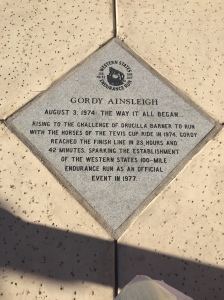
It was at one of those evening aid stations near Cool, California where the race took a three part loop around the same circuit that I ran into trail running royalty. I had just completed my first leg of pacing and had a few hours break before I was on again. As I walked to the car to get warm clothes for my downtime I ran across Gordy Ainshliegh. The man who essentially created 100 mile races.
Few ultra runners are unaware of the legend of Gordy Ainsleigh. In 1974 prepared to ride the Western States Trail Ride, his horse went lame. Nonplussed, Ainsleigh decided to run the rugged course that spans 100 miles from squaw valley ski resort to Auburn, California. He completed the run in under 24 hours and thus began the Western States endurance run. No slow ultra runner, Ainsleigh once ran a 2:52 marathon while weighing over 200 lbs.
Ainsleigh is considered the grandfather of ultra runner and has assumed a cult like status among those who gravitate toward long days on the trial. So it was a bit of a shock when I found him wearing ragged sweats and hoodie, casually sipping coffee, and hanging out with a cop who was guarding an entrance gate to aid station parking. I introduce myself and told him that it was my honor to meet the man who invented Western States, “I’m glad you’re happy that I made my run. It worked out well,” He said.
He’s got his own walk of fame Auburn
He winked and told me that the greatest benefit its that he can travel all over and run for free in any race he wants or just hang around to absorb the atmosphere. He didn’t say it, but I suspect he also enjoys the constant adulation.
I had just registered for my first 100 miler, I told him. “Do you have any advice or training tips.” I asked.
“How many fifties have you run?”
“None,” I explained, “but I have a tough 46 miler next month.”
“You’re running the 100 too early,” he remarked flatly.
“Take a year. Don’t run long on consecutive weekends. You’re no spring chicken. How old are you?”
“48”
“Oh yeah. Don’t run two days in a row. Only do long runs every two weeks,” he prescribed.
“So,” I asked, “by long you mean like 30 miles?”
“Fifty,” he corrected.
“A fifty mile run every two weeks for a year?” I asked, praying that I had heard wrong.
“Yep. Run long every two weeks. 50 miles. Do this for a year and you’ll be ready,” he said with no hint of humor. I waited for a smile or a giggle or some indication that this was a joke.
I’m no spring chicken to be sure, but if I took a year to run 50 miles 26 times over the span of 52 weeks, I’d surely have no spring in my step. I thanked him for the advice, shook his hand, and went on my way to rest and refuel for my next pacing segment while I pondered the unique allure of this trail running legend.
After Megan and Keith had finished their Cool, California loops and ended to the next aid station (get name), Eric and I started our journey to meet them. Eric was in his car and I, at the request of Keith, who was pacing Megan and would go home from the next stop, asked me to drive his car from Cool to Rattlesnake Bar so he could leave for home soon after finishing.
There is more than one Rattlesnake Bar in google maps. Google maps took me to the loneliest place it could find, atop a small mountain 25 miles in the opposite direction of the Rattlesnake Bar I wanted to reach. I knew something was wrong when the terrain became increasingly desolate but I kept the Google faith. Maybe Google knows what it is doing, I thought. Maybe there’s a magical short route it is taking me on. Maybe I won’t find myself in Folsom prison hoping for my own Johnny Cash concert one day.
Alas, Google failed me. I texted Eric when I had cell reception and he sent me a dropped pin so I could navigate my way out of the wilderness. What should have been a 25 minute drive had gone on for close to ninety minutes and more than a fair share of nervous sweat. Thank goodness I was in a Prius with a fun tank of gas and a full battery. I figured I could survive for a few days before search parties found my Fox-eaten body still behind the wheel.
I made it to the aid station, slept in the back of the Prius for an hour or so, and met Megan to pace her to the finish.
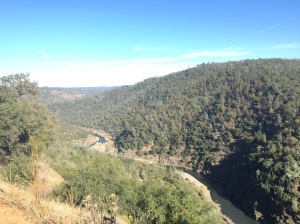
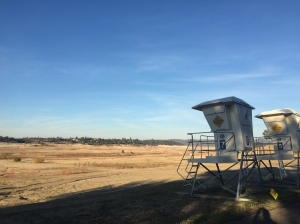
The American River near Auburn, CAI had been told of the CA drought but words cannot describe how bad it is. This was a lake.
She finished strong, under 25 hours for her first hundred. We joked with her after the trace that she hardly needed pacers, she didn’t have a dark moment in the race, and she had to push us to go faster as she reached her peak near the end of the race. I’m just glad I lived through my lost world Fox encounter to applaud her finish.
Let’s recap:
1) Gordy Ainsleigh wants me to die while training for a 100 miler
2) If you find yourself on a desolate road late at night and the only creature you see is a Fox staring at you, then you are most definitely lost
3) Do not fly to Dallas if there’s the threat of any type pf weather other than sunshine and no wind. That place shuts down
4) The Shreveport airport has no capacity to feed, house, and service three-to -four diverted flights. I pitied those poor cafe workers.
5) Airport livin’ isn’t a barrel of monkeys. The weirdest thing is that I felt like those folks who didn’t sleep through the night were watching those of us who did. Eh, I got the willies thinking about that.
6)Putting contact lenses in your eyes at midnight in the back of a Prius using a one inch mirror and a headlamp is a skill only the best of us possess.
Yes, I know NB has released an update to this shoe (the Hierro), and any good reviewer wouldn’t publish a review of an “outdated” shoe. But I love this trail shoe. The love needs to be shared
When I first started running trails, and given that I was a Brooks man through and through, I did what any Brooks man would do and order a pair of Cascadia (version 7).
You never forget your first…trail shoe. The workhorse Cascadia 7
This was a great beginner trail shoe. It was sturdy, tough, had a nice fit, and drained well for creek crossings (which I, in my newbie trail ignorance, assumed you changed socks every time you crossed a stream. Ha, yes, I know, laugh on…).
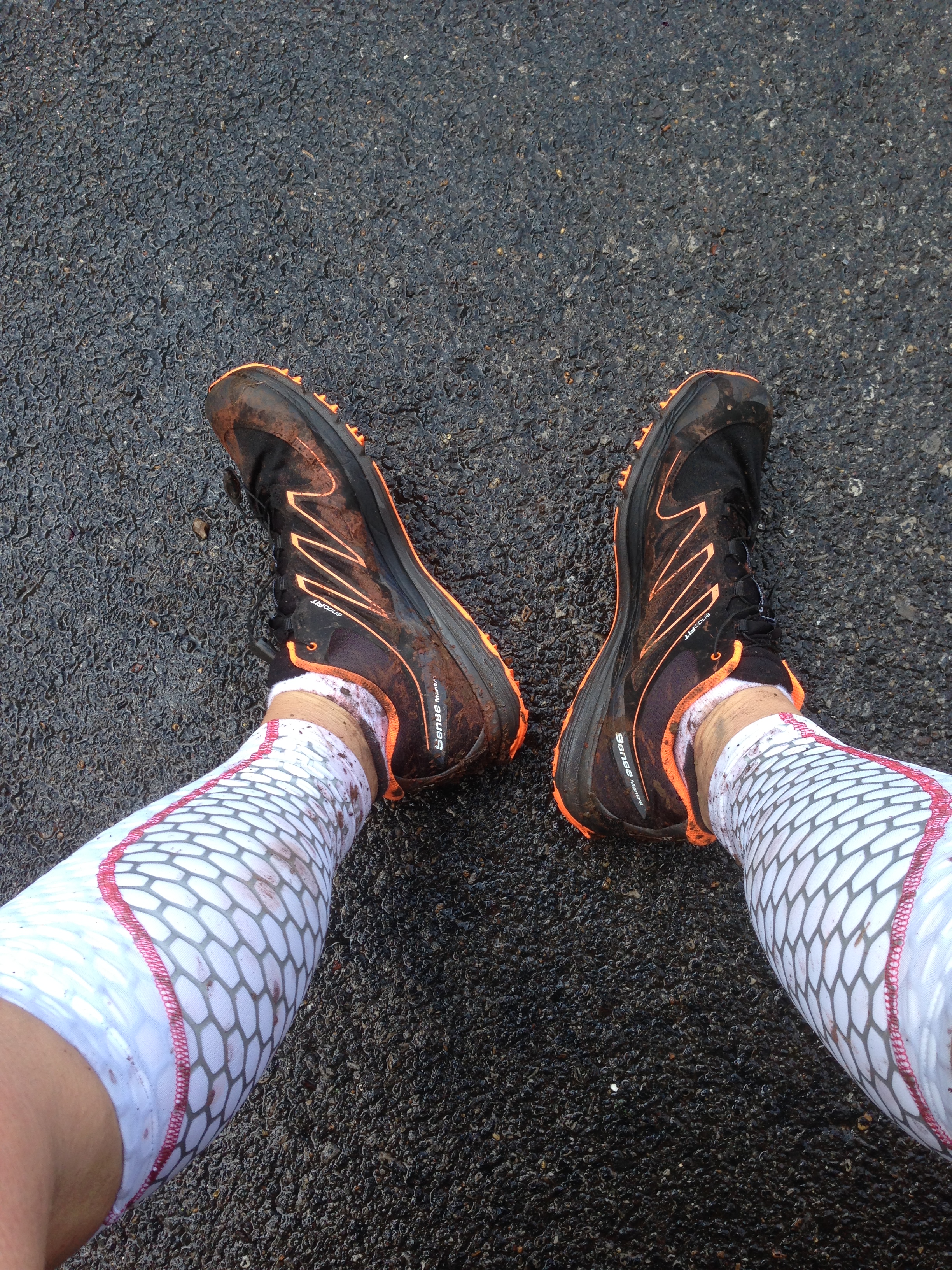
That shoe got me through my first trail race and then my first two 50Ks. It was a workhorse and I still wear it for lawn work when I need something with a solid grip and durability. A year or so later, in search of something a little lighter but with similar durability, I wore the Salomon Sense Mantra II (two pairs worth). That shoe got me through all my trail races for about a year, up through last October.
At that point, I did the Birmingham Stage Race and wore the same pair of shoes for all three days, 53 miles. I really needed to have a second shoe with a little more cushion for these multi day races. My feet were pretty worn out by the end of that three days.
Salomon Sense Mantra II. Great shoe
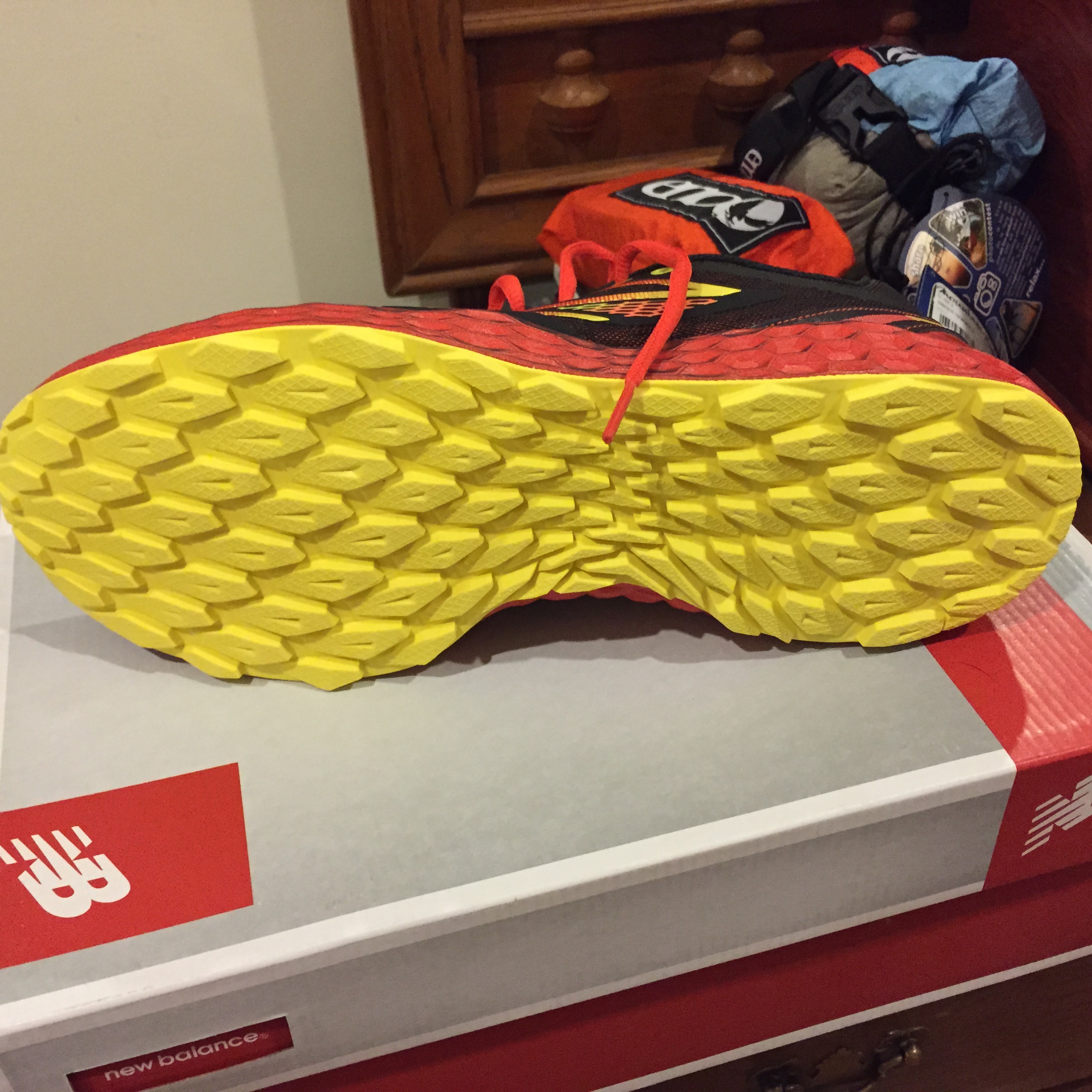
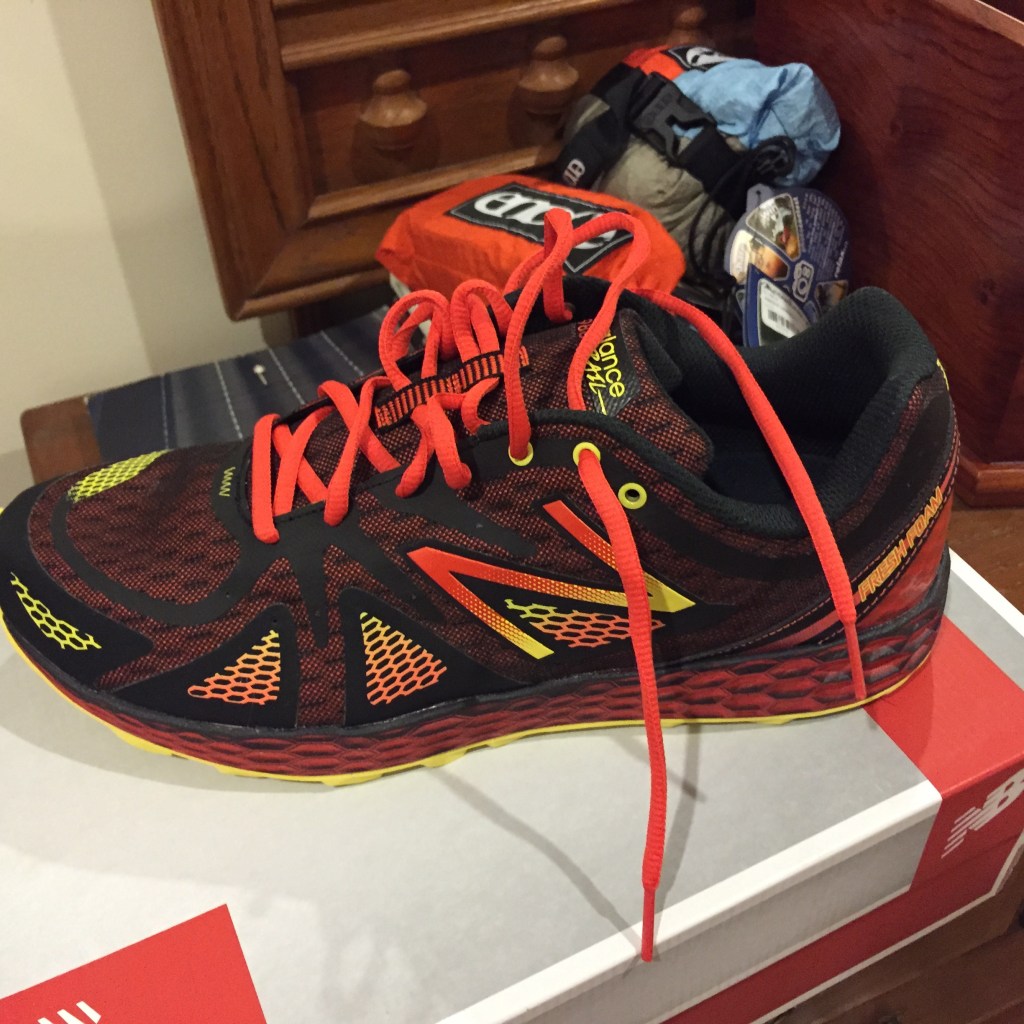
It was in that time that New Balance had introduced their “Fresh Foam” technology and the NB 980 Trail with Fresh Foam. Looking for some cushion, but not too much, I gave the 980TR a try. I wore it at Crusher Ridge 42K that October (2014) and really liked the shoe. Reviews suggested wearing this half to a full size up. I ordered it .5 size up than my normal (to be honest, I could really go a full size up on this shoe–more on that later in the fit section).
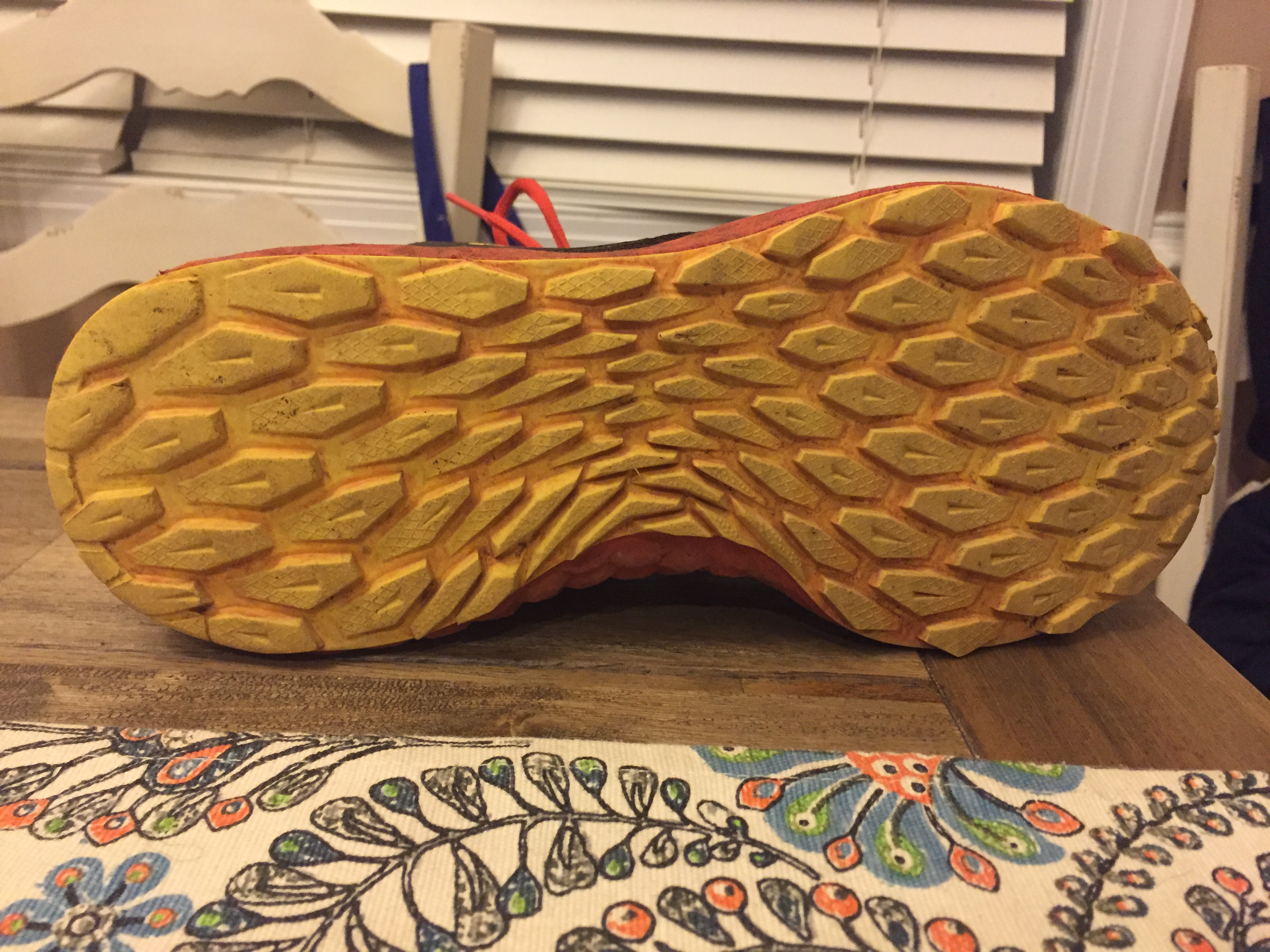
A lot of the longer races here have a few miles on jeep roads, fire roads, and even some paved sections that connect one trail to the other. The NB feels nice on harder surfaces. The Brooks and the Salomon never had enough cushion for road or harder trail miles.
Out of the box:
I love the color ways on these shoes. Saucony, Mizuno, and New Balance have really led the way when it comes to introducing new colors and color schemes to shoes. And it also seems that we are in an age of bright colors after a few years of blues and grays and blacks. This shoe has color, but you also don’t feel like they will burn the retinae of your fellow runners. My second pair (just purchased on sale) is the blue/yellow. I like them both, but the red is my favorite.
Nice cushioning for this shoe, with the “Fresh Foam.” Handles well those parts of trail races that have road component
Fit:
The first thing I notice when I put on these shoes for the first time is that they feel like I’ve ordered them too small. Always. The toe is slightly more pointed than a lot of trail shoes (this is a trait common to a lot of New balance shoes, they just love that rounded/pointed toe. Thats why I went a half size up. But once they’re laced, even with thicker trail socks, they feel fine and I have no issues. The only thing I wonder about is how they’ll feel late in a long race (50 or 100 miles). Will I need a roomier more cushy shoe for that distance with swollen feet? Will moving to a full size above my normal shoe size do the trick? I’ll find out soon enough since 100-miler training has begun.
Wear:
One year after my first run and the sole has proved pretty durable, but then again, when you run on dirt and rock you don’t get a great deal of wear.
One year of trail wear
Quibbles:
I have yet to run in a really wet and muddy trail race. I’ve been on trails after rain but not where the trail isa mess of water and loose thick mud. I’ve heard chatter about the 980TR not having enough of a sole to “grip” the sloppy conditions. I’ve yet to personally experience issues like that.
The only knock on these shoes is the grip in muddy conditions.
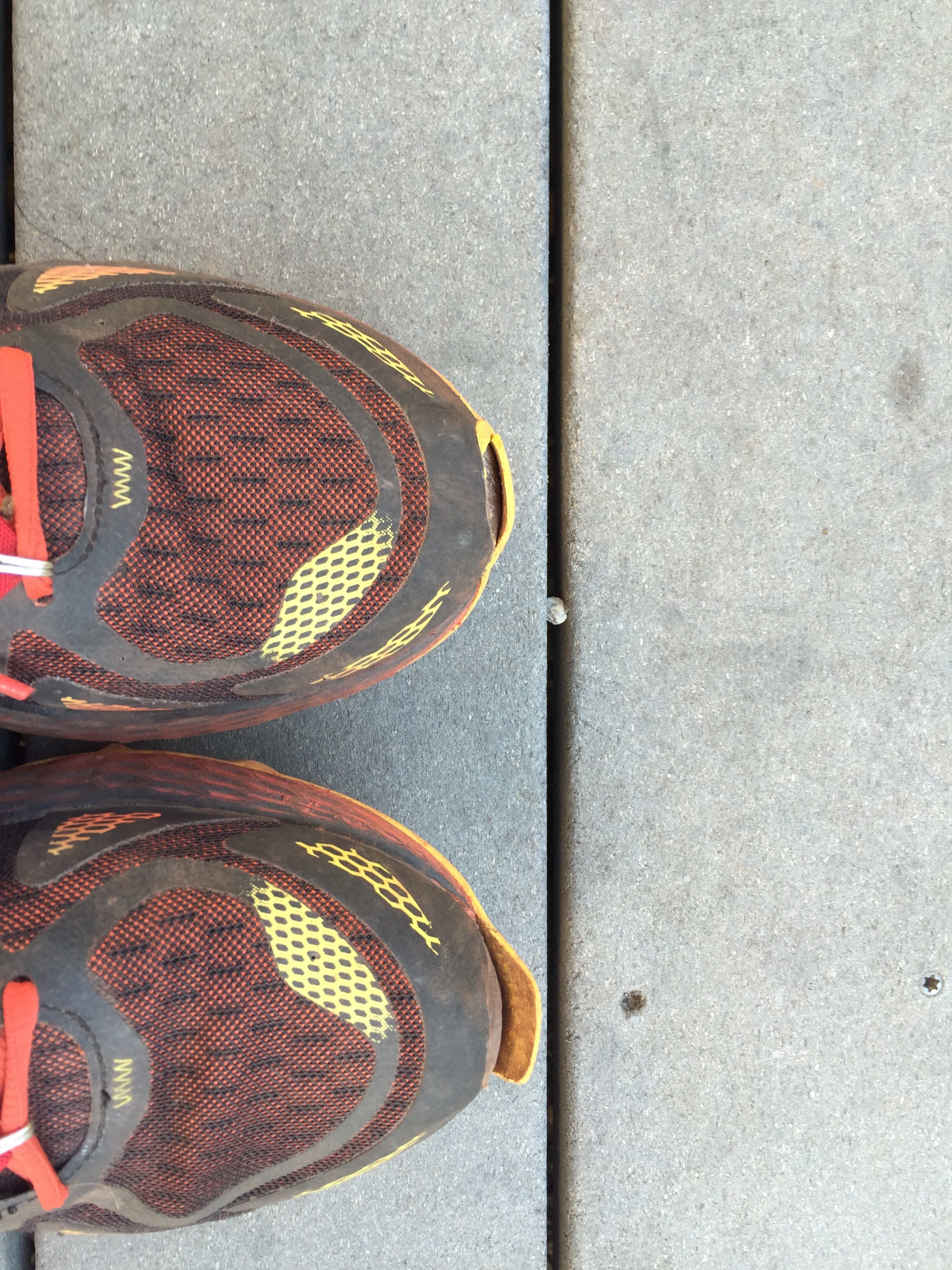
What I have experienced is the rubber toe cap at the end of the shoe has a tendency to peel away from the upper. This happened on two pairs after only 50 miles or so. Not sure if this is just an isolated adhesive issue or if others have experienced this. The problem is that when that part peels away it has a tendency to catch small bits of trail, or vine, or trail stuff in the shoe and trip the runner.
Love the Nb 980TR, but two different pairs peeled a the toe cap
Final thoughts:
l’ll really like this shoe as a middle ground between the more max cushioned shoes like Altra or Hoka and shoes that are less so. I still like my Salomon Sense Mantra II, but I find myself in the New Balance more and more. Is this the shoe that gets me to the finish of my 100 in march? I don’t know yet. Do I need a more max cushion shoe for the later miles in that race? We will see. Until then, this is the shoe I’ll train in. I still want to try the updated version, called the Hierro.
This is one of several reviews that I have been meaning to write since this summer. It has been a crazy busy summer and fall for me and I’ve also published an academic book (my day job is professor of history and department chair) and reading galley proofs, securing photo rights, and taking care of final edits took priority.
As always I have a Facebook page, please “like” it if you don’t mind.
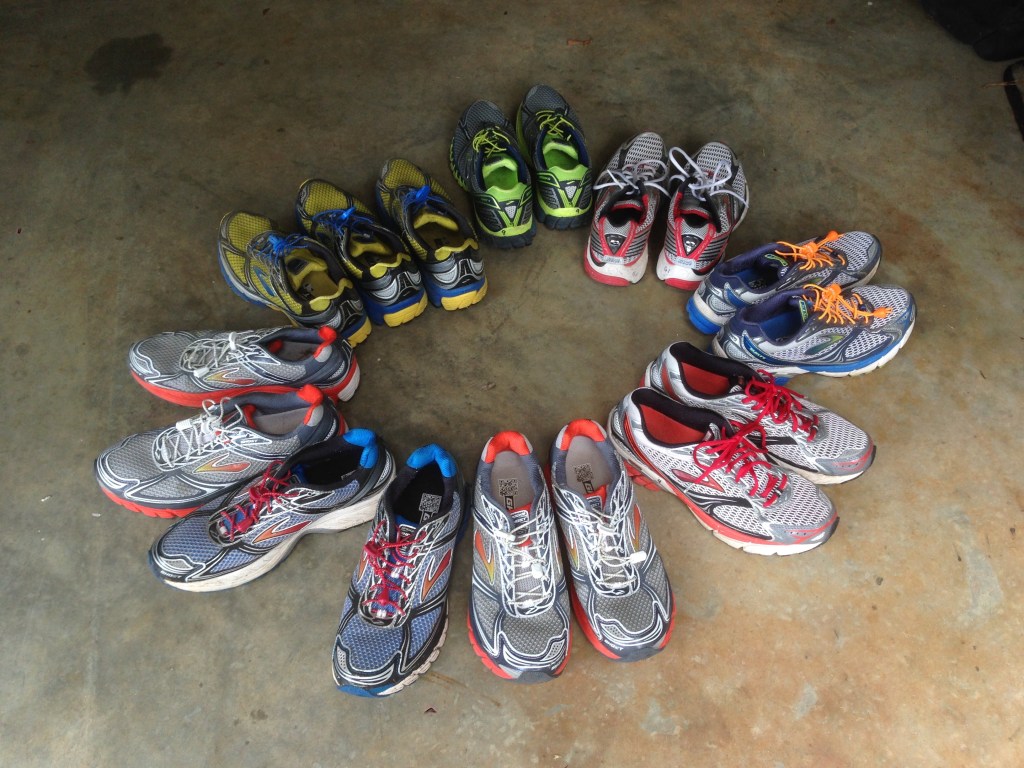
I’ve worn more pairs of Brooks Ghosts than any other shoe. From 2010 through 2013, the Ghost was for me a perfect shoe. Neutral, but with enough shoe to support me as I fatigued on long runs. Cushioned, but not so fluffy that you feel like you’re sponging into the ground. I could train in it daily, do speed work at the track, and race marathons in it. I never considered other shoes because the Ghost was my home.
I’ve worn Ghosts for a long time. This picture is missing 5 pair that I got rid of before this pic
I started wearing the Ghost with their 3rd iteration. I probably had 3-4 pair of each version from the 3 through the 5. But the 6 didn’t feel right. On a tempo run one summer morning in 2013, my legs felt spongy, wobbly even. They felt the same way when I had tried the Saucony Guide a year earlier. I felt like my foot was landing on a wobbly plank. I ran a few more times in the 6 and then bought a few pair of the Ghost 5 for the marathon that I was training for.
I skipped the Ghost 7, having found Saucony Rides and Mizuno Precision 13s and a pair of Mizuno Riders (the 17 that I didn’t care for at all, still need to try the 18) to get me through this shoe homeless period.
But this summer Brooks sent me a pair of the Ghost 8 for review after my friend Mike (Dirtdawg) reported the Ghost 7 and now the 8 had been really nice updates for the shoe that has become a Brooks staple.
The Ghost 8 is what I remember about the Ghost of my past. It is everything that kept me coming back, pair after pair, to the shoe that got me through more of my 13 marathons than any other shoe.
I forgot to take photos of the “new” Ghosts when I got them. This is after 200 miles
Out of the box
Brooks hasn’t done a lot to change the design of the Ghost. There are some slight stylistic changes, but nothing that serves as click bait: “Brooks changed the design of the Ghost, but when I opened the box I never thought I’d see this!” The colorways are pretty nice: there’s black and red, the silver and toxic yellow (Brooks calls it lime) that I have, there’s a New York edition for the NY Marathon, and a blue and orange that is my favorite.
Fit
The sole after 200 miles
Brooks has always fit true to size for me. Of course, true to size is relative to the runner. But I’ve worn 11.5 D in all Brooks shoes with no issues. No difference here. Good fit and comfortable from the first mile on. In my review of the Saucony Ride 7 I noted that it took me about 25 miles for the shoe to feel “good.” The Brooks as ready to go out of th box.
Wear
I have 200 miles on these shoes. I could go at least another 100 in these shoes.
Quibbles
My only issue is that Brooks stays true to overlays on their shoes, while other brands seem to be moving on, and the Ghost 8 is no different . The toe overlay on this shoe rests just above my big toe. If I don’t wear sufficiently thick socks, something under the overlay (these overlays are welded not stitched) irritates and even causes a small blister on my toe. I am sure this is unique to my pair and not a model-wide thing to worry about. But it is something to watch for if you get a pair.
What’s new
From the Brooks press release, their crash pad is now full-length, the overlays are welded and not stitched, and the upper has been updated to allow for more flexibility in movement.
Final thoughts
To quote former Minnesota Vikings football coach, Dennis Green, who once said of an opponent: “They are who we thought they were!” (google this quote and you’ll see what I mean): The Ghost is what I thought it was. Dependable. Solid. Like a warm blanket on a cold winter’s night: comfortable and dependable.
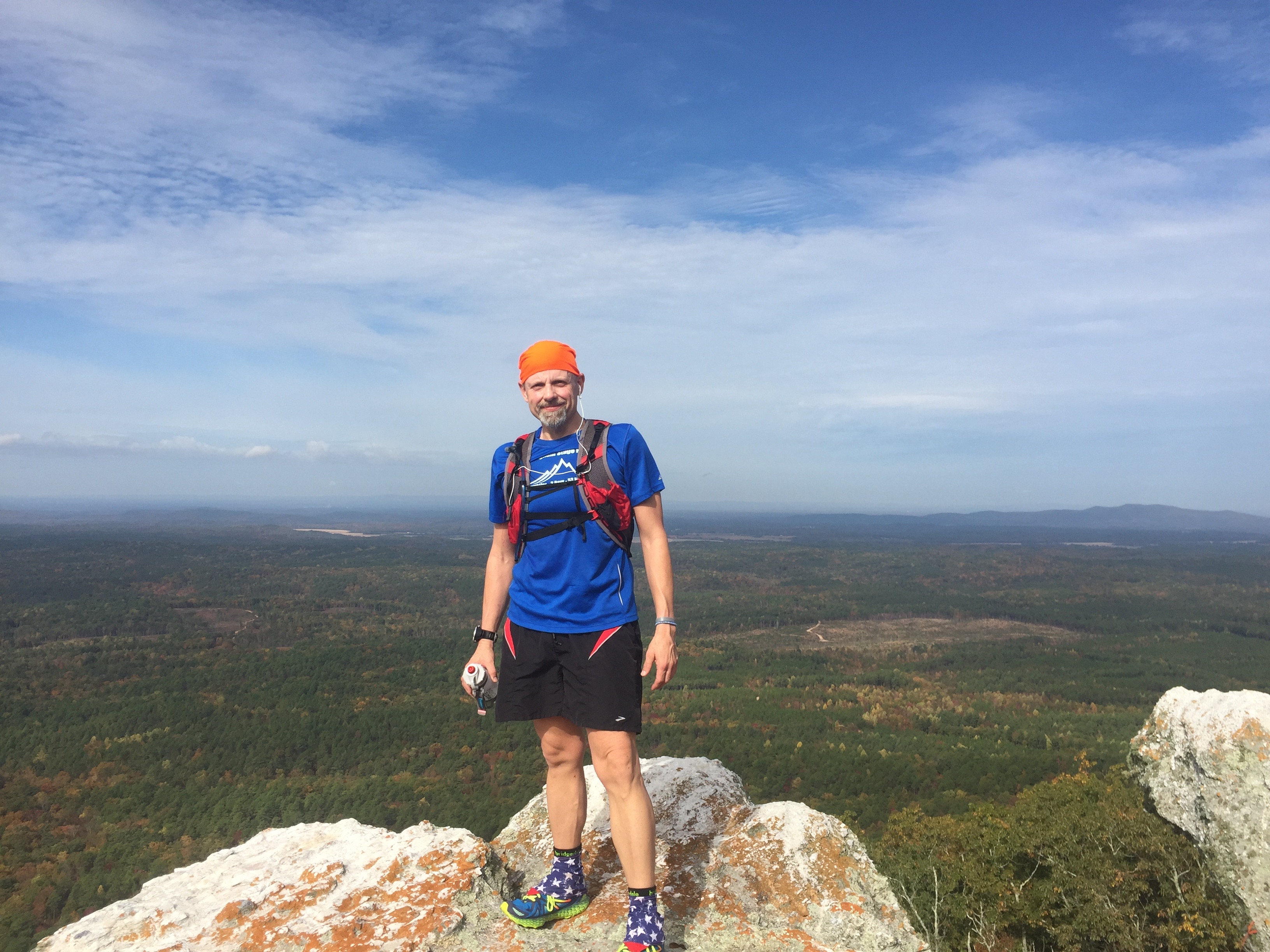
I met some trail friends for a run along the Pinhoti Trail this morning. Some were having their final long run before the Pinhoti 100 in two weeks. Others, like me, were in the build phases for races a little further down the calendar.
This is a section of the Pinhoti that I’d never run before. If you are Pinhoti 100 runner, you will recognize this section as it extends from Porter’s Gap to Bull’s Gap, roughly miles 68-85 or so.
Since it is hunting season, I broke out the hunter orange Buff.
Dawn breaks on the drive to the trail head
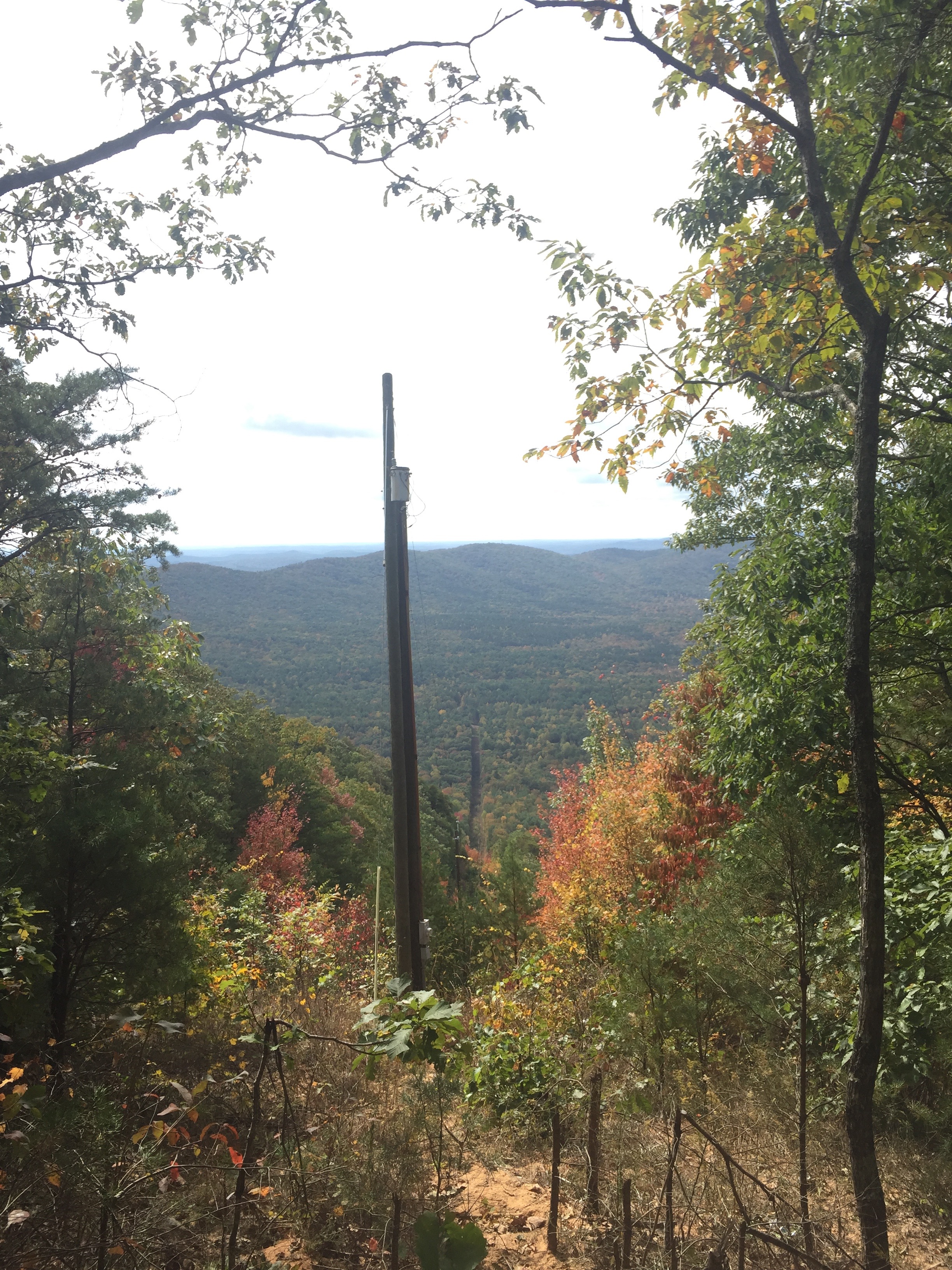
Beautiful section of trail. This was my first run on this sectionFall has arrived
stunning views
“I’m the slow ultra runner of the world!” At Wormy’s Pulpit
At the end of the run, we had come from Porters Gap
I tell myself I’m done. I am convinced I’ll never return to this race. I’ll volunteer next year, I tell myself. But then I find myself signing up once more. Sometimes I’m a stupid man.
For the second time in two weeks, and for the second year in a row, I headed out to Ruffner Mountain to run Crusher Ridge 42K. I had just been there for Day 1, 18 miles, of the Birmingham Stage Race, so I knew what was coming. The Clubber Lang of trails races was about to punish me.
Ruffner Mountain is not an expansive area, but there are a lot of trails and “trails.” The latter being the kind of trail where the race organizers, Lisa Booher and Mary Campbell, just plant a flag and say “look at this new trail. Don’t die.”
You see a trail here?
“trail”
Neither do I , my friend.
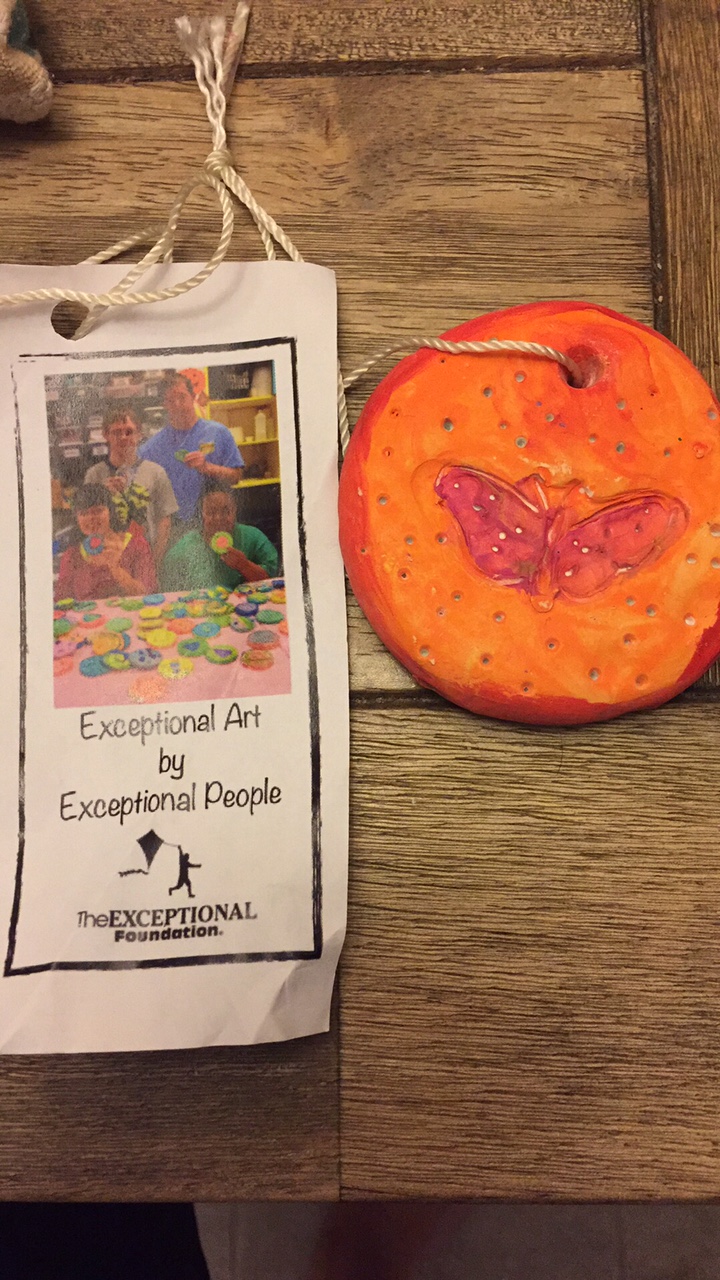
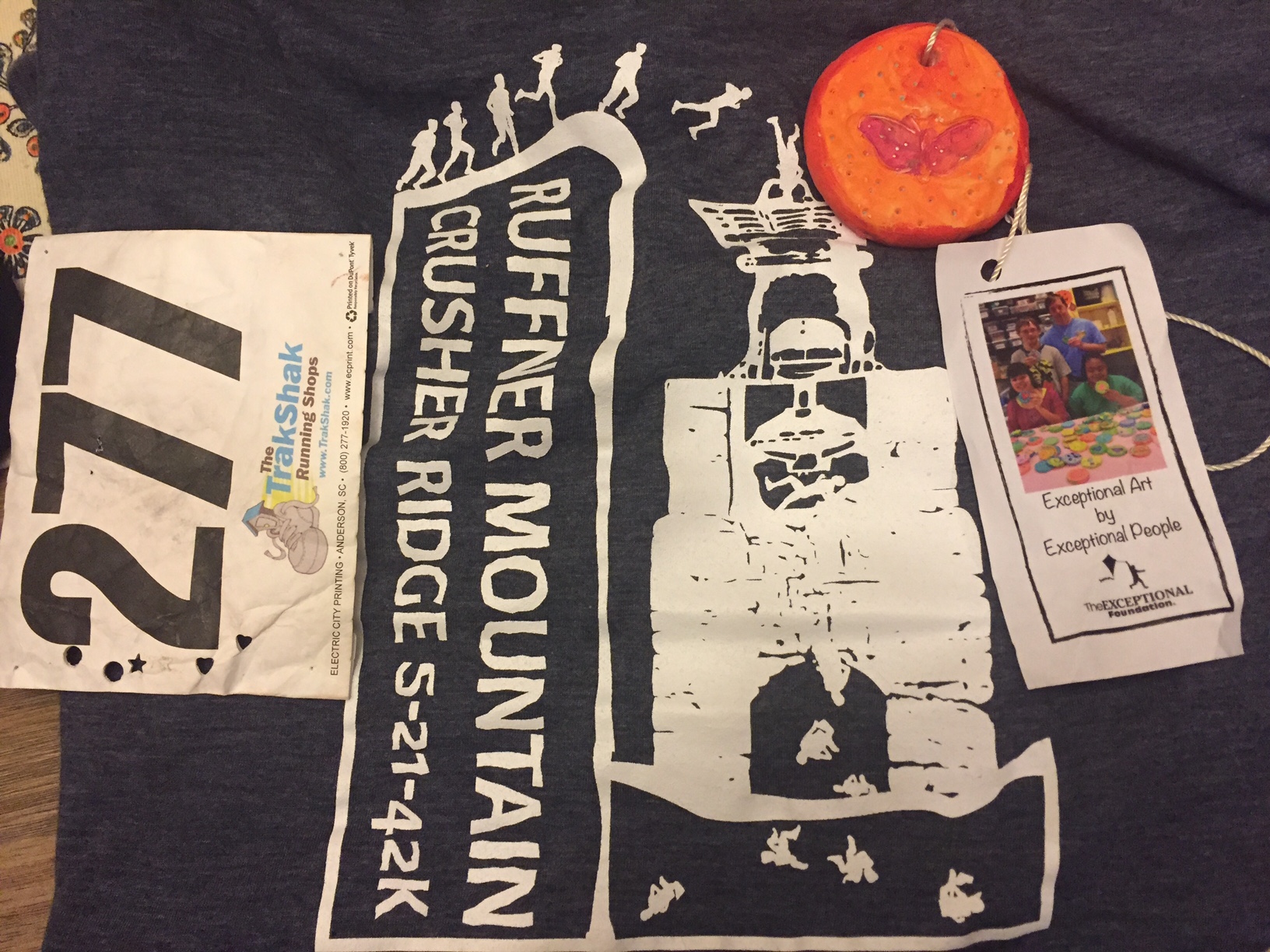
If Mary and Lisa weren’t so darn cool and nice, and if this race didn’t benefit an organization as awesome as the Exceptional Foundation, I wouldn’t go back. Or I’d at least think worse things about Mary and Lisa during the race (well, worse than I already do, at any rate).
“Good luck today. Try to not die. Ready, set GO!”
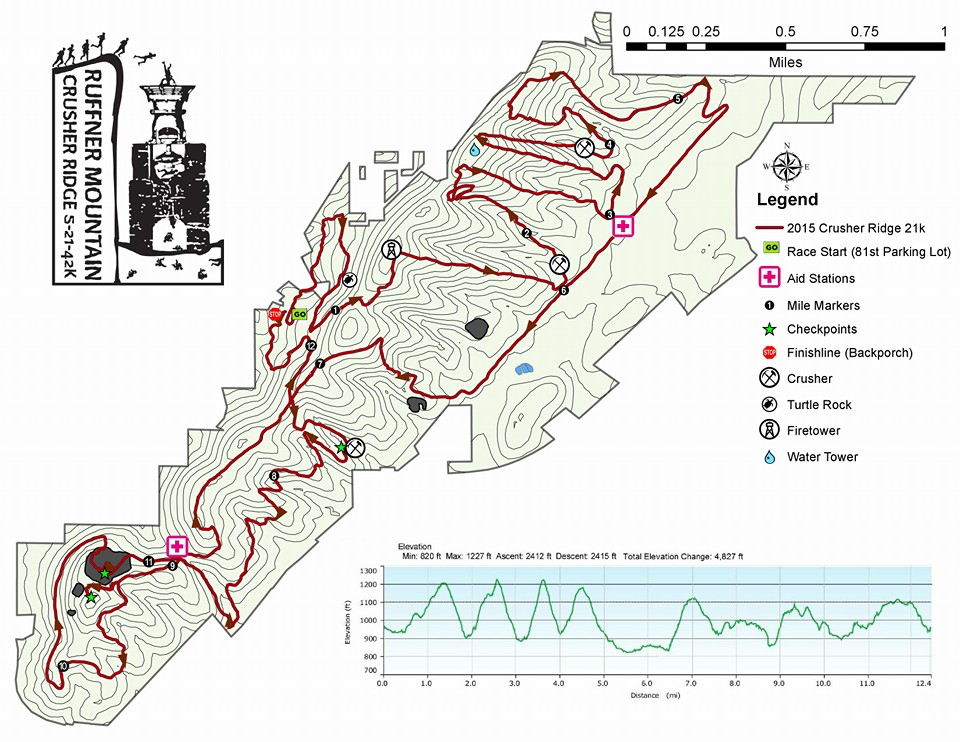
For the 42K, runners complete two loops of a crazy hard course that takes you by each of the three “Crushers” on course. Ruffmnr Mountain used to be an active mine collecting limestone and iron ore for Birmingham’s iron and steel industry from 1908 until 1953. My dad grew up not far from Ruffner Mountain and when I was 40, safely away from my adventurous teen years, he thrilled and shocked me with tales of how in his youth, he and his friends once sneaked into a still operational Ruffner and explored the mines and maybe even borrowed some dynamite from the blast shack.
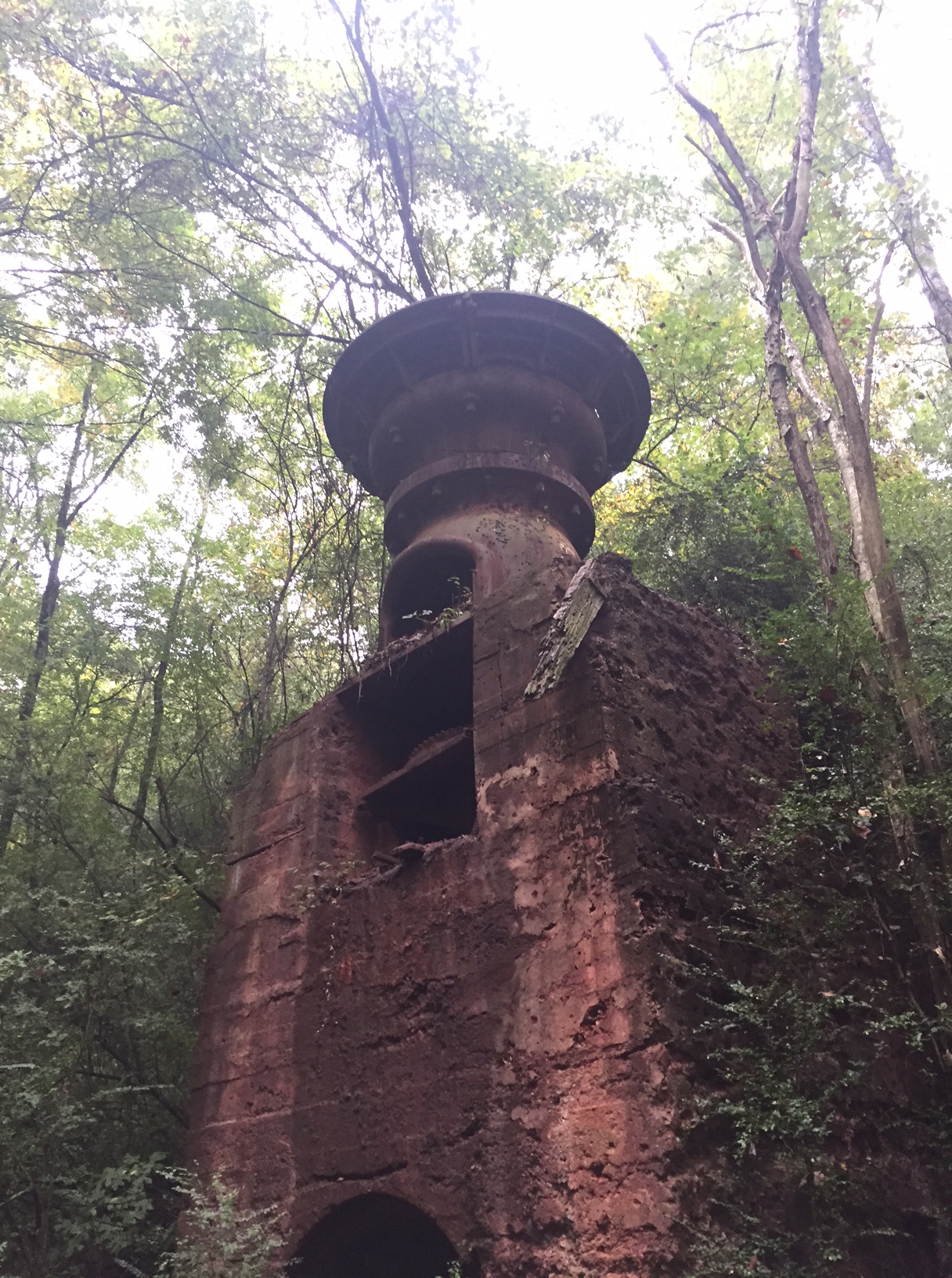
The Crushers remain, and so does some of the cable that operated them, as well as the beds for the railways that took the ore and limestone out of the mine to the mills. Reclaiming the area and making it useful again has been one of many great things happening in my hometown. And that makes the opportunity to run in the place where my father played as a younger man such an attractive proposition to me, regardless of the pain I feel during the race.
The First half of the loop takes you to ridge and valley, over and over again. With trails called Bronco and Bloode Chute and AMF, how could you go wrong? I have named this section “Devil’s Cradle” because Satan gently rocks you to your running death, up and down the hills until your thighs burn with the heat of a thousand suns, and your heart feels like it will pop out of the top of your head. Good times.
Hills won’t stop. Can’t stop
The second part of the loop I wouldn’t call easy by any stretch of the imagination, but compared to the first half, you don’t feel like crying as much. There was a section as I finished Bronco for the second time where I truly debated whether I’d climb faster by crawling on hands and knees. During one particular endless climb (I’m not exaggerating here, it never ended.) I tried climbing by walking backward, until I concluded that that approach may result in an embarrassing trail mishap. “Honestly, doctor, I don’t know how that branch got there.”
I’ve run two races in my short time as a runner and even shorter trail running life that really killed me. Mountain Mist 50K is hard (and yes, I’m registered for the 2016 race). Hard enough that you worry about cutoffs. I mean really worry about cutoffs. It is that challenging of a course even on the best of days. But Crusher Ridge 42K for all its unrelenting climbs and that hopeless “Oh my, I have to do this section again?!” realization in the first loop, is probably the most difficult I’ve ever done. The two races intimidate you to the point of feeling those crazy butterflies, even when you don’t plan to race it.
You also find yourself in a running monologue about fun and how one defines it. I argued to myself that fun should really be fun. That this just doesn’t seem like the kind of fun normal humans do, at least with intent. After rhetorical questions about the nature of fun, I then start questioning the race directors. “Don’t they see, this just doesn’t LOOK fun. It doesn’t FEEL fun. Do they really hate me this much? What did I ever do to them?” Those accusations and judgements give way to lost hope. The feeling that no one will airlift you from the trail. That if you want one of those awesome medals you have to shut up and run, baldy. Or at least power hike. Which took up a LOT of the last half of the second loop. Two times through Bronco, Blood Chute, and AMF (you shouldn’t have to ask what that means) and my legs were toast. Engage survival mode.
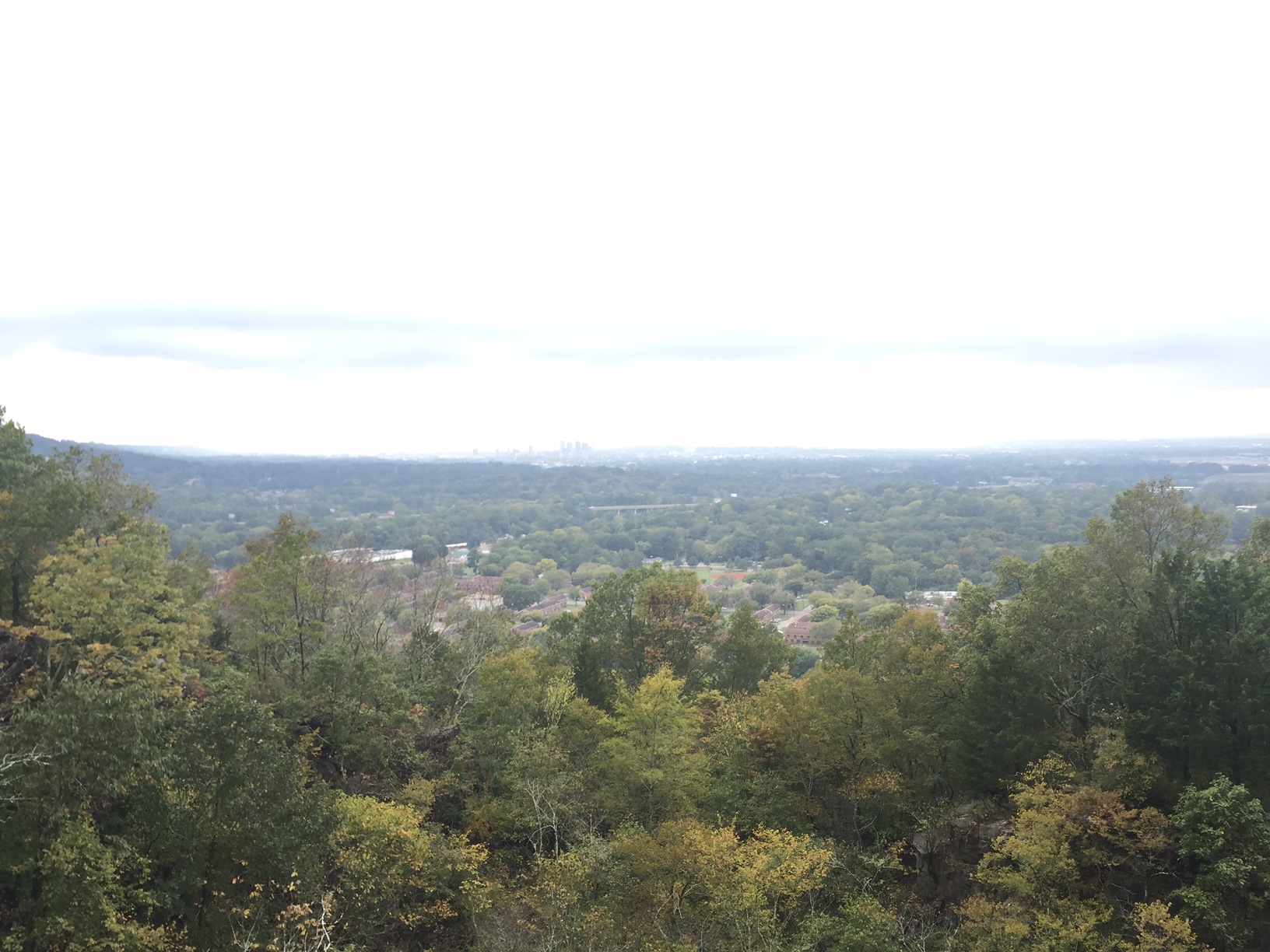
Once I wiped the tears of pain from my eyes, the view was stunning
What can I say about the organization of this race? Perfect. From course markings to swag to communication before and during the race, I couldn’t ask for anything more. Folks at aid stations were incredibly supportive and encouraging. I’m pretty sure they just felt badly for us. And those of us who struggled across the finish at the end of a very long day were treated like we won the race. (And that’s likely because they never expected to see us come out alive.)
Run this race. It will challenge you. It will humble you. Three-hour road marathoners were finishing in 5 hours. It eats you up. But when you do finish, and you will, the pride you feel is incomparable. That’s why I keep going back, against the objections of my body.
The last 6 months have been hard for me as a runner. I DNFd my March 50 miler attempt because I was undertrained on trails and just overheated and lacking mental toughness. I struggled with summer running as it really hammered me on longer runs, and shorter ones, too. I put on 7 pounds between April and September because I couldn’t say no to chips and salsa, and sugar of all kinds. And I had no goal nor the wherewithal to set one. Welcome to Funk City, USA. Population 1.
I’ve been here before. I know Funk City well. There are no road signs warning you of its approach. There are no speed bumps forcing you to slow down. No welcome center to announce your arrival. You just look up one day and you find yourself Mayor.
The DNF embarrassed me a bit only in that I should have been able to finish that thing. And I could’ve had I been willing to walk the next 15 miles to get it done on what was already becoming a long and hot spring day in Alabama. But my heart wasn’t there. I was out of shape for trails (until that day in March the last trail run I had done was in December), and my mind was set after I got to the 30 mile mark. Get to 35, pull the plug, go home.
It go so bad near mid August that on a local trail run, I was miserable. I didn’t want to be there and wanted just to sit and stare off in the distance. For me the sign that I am losing focus on a run is how quickly I start thinking about my post run coffee. Coffee was on my mind the moment I got out of bed that morning.
After that I broke up with running for two weeks. I focused on cross training with HIIT workouts and riding my bike. The summer and my aimlessness had defeated me and I had to create fresh headspace to move on.
A slow return to running allowed me to start over. I put the summer behind me (in Alabama, summer is really never that far away) and looked to fall. Lower humidity, cooler temps. It has to arrive soon.
That I am pacing friends for 20 or so miles at a 100 miler in November has given me something to work toward. It wouldn’t be good friendship to have 100 miler runners forced to give their underprepared pacer support late in the race. To get some trail time I ran part of the Birmingham Stage Race last weekend. No way I was in shape for all three days I decided to skip day three and focus on getting feet time on dirt.
The amazing David Tosch gives final instructions before the start. I love David because his mile estimates for his courses are always lower than reality! We call these “Tosch miles”
Stage 1 was at Ruffner Mountain, a place I’ve run before (see here and here). This is no easy trail run. Ruffner was a former mine, supplying stone and iron ore to the local steel mills through the 1960s.
There were some “flat” sections of the trail that were nice and runnable.But for every section of “flat” trail there were long steady climbs like this one.
My goal was to run slow and easy. To drink lots and to eat only dates and almonds. I wanted to get power hiking time and work on long climbs. Ruffner has all that.
Lots of climbing
Other than being fabulously out of trail shape the day went as I wanted. My eating was solid and my mood only darkened in the middle of the second 9 mile loop as my fatigue built. Three almonds and dates later, I was ok. It was a long 18 mile slog, but one that not only did my body pay for in soreness, but I was thankful to have done as a shock to my system and head that I need to get back in the game.
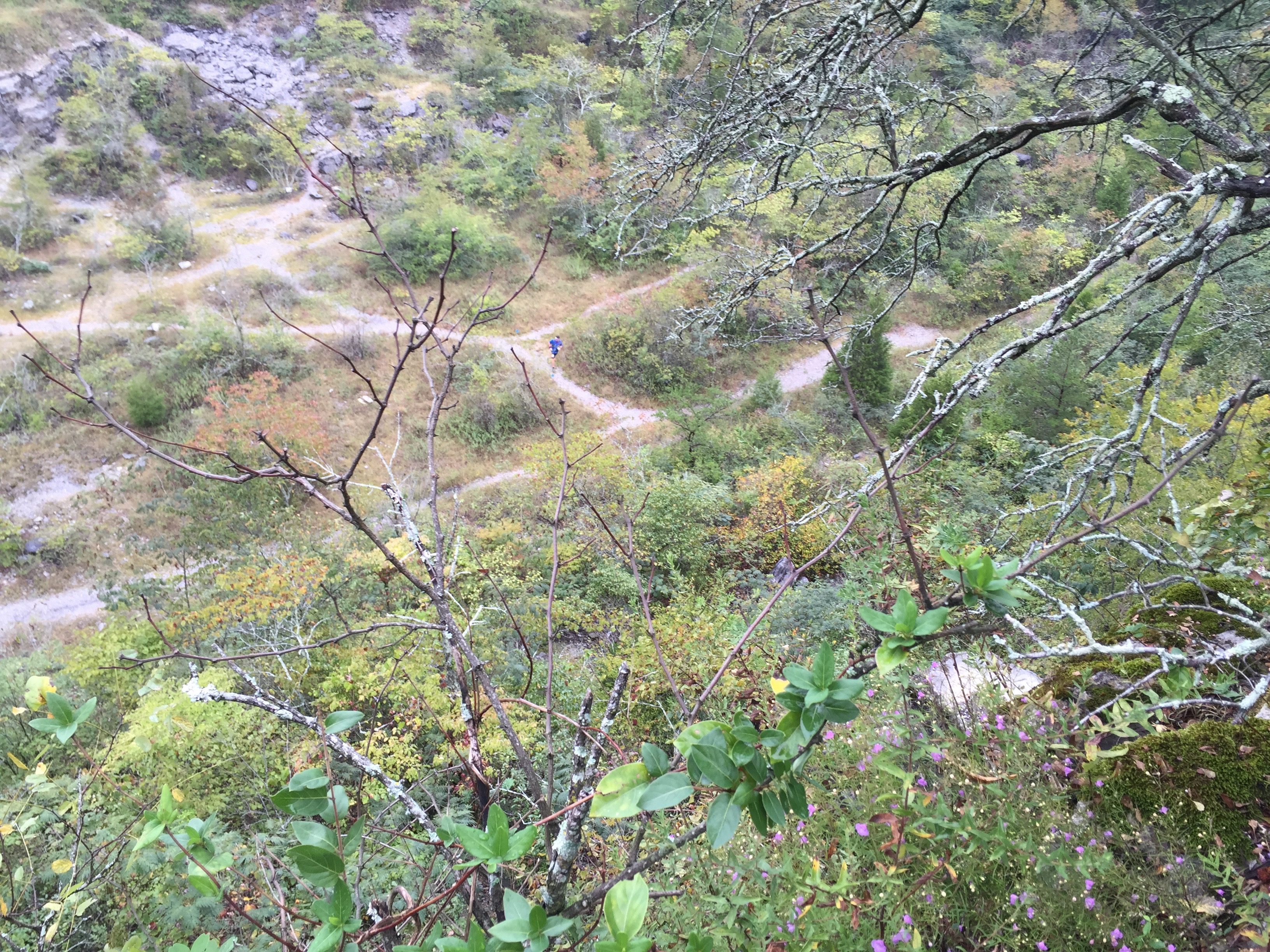
From the ridge looking down to the quarry below. See the runners?
Day two was at Red Mountain in Birmingham, yet another old mine in the heart of Birmingham. This stage was highly runnable, with access roads and wide flat trails. I only ran loop 1 since Hudson was pitching in a baseball tournament that morning. The trails will always be there, my boys won’t. Priorities and perspective. nevertheless it was a good 7 mile run and I feel energized again. I feel like I am a runner again. I feel like I have really missed trails and the people who run them. I’m thinking I want to start thinking big again: 50, 100…
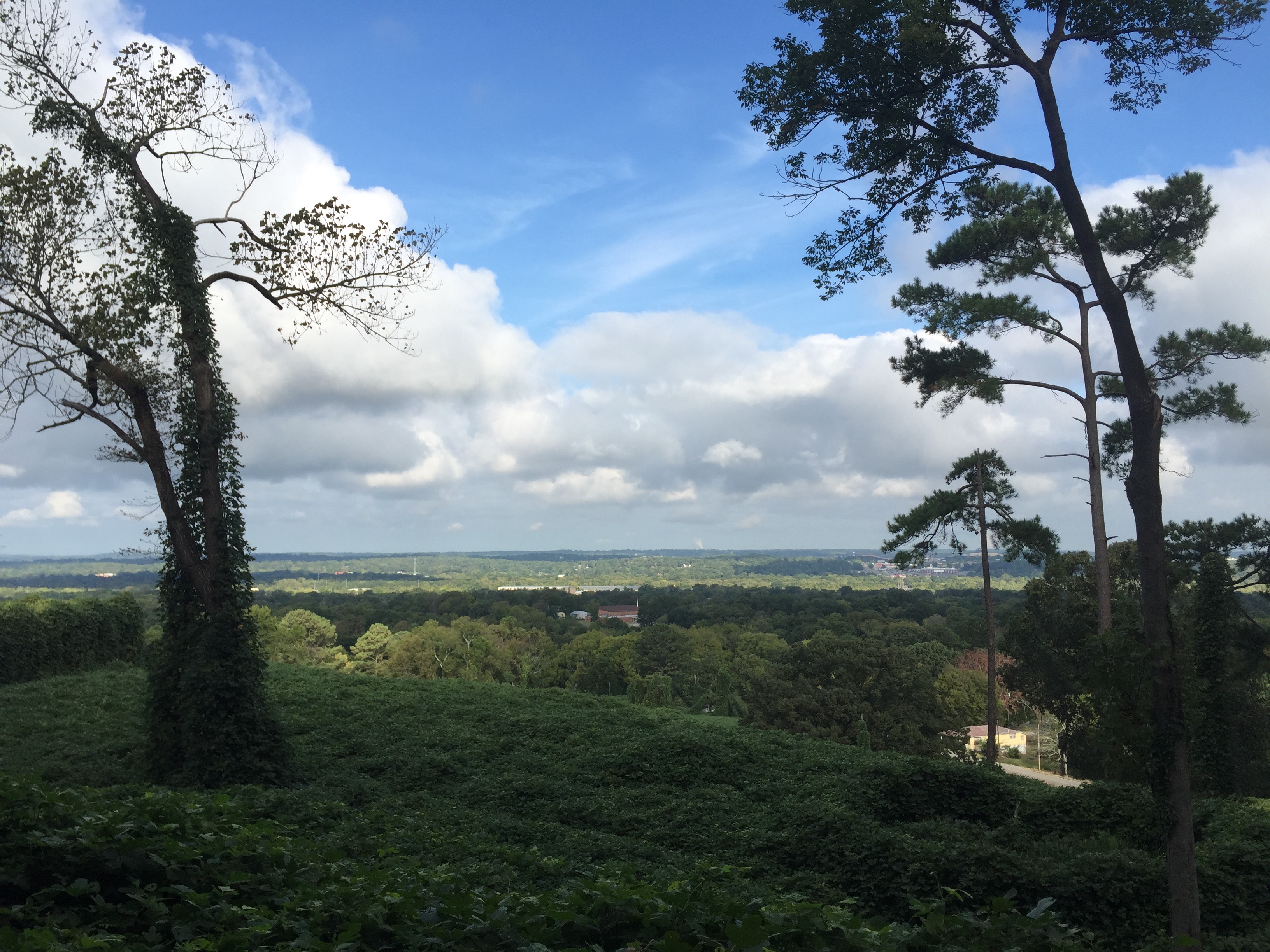
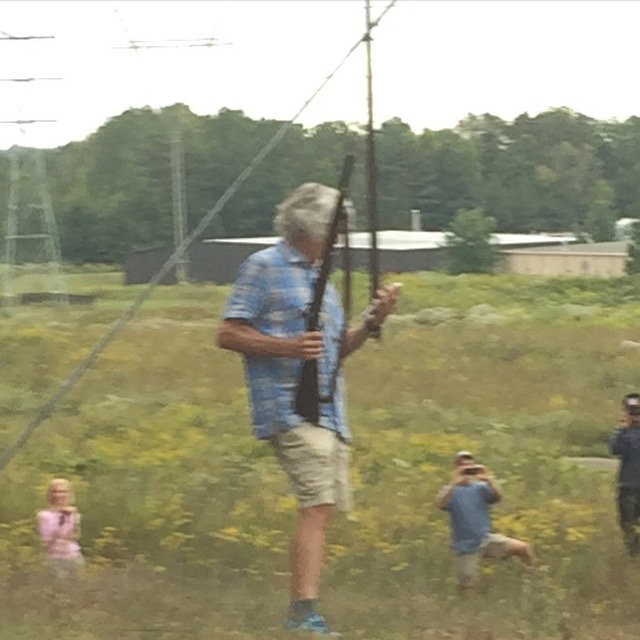
Lovely view from Red MountainDavid brought along an old flintlock rifle for the starting gun. And to motivate us back-of-the-packers.
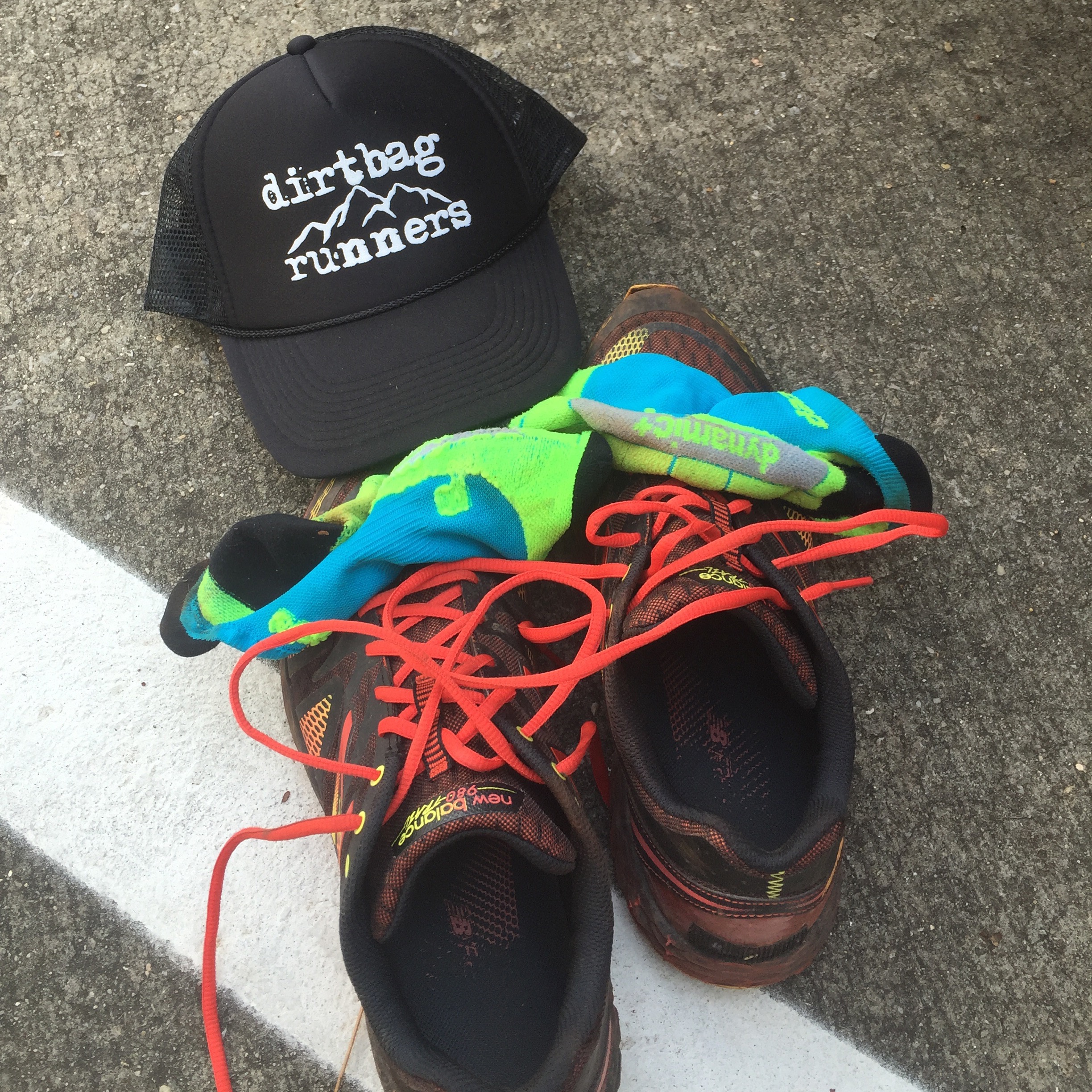
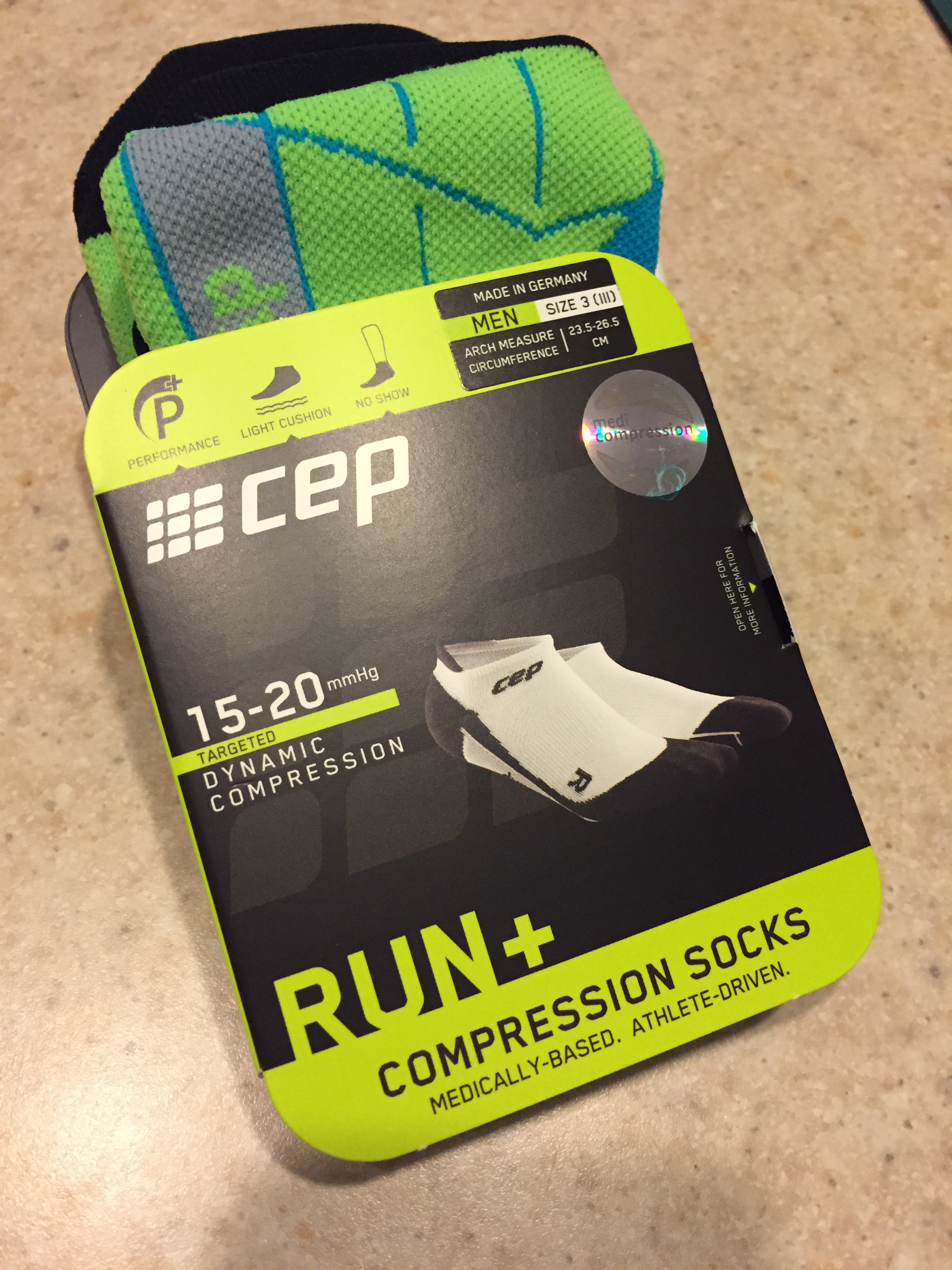
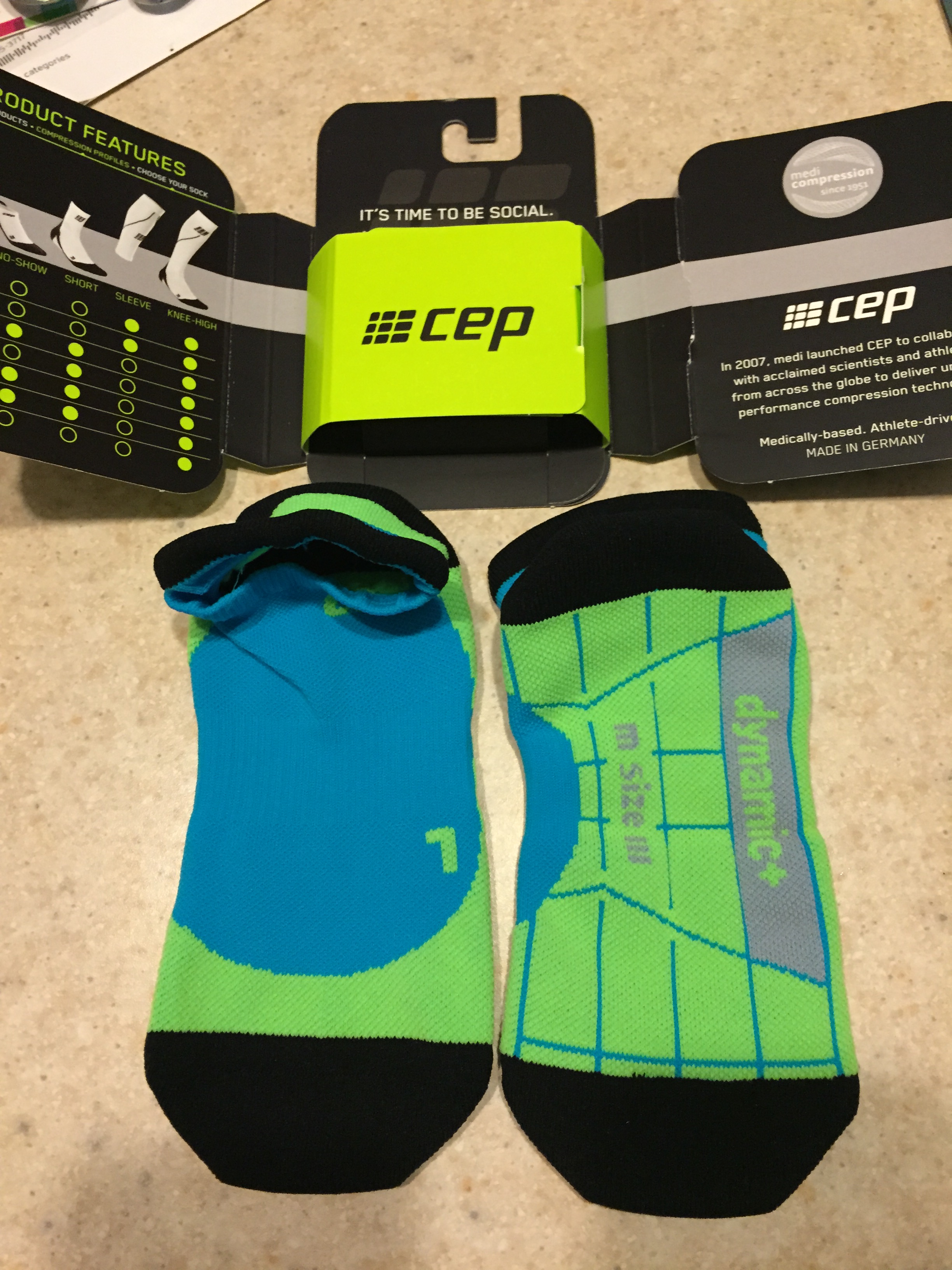
A couple of months ago CEP asked me if I’d like to sample a pair of their compression socks. Not the full-length socks, mind you, but those made just for feet. Yes, just for feet. Too many runners, asserts CEP, runners assume that compression is primarily for the calves. Sure CEP sells those, too, but they’re trying get the message to runners that it’s not just the calves that need compression and support. Your feet need support as well. Hence the Dynamic+ NoShow Compression socks.
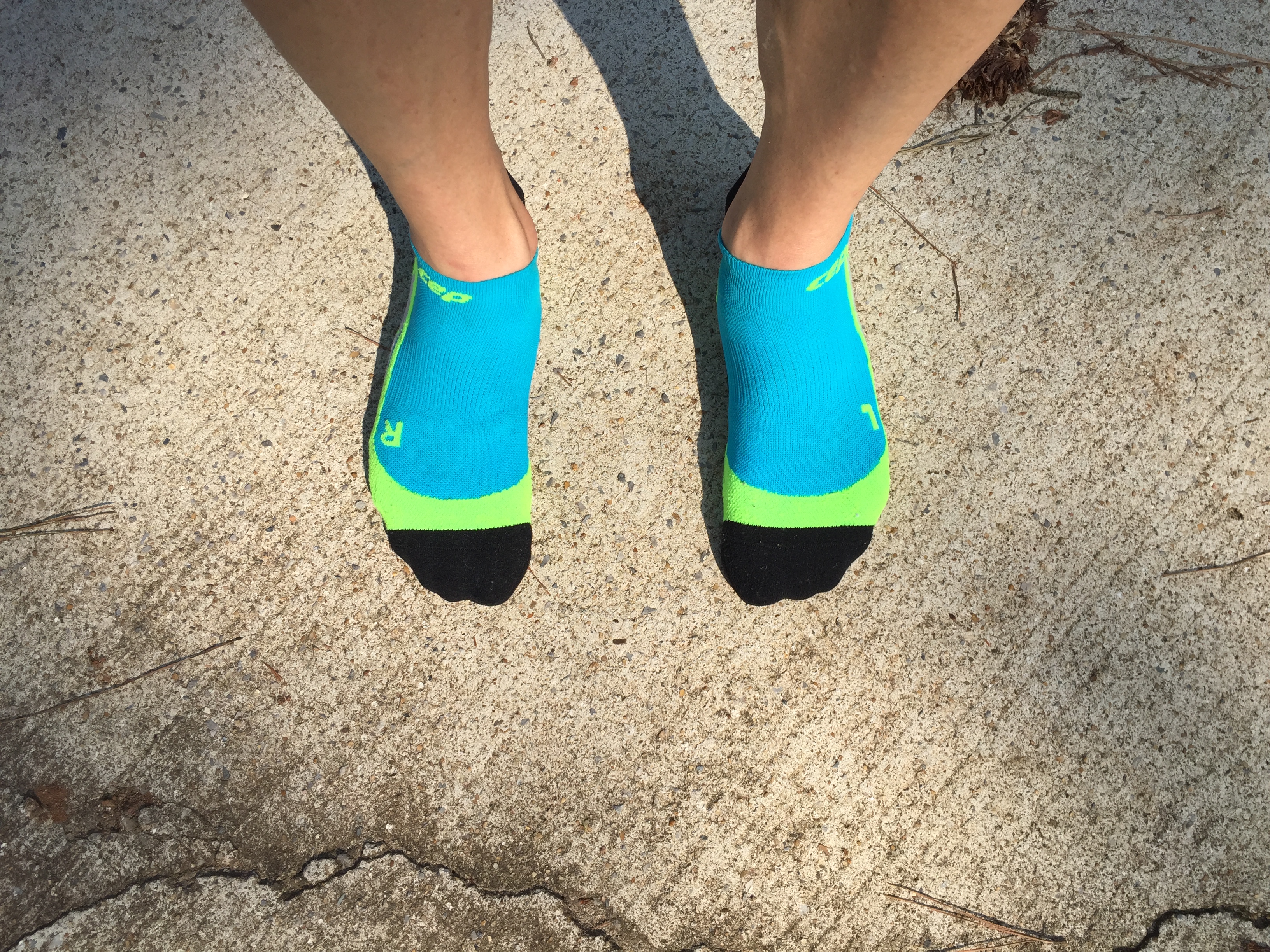
CEP’s Dynamic+ No Show Compression socks
CEP introduced these socks over the summer. They’ve taken the footbed of their popular full-length compression socks and created a no show sock for people like me, who need and like support for the feet, especially on long runs, without having to wear a full-length sleeve, which I don’t always do. Full-length compression for me is a “use it when needed” proposition. CEP has done those of us who don’t live in our compression socks a huge favor. And for those of us who live in, shall we say, hot-as-hell climates, this is a Godsend. Being able to go with “naked calves” in the summer but without giving up foot compression and support is nice.
I received these socks gratis in early July and waited a while before writing this. Not only have I run upwards of 200 miles in the socks, but my family took a vacation to Disney World in late July and I was eager to see how these worked for long days on my feet touring the parks. At Disney, depending on the park, I typically walk close to 30,000 steps a day, which included a 3-5 mile run each morning. In comparing the CEP socks with my run-of-the-mill no-show socks I could tell a big difference. My feet felt less beat up, and well–flat, at the end of the day. They worked as they should. And rightly so. CEP isn’t just some sports company that throws untested compression at you with cool colors and flash. They have their roots in the medical industry in anti-embolism prevention. They’ve manufactured this gear for decades. They know their stuff.
I’ve two pair of their longer compression socks and have never had reason to complain. I’ve worn them in ultras and in half marathons. CEP does compression right. Scrolling through their website I noticed that they also do apparel compression, shorts, tights, etc. It would be an interesting comparison between my CW-X tights and a CEP tights. Anyone have CEP tights? If so, comment below and let me know what you think.
These socks are great. But I suggest using them with shoes for maximum efficiency
Order a pair and thank me later. Before you order, check out their sizing instructions at the links below. Makes a big difference in how they work. Measure incorrectly and you miss out on the benefits the socks have to offer.
Here is link to the specifics in terms of sizing and cost as well as a full list of the benefits CEP touts for this socks. Men’s. Women’s.




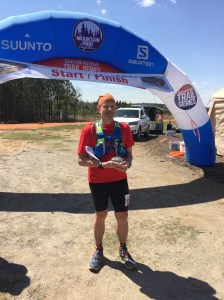
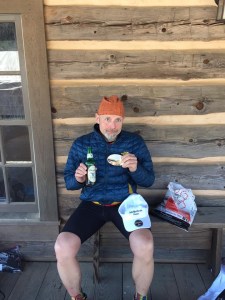

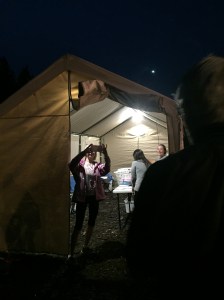 Loads of gear and planning go into a 100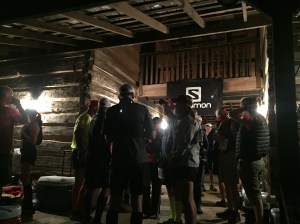



















 This Running Life