A teenager now, he is a bundle of hormones and craziness, with a changing mind and body. To be sure, he has ALWAYS been goofy. He is of my loins, after all. But as he enters the teen years I see in him all the classic pubescent hormonal moodiness that comes part and parcel with this period in his life.
When Preston was born and we faced crying nights, active toddler years, and need for sleep as he expressed endless childhood energy, friends with older kids warned me that this was the easiest part of parenting. That when they became teens, kids were so much harder to raise and father; that you can no longer control them in ways you could when they were 2.
I was scared when I heard this. Mortified by stories of struggle and frustration. But it hit me yesterday that the struggle and frustration doesn’t come from the child’s perspective, necessarily. It comes from the parents’ view. The next 5 years for Preston will not be easy. They will not be all laughs and cinematic moments of self-discovery. There will be frustration, tears, anger, yelling. All the stuff humans do as they mature, as they grow, as the come to terms with the changes in body and mind and soul.
My role in all this? I get to be Preston’s dad as he becomes a man. I get to laugh with him, drive him crazy with my goofiness, be firm when needed, understanding when called for, and consistent at all times. He deserves a dad who will take this journey with him in good cheer, with an affability, and the willingness to suspend my dreams so that he can achieve his. He needs a dad who understands that these emotional and physical changes he is experiencing are not on purpose, or designed to irritate me, but part of his maturation process. That he cannot control most of what it happening to him, so why should I get bent out of shape by this, or take offense? He deserves a dad who will, simply put, be there at any time and for any reason, like my dad was for me. He deserves a dad who “gets” him and smiles my goofy smile as he grows into my son, the man.
I never really knew what love was until Preston was born. That day, as I looked with wonder upon this beautiful boy, I realized that I would do anything, give anything, sacrifice anything, to secure the safety and happiness of that little boy who brightened my world such that I never imagined possible.
“I can hardly wait
To see you come of age
But I guess we’ll both just have to be patient
‘Cause it’s a long way to go
A hard row to hoe
Yes it’s a long way to go
But in the meantime
Before you cross the street
Take my hand
Beautiful, beautiful, beautiful
Beautiful boy
Beautiful, beautiful, beautiful
Beautiful boy “
This runs a little long, but since it was my first 70.3 and a lot of you are curious about how it went, I got a little wordy. So apologies. Plus, it’s my blog. I can write a book if I so desire! LOL
This was a great race, well-organized with lots of support and encouragement. I plan to do this race a lot in the coming years!
The Swim
The swim was crazy. The day before the race I met Dustin, a new Vegan tri friend of mine, at the swim course for a short OWS in our wetsuits. The water was placid, like a lake. Neither of us had raced this far in open water before, so we were excited about the prospects of the swim with such smooth water. Alas, at the race meeting that night, the race director warned of approaching weather for the weekend. This meant that the Gulf of Mexico wouldn’t be so smooth on race day. And it wasn’t. The Red Flags were out on the beach warning beachgoers of rip tides, and we triathletes were greeted with 2- to 4-foot swells for the swim.
My warm up swim the day before and right before the race did wonders for my nerves. I have the hardest time right when I get in the water with remembering to breathe while swimming. So much going on in my mind: “Don’t look like a total newbie!” “Stay alive!” “Act like you know what you’re doing!” So it was nice to get that stuff MOSTLY out of my mind before my wave, which was slated for next to last. This was good and bad. I was happy to have time to study the earlier swim groups, how they attacked the breaking waves, how they navigated the currents, how they stayed alive. But I was nervous with my wave started at 7:05. The swim course closed at 8:20. I was concerned that if I really struggled in the swim, I might miss the cutoff.
The gun fired for my wave and we were in the water. The waves were big and angry! Getting through the breakers was tough but manageable. I stayed near the back of my wave and toward the outside. I didn’t want to get caught up the mass of bodies and lose my goggles or get kicked or pushed under. (One dude from an earlier wave came out of the water with a bloody head.) So I took it slow and steady and tried to find my rhythm. I breathed with every stroke so I could catch my breath and sight. Once I was about 400-500 yards into the swim, I knew I would finish this course. I’m serious, swimming this far has always worried me. Of course, I’ve done it in the pool, but the pool is the pool. The Gulf is another thing entirely.
We swam 950 yards out, took a left for 200 yards, then another 950 yards back home. Funny, the last segment of the swim was hardest of all. I just assumed the current would help a little, but the waves were really rolling in and I had ingested a lot of salt water and was feeling a little nauseous. One big fairly wet burp/vomit and I felt so much better. After I made the turn, I thought to myself: “There’s no way you can stop now. Jeez, you’re alive and you have a wetsuit. The worse thing that can happen is you stop stroking and end up in Mexico.”
I finished the swim in 47 minutes. Happy and proud to have done it. I know I need work, but I wonder how things might have been with calmer waters… On to T1!
The Bike
Spent a few minutes stripping the wetsuit and washing saltwater off, then gearing up for the bike. My goal for the bike was to stay in Zone 2 and not overdo it. I had been warned by veteran triathletes and my tri training books that too much on the bike will kill the run. So, I stayed in Zone 2 and relaxed and enjoyed the view. And I was bored. How do you Ironmen do 112 miles on a bike with no music or books? How do you stay sane!? And my taint. Hoo Boy! My butt was hurting after mile 20, earlier than ever in training! I shifted position a bit, stayed in Aero for most of the ride, and dealt, but really hate my taint for its rebelliousness.
Aero position, late in the ride (Courtesy: Endurance Cycling and Nutrition cycnut.com)
I did my best to pee on my bike. I had to go so bad, and was so ready to let loose, but for me to relax I had to stop pedaling, but the flat course and the wind slowed me down so much that before the pee came, I had to start pedaling again. I was losing time playing this crazy game, so after mile 40 I stopped at a port-a-potty and went. Gonna have to practice bike peeing.
I need to get stronger on the bike. I was passed by a lot of people hammering away. I knew I would see them later at the end of the bike course or dying on their runs. But I need to gain more power in zone 2. That’s the mission for the rest of the summer! (I’ll entertain any suggestions, but know I cannot afford a power meter. So don’t say “get a power meter.”) On the first half of the course I averaged 18-20 MPH in some not-so-bad wind. But as we returned, the wind was unbearable. Gusts into the 30s MPH, sustained in high teens to mid-20s. Oy! My pace slowed to 12-16 MPH. I watched my HR and stayed disciplined. I didn’t want to have to walk or run too slow when I hit the run segment.
The Run
I pulled into T2 feeling pretty good. Some fatigue from the race but no overwhelming feeling of “OMG, I cannot go on.” During my training, I had made a point to run longer on a few of my brick workouts. My training plan called for 15-20 minute runs off the bike on weekend bike workouts of 3-4 hours on the bike, but I extended many of those runs to a full hour. On some runs I’d go very hard the first 15 minutes (6:35 ish pace) and then back off to an easy and steady pace for the remainder of the hour. On other bricks I would just run easy off the bike. Just building endurance.
The plan for the run was to take the first 3 miles easy. Get used to being on my feet again, then after mile 3 and a gel, I would slowly increase my pace until the last three or so miles and see what I had left. The same wind that plagued us on the bike was there for the run, so I decided to run at an easy pace (9:00 ish per mile) until the turnaround and gain some wind at my back.
I was surprised to see how many people were walking at this point; some even started walking right out of transition. Some went too hard on the bike, others seemed to plan to walk from the beginning. It was fun to pass some of those who had cruised past me on the bike segment. I knew my plan was working. I even passed a couple of people wearing “Fueled by beef” kits. Took some pride in that!
I increased pace to just below 9:00 per mile and felt really good from, miles 7-11. But by mile 12 the sun was out and my fatigue grew. And my dang shoes were soaked and heavy from the water I was using to cool my head. (Note to self: investigate Tri shoes for warm weather Tris!)
It wasn’t terribly warm at this race. This tri has a reputation for being a hot one. But with clouds blocking a lot of sunlight, it took a while for heat to take a toll. But late in the run as the noon hour came and passed, the warmth built. Each aid station gave out frozen sponges. I took a sponge at every station and alternated squeezing it over my head or stuffing it down the front of my shorts. Both felt wonderful. (I once read that water or a frozen sponge in the groin area during a hot weather race can cool body temps. I believe it now! Talk about invigorating! woof!)
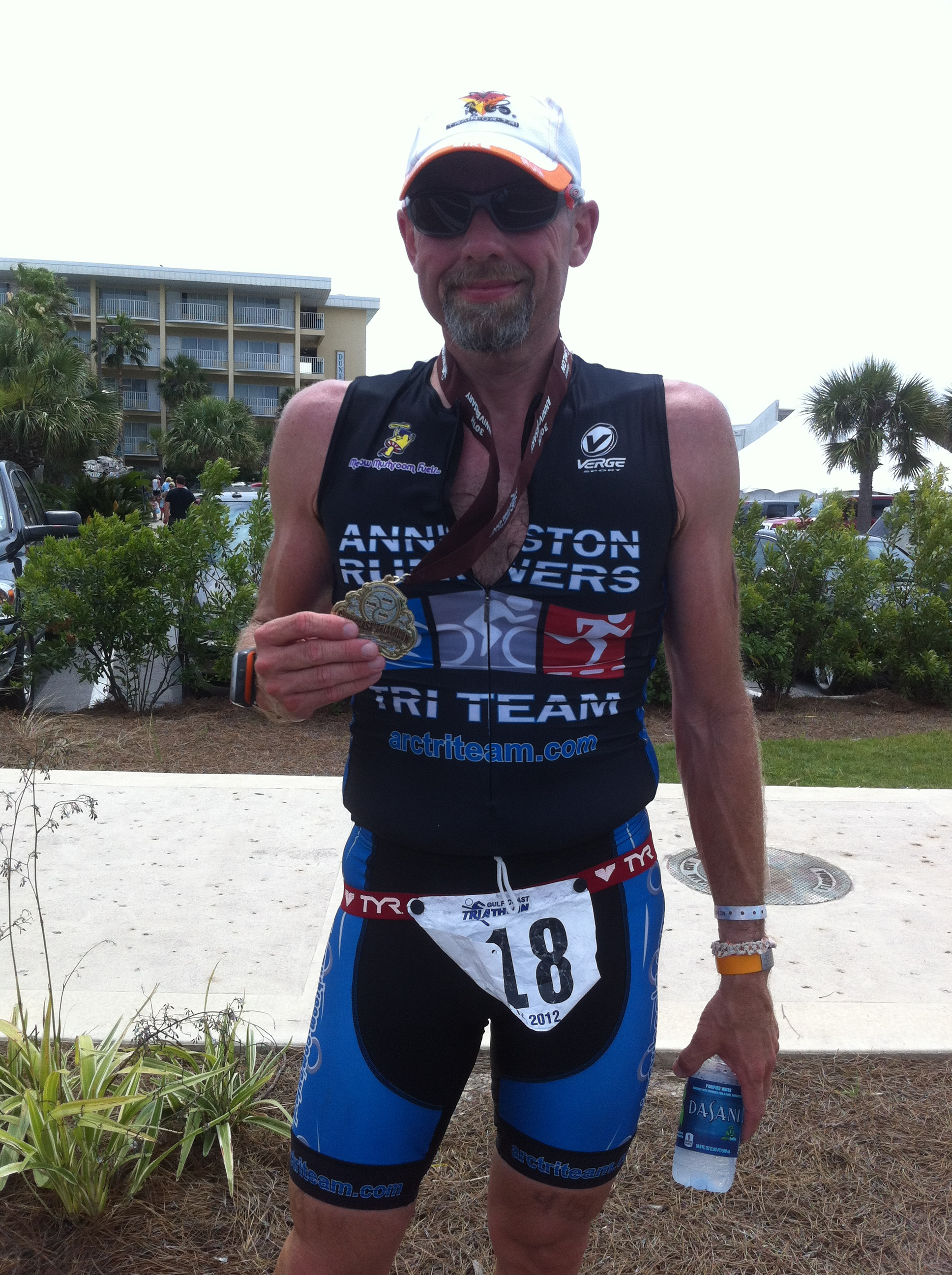
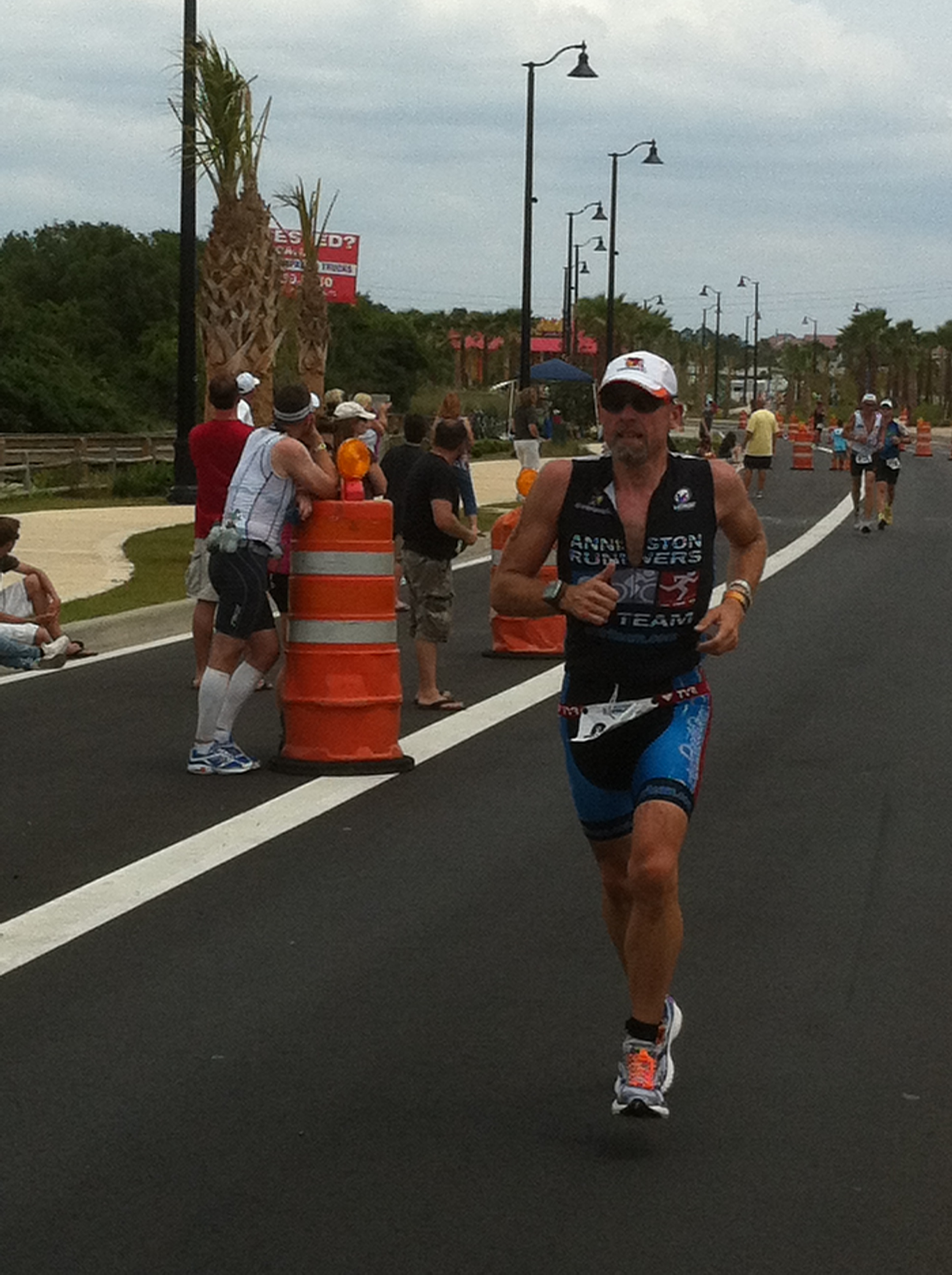
As I reached mile 12, I maintained pace, no kick available now, and told myself to relax, I was doing something remarkable–finishing my first 70.3–and to smile and finish strong. I quickened my pace in the last half mile, and had a pretty strong-looking triathlete who had already finished call out: “Nice cadence. keep it up!” And I gave a small kid a high-five. I heard the announcer call out my name. I smiled. I finished strong.
Rolling into the finish!
Final Thoughts
I cannot believe I did this race. Or that I swam 1.2 miles in the Gulf, regardless of conditions.
I want to do another 70.3! I want to do more Tris. I love the idea of doing three sports in one day. I love rolling into transition and gearing up for a different approach and activity and strategy.
It is race week for me. Just a few light workouts and then I’ll toodle down to Panama City, Florida for the Gulf Coast Triathlon 70.3 on Saturday, May 12.
Obviously, this is my first, as you can tell by the trembly penmanship on this blog entry. To be sure, anxiety and nervousness comes with any race. But with any “first” there’s a great deal of unknown. I don’t know what this race will “feel” like, what mental games I’ll have to play, how I’ll play them, or what I need to prepare for as the race unfolds. I’ve raced enough marathons that I can predict my mood swings, nutritional needs, and how my body will feel at a certain mile marker. But with a long course Tri, I have no clue.
Of course, this ignorance can help a doofus like me. I won’t stress about some of the things that might hamper my race performance perhaps. I can’t fret over what I don’t expect. Get it?
Goals, you ask? Yes, I have them. And I’m not being flippant here. But here goes:
1. Have fun and smile
2. Race smart
3. Finish strong and happy
There ya go. Oh. Time goals for each element? Swim: no clue. Bike: No clue. Run: sub 2:00.
Good news is I reached my race weight goal for the race just this Sunday. Now that Im in taper I can try not to look like Fat Albert by race time. Hey, Hey, Hey!!!
I woke up tired. I didn’t have great sleep the night before. But this was early Saturday, my typical sleep-in day where I ride the bike and maybe run after, but later in the day. No rush–no school or work. But an early baseball for Hudson dictated an early long run of 14 miles . But I couldn’t wake up. Even after breakfast and coffee. I was yawning, felt sluggish, and had NO desire to exercise at all.
But that’s what happens when you train for long races and put in a lot of hours on the bike, in the pool, or on the road. So I forced myself out the door. I knew things weren’t right when after 40 minutes my heart rate had failed to climb into zone 2. It should have been low zone 2 aerobic and I should have felt better than I did. So, I stopped for water, and assessed my situation. I know that failure of the HR to rise during a workout can mean serious fatigue, so I decided to do a 2 hour run, REAL easy. No intensity, no pressure, no requirements other than get it done.
I went to Hudson’s ball game at 10:30 and kept falling asleep in my chair! I was zonked. To be sure, I am in the hardest part of 70.3 training and should be tired, but this was a warning sign. I’m usually peppy after these runs. Or at least awake! I told Megan and we discussed my plans to ride the next day in the Cheaha Challenge. I had planned to ride 66 miles of the Century Ride and then maybe run a bit off the bike. But we decided that I would ride 47 miles, keep my HR in zone 1 or 2, and scrap the run entirely. I would also take Monday off as a rest day, with no exercise.
So, I did. I had a great ride with some great climbing (which did wonders for my confidence) and kept the ride very mellow. Today I am resting, and will get back at it tomorrow. Less than three weeks to go for the Gulf Coast triathlon and I need to be careful and smart with training. Taper will do me wonders, but I have to get there in good mental and physical condition.
It has been 129 days and 7 hours (as I write this) since my last marathon. If you’ve read earlier posts you’ll know that I’m taking off the early part of this year from marathon training and racing to recharge, rest, get stronger, and clear my mind of the mental pressure that accumulated after racing 5 over a 57 week period in 2010-2011.
But with every passing week, and each passing race, I find myself missing it more and more. This break is working! My heart is growing more fond of something that, while I never stopped loving, I had grown weary of the pressure of training and trying to achieve faster goal paces. I needed this mental and physical break, but as my 70.3 approaches, I find myself looking beyond May 12 and to the “summer of Gordon”– where I’ll slowly build my marathon base back to race levels, and a little higher. And to the fall where I’ll begin training for my 8th marathon (to be decided later) and another attempt at BQ.
I miss the training. I miss the buildup to weekend long runs and the anxiety and joy that they bring. I miss what marathon training does to me—at once, it makes me joyful, strong, crazy, anxious, neurotic, tired, elated, proud.
I am convinced that save for the ironman triathlon distance, there is no other test of will, mental acuity, dedication to goal, and physical condition than racing a marathon. I’ve never felt as low as I do at points during a race, and I’ve never felt as proud and high as I do when I finish. Every race is different and teaches me something about myself. I’m learning how to race 26.2 miles, but I will never master it–no one will. The marathon is a lifelong learning experience, a gift, if you will, that never stops giving.
My life as of late has been defined and transformed by this race. While training for the past 7 races, I’ve undergone a transformation of epic proportions, mentally, physically, emotionally. So to revisit this race, to pay it homage with my time and energy and devotion is my way of saying “thank you” to this thing that has led to so much change in my life.
I miss building a training plan and race strategy, and following it to fruition and then seeing what race day brings to elevate my running or pose unforeseen challenges. I love the nervous energy of a race expo. How we feed off of each other, seeking support while also measuring up fellow runners for the race that is to come.
I miss training more than the race itself. While the race is a “victory lap” of sorts, I miss training for the race more than the race itself. Sounds goofy, but bear me out. There is comfort and challenge and regularity in a marathon training schedule. For at least 16-18 weeks, I build and recover and repeat the process. It changes slightly in terms of distance per week or types of runs, but I know that each week my routine is the same, and each week I must find it within me to get through another set of challenges, pressure, fatigue, and distance.
Then there is taper (which sucks–moving right along). And the race. The two-to-three weeks surrounding a race is fun since I am at the end of another training cycle and get to see how honest I have been with myself, and how my training strategy will pay off, but I despise taper and recovery! Yes. Yes, I know they are necessary and vital to growth as a runner. I fully admit that and embrace them when they arrive. That doesn’t mean I have to like them when they are around!
I love how during a marathon I find myself attracted to other sports. Often, between miles 18-24, I’ll find myself thinking: “Cycling sure seems like it would be a lot of fun. I should’ve been a cyclist! You get to sit down. Coast on descents. What was I thinking registering for this race. When this is over I am becoming a full-time cyclist, or go into motocross, or woodworking.”
I love the feeling I get as I cross a finish line, no matter how well or badly I raced that day. The sense of accomplishment. The pride I feel as I walk through the finish line area and hear the cheers of people I have never met. I beam.
I’ve completed 7 marathons. And with each approaching race I have tremendous doubt about myself; whether I can run that long, if I’ll ever finish another one. I mean, I KNOW I’ll finish, but no one serious about this sport will tell you that they never doubt themselves leading into a marathon. Go watch “Spirit of the Marathon” and listen to Deena Kastor, Joan Benoit-Samuelson, Amby Burfoot, Dick Beardsley. Elites go through the same emotions we plodders experience. They just suffer these emotions while running much faster!
And this is the beauty of this race. It humbles each and every one of us, from the Ryan Halls of the world to the Gordon Harveys. It exposes our weaknesses, where we held back in training, our deepest anxieties about ourselves, and it elevates our deep need to prove to ourselves again and again that we CAN do this. We CAN finish or set a PR or a world record or, in my case, qualify for Boston.
I love the marathon. And yes, sometimes I hate the marathon. Sometimes at the same time! But for a guy who never thought I’d run more than one, or run faster than a sloth, I am in a lifelong love affair with the marathon. And I’m never letting her go, no matter how much she hurts me, humbles me, and teaches me lessons about myself than I can learn nowhere else.
The link below is to an article on Active.com by Matt Fitzgerald. If you read this blog or have listened to the podcast I used to produce, you will l know I’m a huge Fitzgerald fan. My first REAL book on running was Fitzgerald’s Brain Training for Runners (a gift from a dear friend) and I learn something new every time I read it.
One of Fitzgerald’s tips in the article linked below is to decrease the amount of intensity in our running, which leaves us in the aerobic zone for more miles of the week, which leaves us with greater HR capacity on tougher more intense runs, and not as tired by the time race day gets here. This is not unlike the Maffetone method I wrote about earlier. Training in the aerobic zone, a slower-than-we-think aerobic zone, is actually better for our speed and overall race-day capacity than most would assume. Beginning with the big running streak to close out 2011 and continuing with my 70.3 training, I have followed this advice (of course, it helps to follow a 70.3 plan that Fitzgerald wrote himself!). I do shorter, more intense intervals, surrounded by a lot of running in the aerobic zone. This holds true for cycling and swimming as well. But running, my central focus, is where I am seeing greater results. For example, these shorter, more intense intervals include a variety of things such as 800s at a low 6:20-ish pace, 400s at something under a 6:10-ish pace. And some mile repeats at 6:30-7:00-ish pace.
Throughout the training cycle I’ve maintained a 30-36 running mile per week average. So my runs, save for the weekend long run, do not exceed 60 minutes, except for the occasional 5-10 minutes above that if I have a little extra time in the morning before rushing in to prep kids for school.
During these runs, in this cycle, I’ve been diligent about not over-reaching in terms of intensity. Small doses of speed and intensity surrounded by lots of zone 2. Reading Maffetone, and heeding the advice of others regarding intensity in runs, convinced me of the value in and necessity of building a strong aerobic base that can lead to a lower HR while running faster paces.
I’m beginning to run a little faster in my HR training zone 2. That is to say, it is taking less energy to run at this faster pace. Over time, I expect to see this expand to even faster paces at less effort. It is already in a way, but it has only been a few weeks, and this process takes several months. So consider this an interim report. It is said that elite marathoners run most of their races in the aerobic zone, and that’s where I want to run mine. So we shall see, I guess.
By way of an example, today was my tempo run day. Today’s run called for 2 easy miles, then 2 miles at 10K race pace, then 2 more easy miles. Since I run 60 minutes, the remainder would be an easy run until I reached the end of the hour.
Mile 1 was nice and easy warm up. Mile 2 was a little faster to prepare the body for the 10K pace miles coming up next. I ran mile 2 in 8:19 at an Avg HR of 127. Let’s compare this to a similar run from September 2011, at the early stages of my prep for CIM. On September 6, I ran an 8:49 mile in roughly the same place of a run as I did today, at a pace of 8:49 but with a higher Zone 2 HR of 131. On September 23, I ran the following miles: an 8:31 with a 129 HR, and 8:38 with a 131, and a 8:32 with a 131. (Similar runs, similar times of the day. Maybe a tad more humidity than I faced today, but comparable for my purposes). I tried to run easy, with good form, smooth and deep breaths, and just relax. I felt like I was running easy and tried to not look at my watch, just run by feel in these warm up miles. I was surprised to see a low 8 minute pace. My zone 2 HR is 116-133, so I’m running a bit faster with a lower HR.
Here are a few links that I am finding very useful or interesting as I train for the Tri and look to a fall marathon.
Phil Maffetone came to my attention from Dirtdawg’s Blog and Podcast as he used the training methods Maffetone prescribes to prepare himself for his last attempt at a BQ. He raved about what Maffetone’s method did for his base aerobic endurance. So I’m intrigued and bought the book!
Since I am 70.3 training at the moment and so much of Tri training seems to be building a solid aerobic base, I’ve been dabbling in this a little bit already, but wanna see what Phil can do for me in a fall marathon perhaps.
And while on the subject of training, here is a link to the training plan I am using for the 70.3 in May. This was put together by an endurance expert I’ve grown fond of, and who has done more to assist me in my training–mental and physical–than any of the writers out there.
Matt Fitzgerald’s book “Brain Training For Runners” was my introduction to him and the idea that much of what limits us as endurance athletes is mental more so than physical.
This plan is his “intermediate” plan, but I am modifying workout duration/mileage to reflect my current base of fitness. For example, if he calls for a 45 minute run, I’ve ben doing an hour. I have also kept my weekly long run of no less than 2 hours in all weeks except for recovery weeks. And I started doing bricks earlier and for longer duration than he suggested. Again, my conclusion was I already train at an average of 13-14 hours a week. My issue for this 70.3 was shifting time amounts more to swim and bike than to run, as it was during marathon training. So I still get 30-38 miles a week running, but swim and bike are getting the time that had been spent on training for a 26.2. I really like this plan’s format and schedule for its simplicity from week to week. No weekly upheaval of routine, and I can understand it, to be honest. So many tri training books make my head hurt. No wonder people pay out the wazoo for coaches.
Another link which came to my attention a day or so ago was this about training the body to fuel on fat stores instead of glycogen stores. Now, Maffetone and this article aren’t totally unrelated as some of the ideas of aerobic training/base building seem to cross over. I am planning on trying this for my run this weekend, “zero cal training”
I’ve decided to track my training hours for the 70.3 in May. So, at the end of each month, I’ll report my stats here. So here ya go: (I’ll also keep track of how many sentences I begin with “so”)
Since I plan to take the winter and spring off from marathoning, it seemed like a good idea to put my interest in multisport as cross training to a test. I’ve registered for the Gulf Coast Triathlon to be held in Panama City Beach, Florida on May 12. This is a “long course/70.3” race, which would be considered a half-iron distance. I was nervous about registering, but as soon as I did, I felt excitement (yes and fear!) about the possibilities and to see what I could do in this new challenge.
For training, we are using Matt Fitzgerald’s intermediate 70.3 plan, with modifications to the running and swimming portions. Since I’ve a considerable base in running, I will run longer than he prescribes. Plus, I’m swimming an average of 2,000 yards per session now and his plan starts in the 800s. So, I will remain at my higher level of swim distance.
As 2011 dawned and I enjoyed some success in marathoning and in running, I set a personal goal to reach 2,500 running miles by the end of the year. I was right on track for this goal for most of the year until I decided to run CIM. That race was my 5th marathon in 56 weeks and I was approaching a point where I needed a recovery period something fierce. So after CIM, I took a full week off, then started with shortens of 4-5 miles every other day. Megan and I discussed my goal and I concluded that while 2,500 was an admirable goal and likely within reach, it was best to not get caught up on numbers. I had well exceeded last year’s total of 1,700 miles and experienced more growth and maturation as a runner than I expected. So I had no problem settling for 2,400 miles and change. In fact, I had put in some solid sessions on my new bike and several 2,000 meter swims, so I wasn’t lacking for activity.
So, on Wednesday, December 21, I texted Megan to let her know that I had exceeded 2400 miles, and reached my secondary goal of averaging 200 miles a month, or 50 miles a week. I was satisfied. But late that day she called and said “I think you should do it! You are so close. You have to give it a shot!”
So, we agreed on a few rules. I would run consecutive days, close to 7-9 miles a day with two or three 13-milers on the weekends and if all went well I’d hit 2500 miles on the 31st. I’d listen to my body. I would not run through injury. I would be honest about how my legs felt. The goal was important but not more so than my health.
I had 97 miles to run in 10 days. The first two-to-four days of this 10 day streak were tough. I had come off a recovery period after running CIM and ramping up mileage so soon was a shock to the system. I wasn’t sure I would be able to keep it up every day until the end of the month. My legs were sluggish, I didn’t push hard at all, and took to listening to audiobooks to slow myself down and distract my mind from the miles.
Christmas morning dawned. Well it hadn’t dawned yet, as I left the house just after 5 to get 9-10 miles in before the events of the day—and the travel—absorbed my time. Somehow this run was better than the rest. It was early. And cold. But my legs felt ok. Not as heavy as the first few days. Something was happening to my body. It was becoming acclimated to running long mileage every day. And it was starting to desire those miles.
I cannot explain it, but the more I ran, the more I wanted to run. Monday the 26th was a turning point. We had traveled to my mom’s house for Christmas and were heading to Florida the next day to see the in-laws. A change of scenery was just what I needed. My legs felt peppier, I turned the music back on to give me a lift. I started listening to Kesha, Rihanna, Beyonce, Flo Rida—and liked it!
By the time we got to Florida (the state, not the singer), I was on a roll. I found a pool nearby and was able to get early morning swims before I ran. And my mileage was increasing. Instead of 9-10 miles, I upped the distance to 12. My body craved these runs. The stress of travel. Of family. Of holiday hustle and bustle all melted away. Every day was better than the last. I didn’t want this to end.
I exceeded 2,500 miles two days early. But I couldn’t stop. Jeez. Who could? I was on a roll, I had never run this much in such a short period in my running life. I was learning so much about myself and my body and that it is stronger and tougher than I thought.
My daily totals for the ten day period: 12.86, 9.1, 13.5, 9.2, 10, 13, 12.15, 12.15, 12, 12
Things I learned while running 116 miles in 10 days:
My body is capable of pushing beyond limits my brain tries to establish
Running a lot of miles on consecutive days will not automatically lead to injury
My body and mind crave long periods of long slow miles from time to time. After the stress of marathon training all year during 2011, it was nice to just run
That I can eventually up my mileage from 2011’s 50 mike a week average to upwards of 70. It will take time, true, just like getting to 50/week did.






 This Running Life