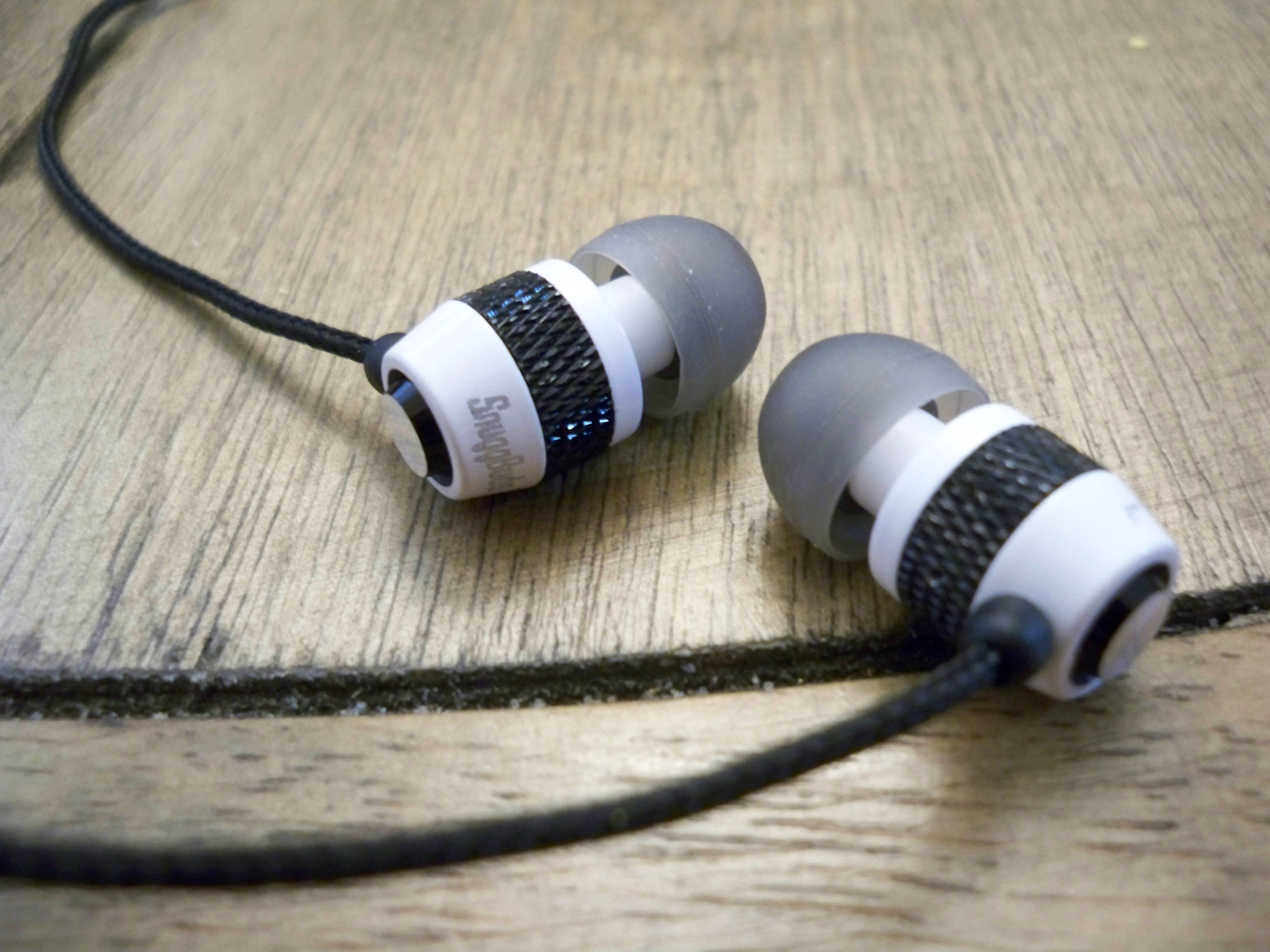
Part of my role as a SF Marathon Ambassador is to review products sent to us by race sponsors. So, last week I received a pair of SnuggBuds ear buds. I sampled the SB-X model or sport model. They make ear buds in all sorts of varieties and styles, from those specifically for Droid and iPhones, for those who need LOTS of bass in their ears, for those who would like their ear buds “bedazzled.” First, I was pleased to received the white sports model and not the hot pink, Blingg Buds.” But I digress.
Ok, I wore these on a couple of runs and in the car on the way to work. I LOVE the cord. It is a fabric, tangle-free, cord that drapes well, and not stiff or curled up like most new ear buds can be right out of the packaging. The buds come with extra ear gels fo various sizes. For me, a guy with a big mouth, I have strangely small ear openings. So I gravitate toward the smaller of the ear gels (why am I telling you this?). The buds seal off the ear pretty well and restrict any ambient noise from disrupting my Lady Gaga tunes (not sure I should’ve shared that). They aren’t too bulky either, so I didn’t feel as if I had marbles in my ears. If you have issues with those buds that just rest just inside the ear falling out of your ears (and I do) then you’ll love these. They do not move once you’ve secured them.
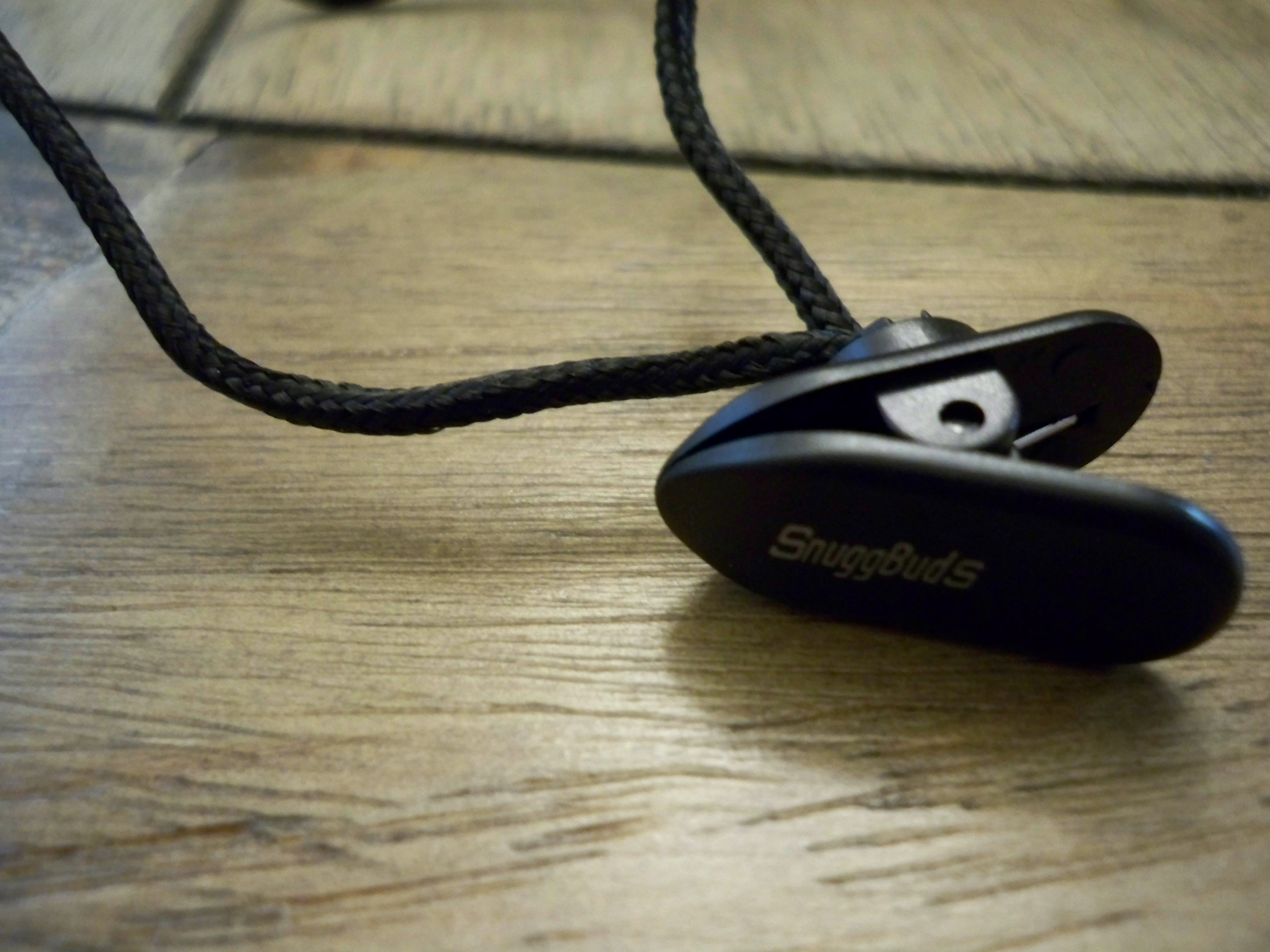
Another thing I love about these buds is the cord. It is wrapped in fabric, which prevents tangling (to a point–my kid can tangle anything. Sorry Snugg Buds). The fabric covering keeps the cord light and easy to manage. Plus, it comes with a clip for securing the cord to a shirt collar or a hydration belt, or even a backpack strap. I love the clip!
The cord length is 1.2 Meters (close to 4 feet), which allows for me to keep it attached to my iPod in a lumbar pouch with plenty of cord to spare and not feel as if it is tugging or too short.
The sound quality is fantastic. These are your basic SnuggBuds, and not the one’s with enhanced Bass. I cannot imagine how much bass you get with those. quality set of buds!
I’d really like to try a pair of their iPhone buds with a clickable mic to talk. I drive and talk on my phone a great deal, so having a quality set of dependable ear buds with the mic would be ideal!
Just before the LA Marathon I was contacted by K-Swiss and asked if I was interested in reviewing a new shoe they have on the market, the Blade-Light Recover. This is a light weight slip-on shoe that is designed for runners and triathletes to wear following races. Very easy on and off, the shoe is light and very gentle on tired feet.
This shoe (and others in the Blade-Light “family”: the Blade-Light Race and the Blade-Light Run) features “Blade-Light” concept of shoe design. A one-piece midsole/outsole that keeps the shoe light and responsive. The “blade’ comes from the angles of the “K-EVA” blades on the midsole/outsole. The angle of these blades, especially in the race and run models, is supposed to provide responsiveness and flexibility.
I was sent a complimentary pair of the Recover model of this shoe. I’ve worn it at various stages of training: following long runs, after swims, just getting off the bike on a long-ride Saturday morning. They feel great and they solve my issue of what to wear after a race or hard effort. A lot of runners like to slip on a pair of flip-flops or sandals, but the soles of my feet are sensitive after a long run and the memory-foam in the insole feels like a pillow–I kid you not. I’d rather wear these shoes after a marathon, than walk around in my race shoe or sandals.
Speaking of sandals, if you like to wear shoes with an open heel, then you’ll like this shoe. The heel folds down to create a heel pad so that you can wear these shoes like clogs, if you see fit.
So, for a recent example of what I’m currently discussing, here are two workouts from this past week. The first took place on my regular Friday hill run. As I wrote in the last Adaptive entry we are using Mountain Drive for hill training, along with 11th street.
So here was the plan for the Friday hill run on Mountain Drive and the vicinity:
-1 mile warm up
-2 x up and down mountain, try to hold a consistently fast pace unless unable to (6 miles total, 1.5 up, 1.5 down, twice)
-2 miles fast flat sub GMP
-.5 -1 mile cool down
~9 to 9.5 miles total
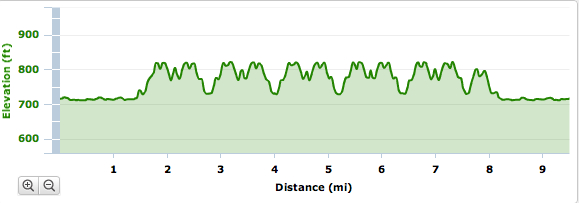
Below is the elevation chart:
Total elevation gain for the run was 933.
My Sunday long run also incorporated hills, with faster sub MP miles after the hills to model 1)the SF course, and 2)practice running at GMP on fatigued legs.
Here was the plan:
-2 warm
-2 miles around mp 7:35-7:42
-Hills for 4 miles working on keeping pace strong but we are not gonna worry if it’s higher than mp. See if you can keep it in the lower 8 range
-1 mile easy 8:10-8:30
-2 miles 7:30-7:37
-2 miles 7:25-7:35
-2 miles 7:30-7:37
-2 cool or split, your choice
I did the 4 miles along 11th street, back and forth, up and down, then headed back the way i cam for the sub-GMP miles. Today was a real mind battle. I am moving into recovery week, and boy do I need it. The past three weeks have been good and productive, but they’ve also been tiring! Adding to the fatigue is an increase in double work outs for 5 of 7 days a week. If I run in the morning, I ride the bike or swim in the afternoon. You can see last week’s training on the “My Training” link above.
Just a quick post to let everyone know that my family and I are safe and sound. We were hit with some pretty nasty storms, but nothing like other parts of the state. Thanks for the well wishes.
If you are interested in the aftermath, this is a handy site with pics and news:
So, how does one train for a course with this kind of elevation?
Elevation chart for the SF Marathon. 1,686 ft elevation gain
So, over 26. 2 miles the SF Marathon course has a net elevation gain of around 1,686 feet. And there are some pretty nice hills to cover as you try to maintain a Goal Marathon Pace (GMP). So the question remains: how does one prepare for this race? What I’d like to do is discuss how we fashioned workouts for Megan’s 2010 SF race, and how we are doing the same for my 2011 SF race.
So, to train for SF with a GMP in mind, one has to think about doing a couple of things over the course of marathon prep:
1) Find a hill profile that models what you will see, in part, at SF.
Of course, Megan had a distinct home-field advantage, since she lived in the Bay area and could either travel up to the city and run the course, or turn either direction on her street and find BIG hills. My task here in Alabama was to find a hill profile that would allow me to work the legs in such a way that the SF hills would not feel so large. Where I live in Alabama is the highest part of the state and we have a hilly terrain. So there is ample opportunity for me to find some largish hills on which to train. One of these is 11th Street. This is a street that is .70 of a mile from one end to the other. It has rolling hills, and a mother of a climb at the end of it.
Here is a screen grab of a recent run along 11th street (in this run, I did 5 repeats of 11th street)
Hill repeats on 11th Street
2) Weekly hill sessions need to have some similarity to race course hills and if possible get at or close to Marathon Pace.
So, it is not enough to train for SF by doing the occasional workout with hill repeats. Training “flat” for this course may help you finish the course, but you won’t finish strong and you certainly won’t achieve a goal time. So we have to think outside the box a little. Hill runs and long runs with hills are a necessity. To be sure, not every long run should have a hill component. You need to have time to cruise at goal paces and build endurance. Hill runs should be a little more than repeats up and down a hill. Do that early in the cycle to build endurance. But as your training cycle evolves (and it should EVOLVE, adapt, reshape as you grow or struggle), then creativity is called for.
What we did with Megan was design hill workouts that focused on several things. First, we wanted to climb hills at a slower pace, modeling a hill climb in a race, but training for quick recover at the crest and then regaining the desired race pace after the hill was conquered. To do this, we had Megan run her normal warm up, run a fast 1-2 miles on a flat portion, then climb slowly, much slower than desired race pace, for example, something like GMP + 30 seconds. As she returned to a flat portion, she had to “make up” her pace to regain an overall GMP average pace for the ascent and descent of the hill. We called this erasing the “pace deficit” and she did it over the space of a hill run. At the end of that session she might then do a couple of fast sub-MP miles to visualize a strong finish on tired hill-climb legs.
We played off of this sort of plan a good deal. One week she would climb slowly and catch-up, as I described above. Other weeks she might climb at or near GMP, and hold on to pace on the flats. You can play around with it and make it interesting so that each week is not the same thing. But we did use fast, flat miles before and after the hills to get the legs used to post-climb racing at GMP or better.
So here is a sample of one of our hill sessions that Megan ran in taper week one (17 days from race):
10 min warm up
20 min hills at GMP. (but if you are slower, don’t stress, just practice TRYING to maintain MP on the up hill.)
8 min recovery (not slow, but not GMP of around 8:00-ish per mile)
20 minutes of hills
in this section go up the hill at 9:15 or slower and at flat area run equal amount distance of the hill you just climbed at pace fast enough to get you back to MP average, and erase the deficit.
8 min recovery
15 minutes run (hills or not–whatever you come across) at SUB- MP.
try to really hammer. you’re gonna be tired after the other intervals. lets see what you can do. and don’t fret if you can’t get to GMP or sub GMP. This is good mental practice time now, at this part of the run
10 minutes cool down
total of 91 minute run
So now, as I train with her for the 2011 race, we are adapting these hill sessions for my training here in Alabama. So where will I do this? Two locations. 1) 11th street , which has rolling hills and a booger of a climb at the end. See the elevation chart above for a glance at 11th Street’s elevation profile. Not huge but running back and forth over it for 5 miles or more sure feels like a lot!
The goal is to run up, at pace, the steep incline in the distance.
and 2)Mountain Drive, which has a nice steady uphill grade (much like Golden Gate Park) and then literally goes up a mountain, a local small foothill we have here called Chimney Peak.
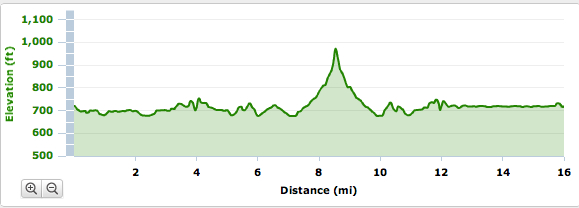
Note the elevation for just the lower part of mountain. From mile 7.5 throu 10 or so, there is a 1 mile approach that has a slight Golden Gate Park-ish grade then erupts into a full-blown mountain. The road I was on climbs much higher than I was prepared for on Sunday’s long run.
Mountain Drive
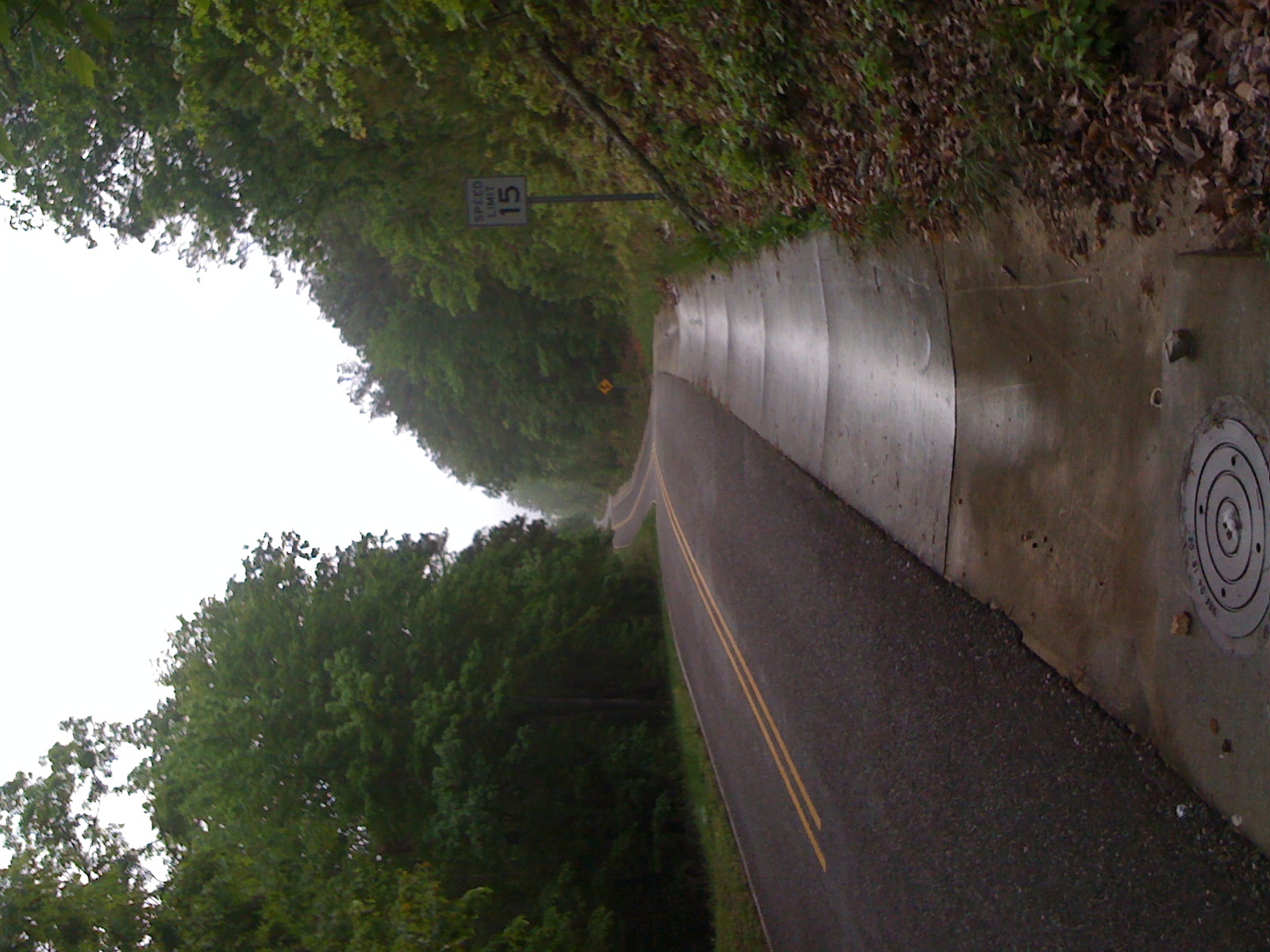
And here is a pic of the road from where I turned around.
Mountain Drive climbs for another mile or so to Chimney Peak
So, over the next 13 weeks, I’ll see a lot of these roads during my long runs and my hill-specific runs.
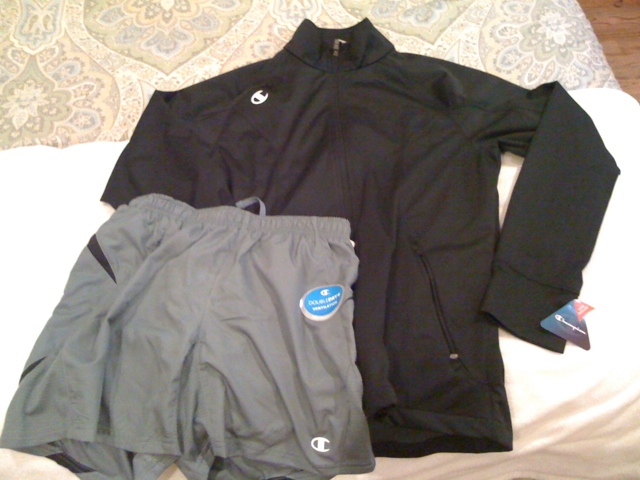
Champion sent me samples of their new spring line of active wear: a Double Dry all weather soft shell jacket and a pair of Double Dry running shorts. Look for a review of each in the coming weeks. Champion website
One of the first books I got when I started delving into training philosophy behind running, specifically the marathon, was “Run Faster, From the 5K to the Marathon: How to Be Your Own Best Coach,” by Brad Hudson with Matt Fitzgerald. My friend Megan recommended it, since she had used it as an aid in crafting her own plans. I love this book because it echoes a philosophy of training that Megan has pursued for some time now and that I have strived for and finally attained. Let me explain before I get to San Francisco hill training in the next post.
A year ago as I took stock of my running, I realized I wanted to attain a level of running fitness where I could run any marathon in the space of 2 weeks and race after only 5 or 6 weeks of prep. It took about a year to get me to a base so that I could do just that. So here I am, with a running base of about 50 miles a week, with 2-3 bike sessions and 3-4 swims per week. In fact, between November 13 and February 18, I ran three marathons, including Disney’s “Goofy Challenge” where you run a half on Saturday and a full on Sunday. I PRd in each race, taking my best time from 3:48 in November to 3:28 in February.
When I got the Hudson book, I was pleased to see him stressing that runners should strive to maintain consistent high level of well-rounded fitness. For me gone were the days of running a marathon and taking weeks off to recover, only to start from square one when the next training cycle kicked off. Combined with my new Vegan lifestyle, I found it easier to recover from long and/or intense training runs, which allowed for more intense training and a slow build of base mileage per week.
Ok. So back to hills and the SF Marathon! One thing Hudson wrote about and Megan and I have done in our training over time, is follow 5 training principles:
1)Customization. Training plans should reflect the experience and skill level of the runner
2)Core. Core. Core. Do not neglect the core, it supports so much of our running.
3)Do not neglect the recovery (“zone 2”) run. This is a low HR run where the body builds running endurance, while also recovering from more intense efforts. A huge mistake many young runners make is thinking that they should go out on every run and “kill it” because they felt good that day. Discipline and self-control are vital here!
4)Cross-training. Not only builds endurance, it also develops muscles used in support of our running. Swimming, cycling, walking, elliptical, all play an important role in a runner’s overall fitness.
5) Train to the race. For a successful marathon and to meet our goals we MUST train to the race. Got a hilly marathon course? Better run some hills, LOTS of hills. One cannot expect to maintain an overall goal pace if she hasn’t spent a great deal of time training for the peculiarities of the race course. This is vital to success. This involves more than one hill session a week of a half-dozen hill repeats. It requires folding hill training into tempo runs, long runs, etc. The body has to be able to achieve a level of what Hudson calls “specific endurance,” the ability to resist fatigue at goal race pace. If we don’t spend time on the hills practicing race pace, or at least building a level of hill fitness that allows us to recover from a climb quickly and return to goal marathon pace (GMP), then how are we to attain our goals in the race?
This constitutes the essence of what Hudson calls “Adaptive Running:” customization, responsiveness, evolution. Training plans are made to be changed and modified. They must evolve to meet the growth of the runner. They must be changed as runners grow faster than expected, or suffer setbacks or injuries. And training never stops. Runners have recovery periods and reduced intensity weeks, but to maintain a level of overall running fitness, one without months of down time, we must follow these principles and look at marathon training as a linear process and not cyclical. Ongoing and not with start and hard stops.
NEXT POST: Training for “specific endurance” (hills!) for the SF Marathon.
Michael from the Michael runner blog asked me to write a guest entry on what I learned from my first Triathlon. Here is a link. Click on over and take a read and enjoy his excellent blog!
Sorry for the long delay in posting. Been crazy since I got back from Myrtle Beach. Episodes 17 and 18 of the podcast have really detailed race reports.
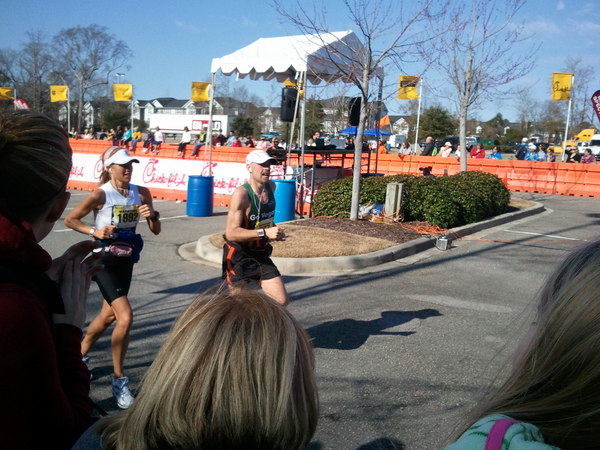
I fell short of the 3:20 goal for BQ, but did set a new PR at 3:28. So very pleased about that. Here is how I did relative to the field of runners that day:
Finish time: 3:28:26
Overall placement: 174th out of 1,737 marathon finishers
Age Group: 40-44 AG, 27th out of 203.
Between November 13, 2010 at Chickamauga (3:48) and February 19, 2011 Myrtle Beach (3:28), I’ve shaved 20 minutes off my marathon time.







 This Running Life