It is no secret at all that I despise hot weather running. Yes, I’ve lived in the South all my life, but the high humidity and heat kills me. It does for everyone, but I am a pretty good “heat whiner” about it all. On a run this week, and covered in sweat barely a mile into the run, I started muttering to myself in the Dr. Seuss metre: “I do not like this heat, I don’t, I won’t!”
Next thing I know I’m drafting this little thing in my pocket notebook al week when i have a few moments. Here is the result, with apologies to the brilliance of Dr. Seuss for my crude and meager attempt to replicate his voice.
——————
The runner sat glumly with head hung down,
The friend said what causes your unhappy frown?
It’s summer in the South, there’s cheer all around
you should pump your fists and jump up and down
Be happy in this heat? I’d say rather not!
It’s humid and sticky and so awfully hot!
But winter is cold, said friend, it freezes your bits
and you know it makes you throw a many hissy fits
I know, I know, said the runner resigned,
running in ice is not for what I was designed
Its true that now my bits are more thawed,
but to say I love summer running is supremely flawed
Heat running is rough and a super sized chore,
It never leaves me happy and wanting for more
When I run in humidity, I never feel at ease
My body revolts and my legs feel diseased
I want to run fast, and I really do try
But its so hot outside that I think I may cry
And if you should see some tears start to fly,
‘Tis merely the sweat that’s flopped in my eye
The friend said wait now, you tell me a bunch,
That hot weather running grows your strength so much
You say that if you can just withstand the pain,
To run in the heat can cause you great gain?
Do you a favor and listen to what I know,
That to run in the heat come fall the faster you will go
Your paces will hasten, and your feet feel light
You’ll smile again, and know running delight
You’re right, said runner, with half a smile
I’ll attack this summer one mile after mile
Humidity may hurt me, but won’t knock me down
And when the fall approaches, I’ll dance all around
I wrote this in 2013. I go through this song and dance in my head every summer, so I thought it worth a repost.
A sweat me on the pavement
——–
It happens every summer. I tell myself I’ll remember what heat and humidity do to me. I remind myself of the physiological benefits of running in this Alabama climate. I say to myself, “hang on, because once fall temps and humidity levels arrive, you will feel supreme!”
But it never fails. I forget all these things by the time July rolls around. I’ve documented on these pages many times before what running in heat and humidity does to and for the body. I’ve written about my past success in fall races because of summer training.
This summer has been no different. I’ve found myself thinking things that I know not to be right, but they still pop into my mind during and after runs. Here are the top three:
1. I have a lower body/leg disease. The body’s need to cool itself in high heat and humidity draws l=blood away from the legs during my runs and my legs fatigue quicker. I feel like I can’t generate any power, or sustain a fast pace. I am positive that I’ve contracted some rare and exotic disease that affects only the legs.
2. I need to reevaluate my marathon goals. “There is no way I can sustain a 7:37 pace for a marathon! Jeez. I’m having trouble moving forward. I should reevaluate goals and try to maintain a 12 minute pace.” I know better. I know that I should follow my HR and my “marathon effort” intensity in runs and not the pace. I’ve done it before, but when the mind starts to crunch numbers, I start to freak out. I know that eventually when the weather breaks, my paces will be right where they should be.
3. Unless you live here for an entire summer, you just can’t understand the mental and physical beat down that a summer of running here provides. (Nah. That one is true! LOL!) But seriously. I can’t describe the mental pummeling that day after day of 96% humidity and 75 degree temps BEFORE DAWN can give a runner. The blow to confidence is the worst. Summer running is more of a mental than a physical battle. If you can survive a summer like this with some semblance of confidence and sanity, you will emerge a better runner. (Remind me I said this, ok?)
[Don’t forget, if you haven’t already, please “like” the blog’s Facebook page found here]
A few weeks ago I received an email from Steve Saepan of Tiux Premium Performance Compression Socks. I’m a sucker for a good compression sock or sleeve so I agreed to review a pair. Not HIS socks, mind you. That would be kind of gross. A pair of his company’s socks. Clean as far as I could tell. He sent me a gratis pair and off I went.
The plan was to wear these socks a few times on my daily runs, which I did. And later I planned to wear them in the last 20 miles of the Lake Martin 50 Mile race, which did not happen. I DNF’d the race at mile 33 and never got a chance to change into the socks. Fortunately, I’ve run in them several times and have a good 30 miles in the socks. I’ve also worn them around the house a few times by way of recovery. So I can give a pretty fair review.
Socks vs sleeves
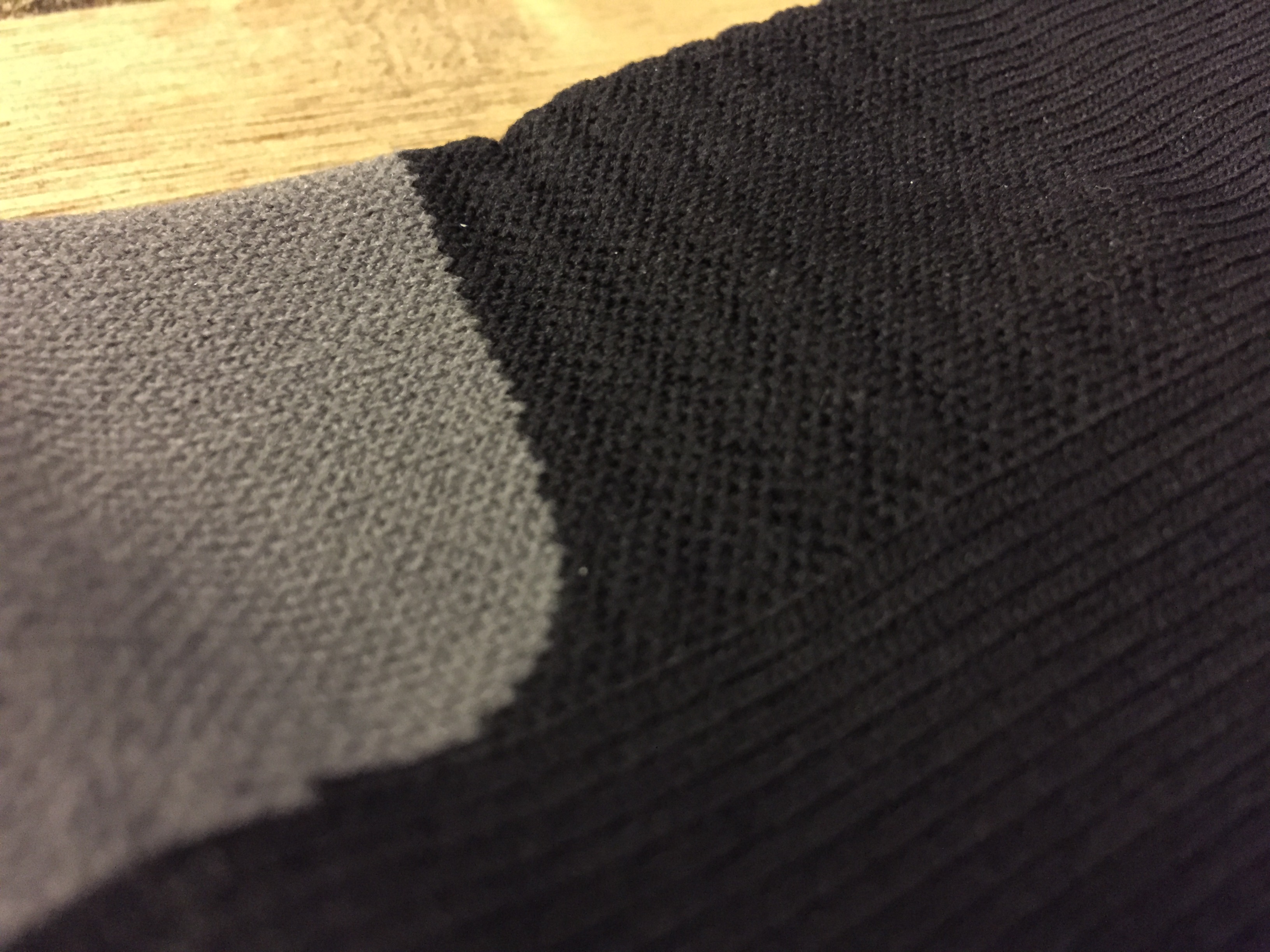
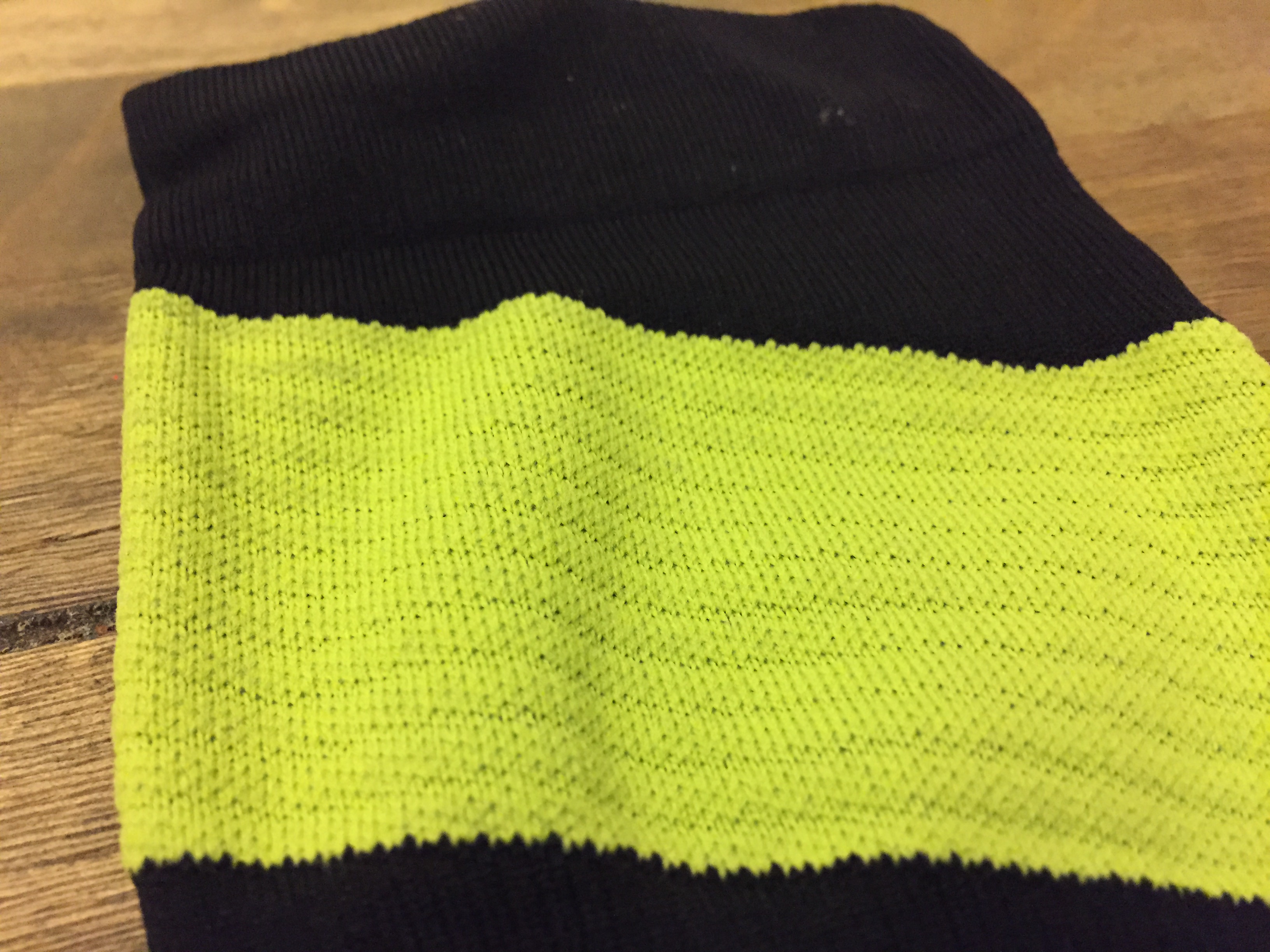
I’ve always used compression sleeves because I am peculiar about my socks. I was slightly reticent to surrender my sock predilection in favor of the all-in-one compression socks, but I did enjoy the compression aspect around my feet. More and more sock makers seem to offer a compression feature, if only around the arch. Tiux socks felt nice; not too thick, but not paper thin such that you might worry about blisters on a long run. An added benefit of the Tiux sock is that they’ve built in some achilles support along the back of the sock which I like a lot and think very useful for late in long races or training runs.
This is the achilles support section of the sock
Sizing
Compression sizing has always been tricky for me. I want a snug fit but not one that constricts blood flow and makes my feet numb and tingly. I’ve had big brand compression that didn’t feel like compression at all, even though I fit squarely within one of their sizing categories. Studies conflict when it comes to the benefits of compression. Some dismiss it as mere placebo while others credit the blood flow benefits to recover and rejuvenate tired muscles. At any rate, the benefits of compression are a highly individualized thing. If it works for you, then go with it. If not, fine. But how many of us know how snug compression should be for optimal return on our compression investment? I don’t. I rarely see info pieces about that. So we are left with feel, which again is a highly individualized thing. You know when it feels right. You know when it doesn’t.
Tiux felt right. They didn’t feel like glorified tube socks, like the big brand I mentioned earlier. They also didn’t feel as if I was being slowly squeezed to death. There’s also the matter of length. This is the tricky part of compression socks versus sleeves. If your lower legs are short then you run the risk of looking like a Catholic schoolgirl with socks up over your knees as you run down the road. If your legs are longer, then you look like you have a pair of expensive crew length socks. I’m 5’8” with a 32 inch trouser inseam. Tiux socks came to just below the lower part of my kneecap. Perfect fit.
The bands that support the upper calf
Performance
Because of their Goldilocks size and snugness the Tiux socks felt good. I felt the support of the compression but little else. I want gear that supports me but doesn’t necessarily remind me that I’m wearing it. Like a good pair of shoes, all my other running gear needs to disappear while I run. Tux did that wonderfully. My feet felt nice during my testing runs in the wild and unpredictable weather that comes with spring in the the U.S. south. These socks performed well under all conditions. They didn’t move or need adjustment after I put them on. Good stuff. I was excited about using them at Lake Martin. They seemed to be a perfect late long run change of gear for me to look forward to after many hours on my feet. I regret that I didn’t get that chance.
Cost
I’ve worn Salomon, Zensah, Sugoi, and CEP compression in one form or another over the past 6 years. Tiux is a new company and not well known yet, but their product is just as good as any of the bigger brands you see in the compression world. Let’s say that Tiux is just as good as, if not better than, these bigger, well known brands. What then do we use then to set them apart? How do we choose one over the other? Cost to the consumer.
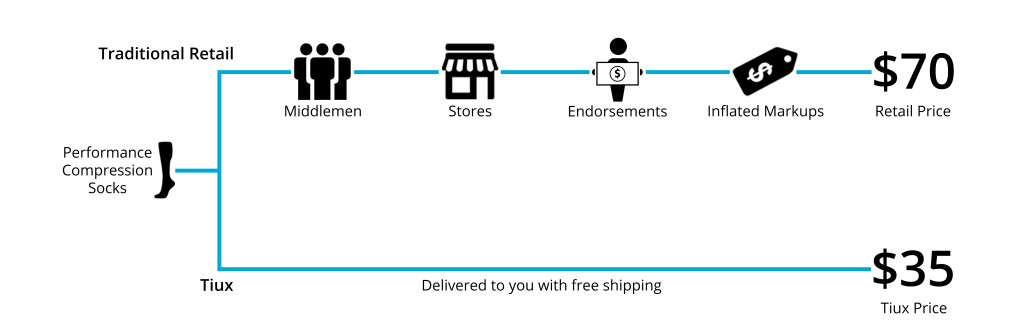
Tiux socks are so much more affordable than the bigger compression brands but without a decrease in quality. Their business model is unique and refreshing and saves a great deal of money without sacrificing performance.
I took this from the Tiux website because it best illustrates what I am trying to tell you about their business model.
I did a little research of major brands and the cost to consumer. Salomon Exo Calf sleeves are $55; Zensah Socks are $49.99; Compress Sport socks are $60 and their sleeves are $70; CEP sleeves cost $40 while their socks cost $60; and CW-X socks cost $49.99. Most if not all of these brands also charge you for shipping. Tiux has created a no-retail, no endorsement business model that supplies them to you for as cheaply as I’ve seen compression offered (with free shipping!), except for end of year sales. That’s not bad for some solid compression.
I’m impressed with Tiux. The cost is superior and the compression is as good as any I’ve worn. They’re slowly expanding their color options, too, which will help sales and growth. Give them a try.
Since Tiux is new, I thought I’d post a short interview I did with Steve Saepan
1) Your model is direct online sales with no traditional retail path. As you’ve said, this allows you to keep the price point low (including no shipping charges), but I am curious how you came to this decision? Do you think it will set you apart from other compression brands?
I wear compression socks and was paying $60 or $70 for a pair. I didn’t think these brands were offering a fair price and saw this is an opportunity to start my own brand. Our goal is to set ourselves apart by offering the most value, and we do so by creating high quality compression socks at a fair price.
2) Tiux donates 1% of its revenue to MAG (Mines Advisory Group), which helps communities around the world protect themselves and remove unexploded ordnance and the remnants of armed conflict. How did you select this particular organization to receive your donations?
We wanted to partner up with an NGO that was involved in helping local communities around the world. MAG is a great organization and the work that they do has such a positive impact on these communities. It made sense for us to work with them.
3) Other than price point and the sales model, what sets Tiux apart from other compression brands in a crowded compression market?
We set ourselves apart by providing the most value and convenience for our customers. We use premium fabric and work with the same manufacturers as other leading compression brands. However, our sales model allows us to sell our socks at a fair price with free shipping.
4) Tell me a little about how you designed these socks? How does one set about designing a compression article? What’s the process?
We work closely with our manufacturer during the design process and leverage from their expertise. Once samples are made, we have a group of runners here that will test the socks and provide feedback. We continue this process until we’re satisfied with the final product. Our manufacturer has been very patient with us 🙂
5) Tiux is a unique brand name and one that is just different enough to remember. What does it mean?
Tiux, pronounced tee-oo, is a Mien word that means to run or jump.
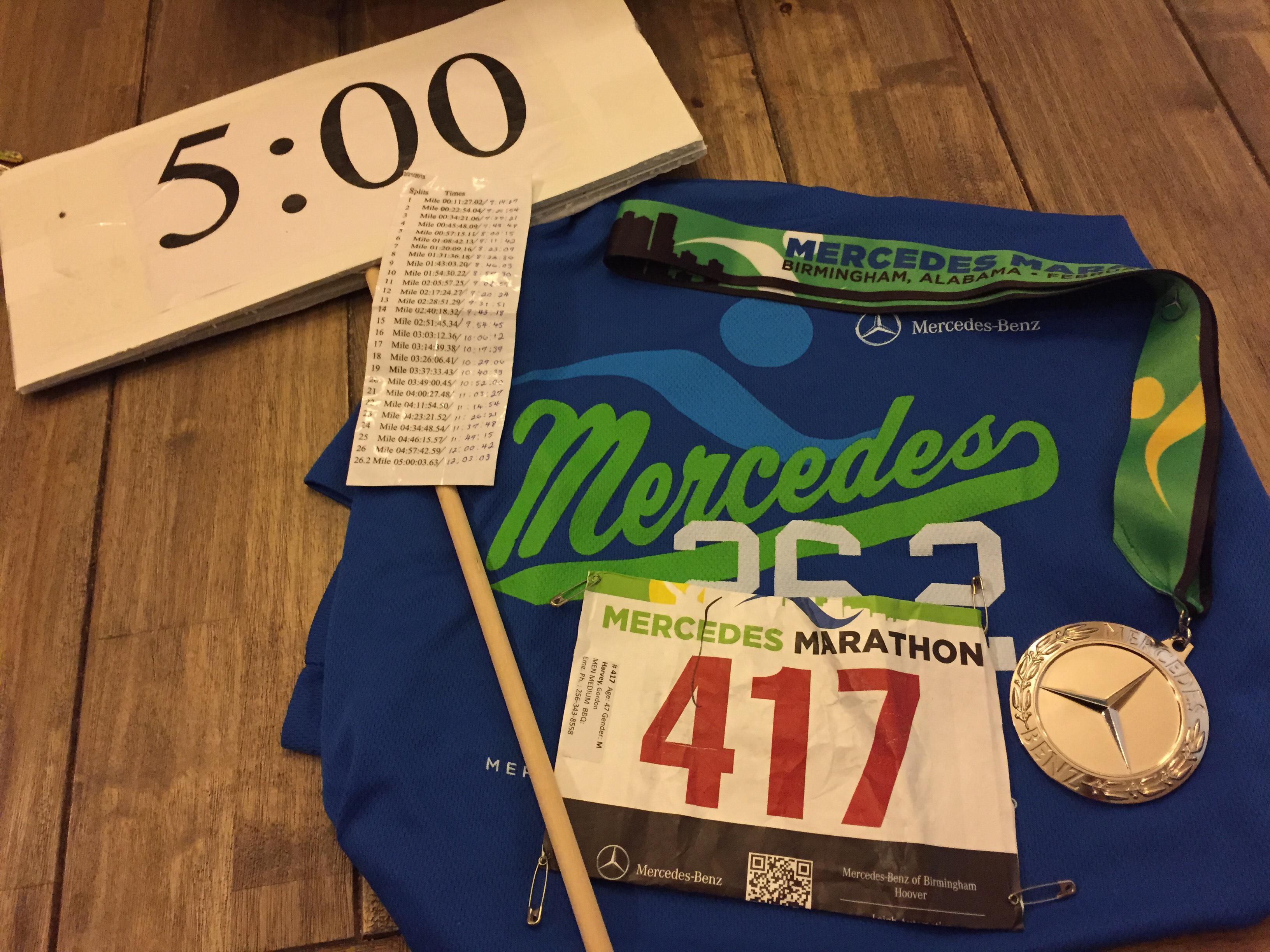
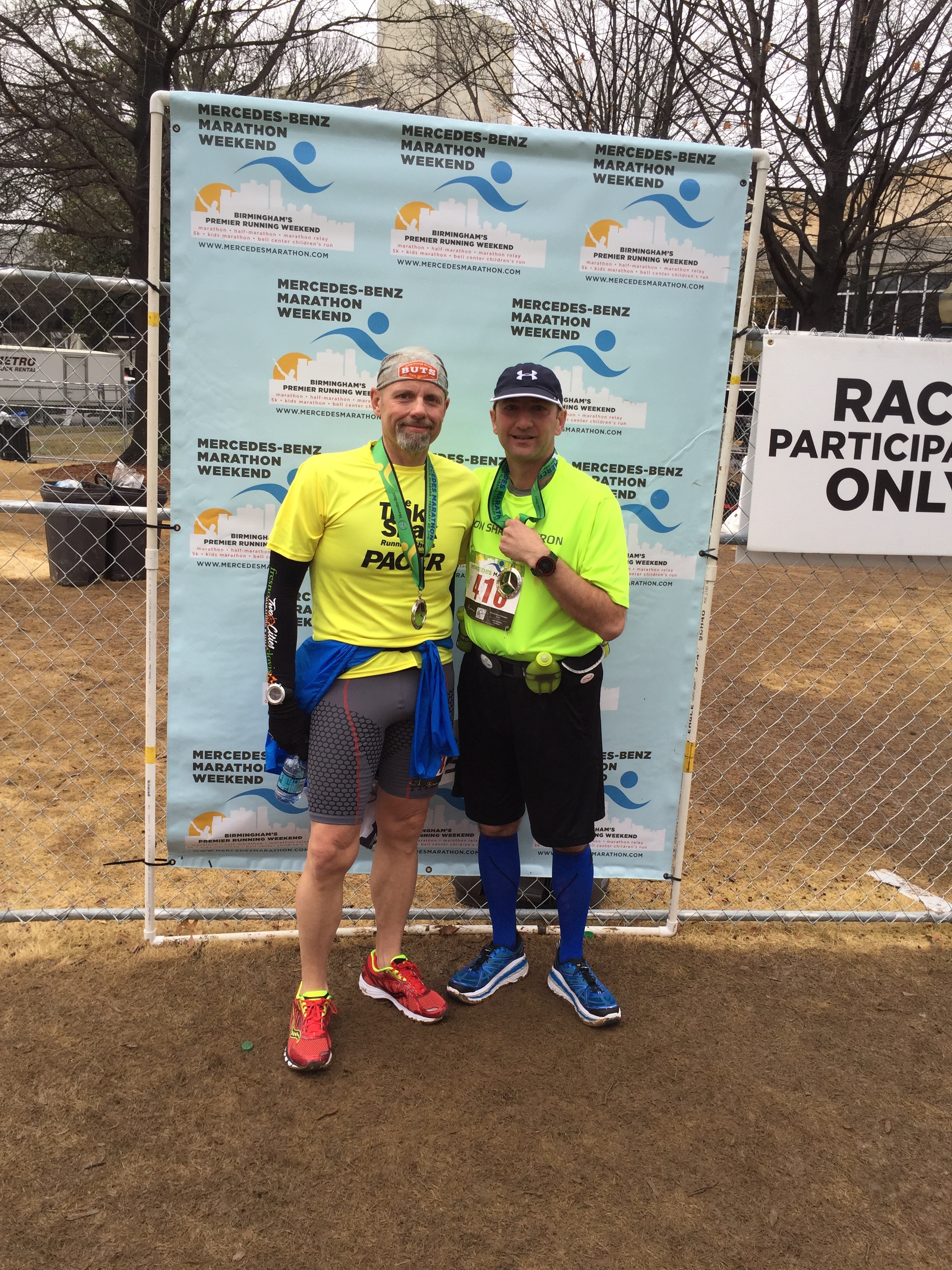
I crossed the finish line in 4:59:14. By simple time standards it was my slowest road marathon in 5 years. But other than when I completed my first marathon in 2009, it is among the most fulfilling. I helped lead the 5 hour pace group for the 2015 Mercedes Marathon. And it was my brother’s first marathon, as well. It was a big day for him and his family and his health, which he had regained control of over the past few months, citing me as an inspiration. I’m so proud of him.
With my younger brother after his first marathon. Enjoyed watching his proud marathon shuffle!
Leading a pace group always intimidated me. That’s a lot of responsibility. People looking to you to help them reach a goal. Of all the miles and money they had invested in the training for the race, they now look to a pace group leader to help them bring it all together. To be honest, even though people see me as thin and fit, I still see my old fat self although I weigh around 162 lbs. I still see 262-pound Gordon in the mirror. I don’t equate myself with one of those in-shape, fit, and in control pace group leaders I saw at races. So not only did I feel intimidation at the great responsibility of pace group leadership, I felt self-conscious at the idea that runners in my group would have to watch me jiggle along the course in front of them.
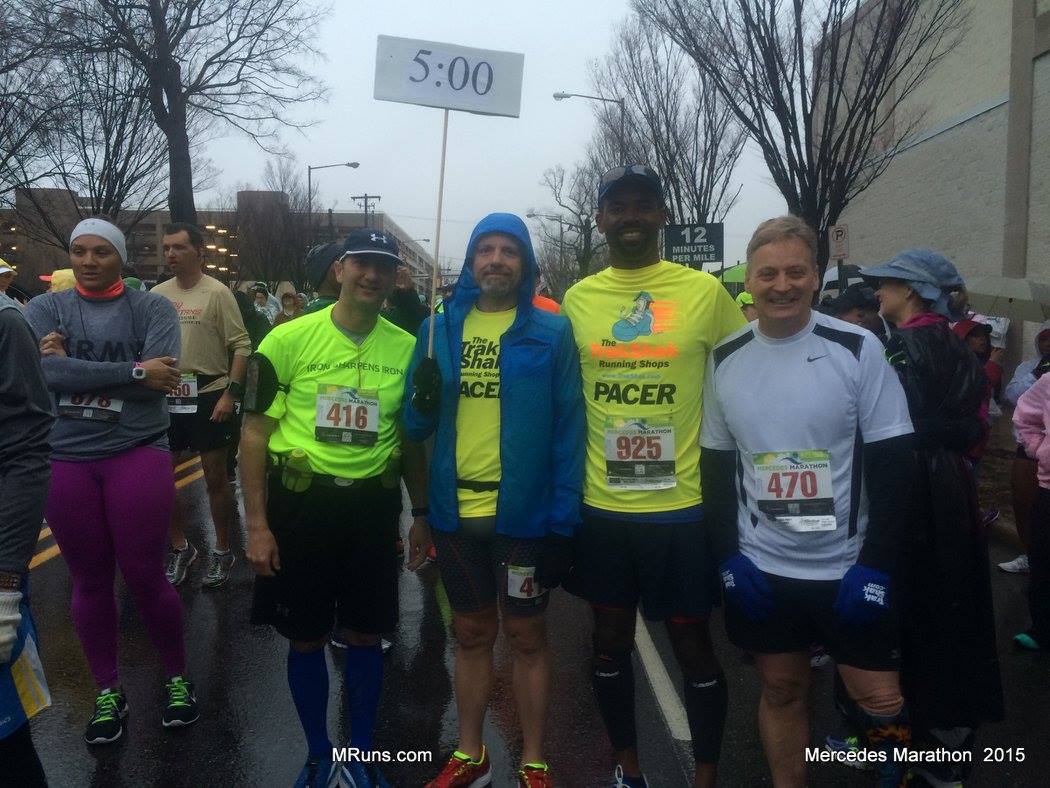
Before the race. Rained a little but held off as the race started. (Credit: Suman from Mruns.com)
Agreeing to lead a pace group made me accept, at least for a little while, that I was in shape. That my body wasn’t the large thing it once was. I had to forget about my problems and sell-image issues and focus on other runners for 5 hours. It was a very good thing. I need more of this. I think I’d like to try and join the Clif Pace Team and pace at Disney. Wouldn’t that be great: Telling my pace group that six years ago I ran this in 6:12 and now I am here to lead a group to their first finish line or a new PR? There’s something wonderful about helping others reach a running goal. I can’t get enough of it.
Here are a few thoughts that came to me as I paced this race.
Responsibility:
I was nervous as I trained for this duty. Running a marathon is a highly individualized matter. You rely on yourself to prepare, you are alone among thousands on race day, and you alone are responsible for your success or failure. If you fade or DNF, then no harm to anyone but yourself. Better luck next time. Leading a pace group changes things. You are responsible for providing your people with an opportunity to cross the finish line in the time you have committed to. Your group looks to you. They trust you. They can relax and run, knowing that you have the pace under control. When you hold up that sign with your pace time you are telling them “Don’t fret. I will get you there.”
Pressure:
See above. There’s enough pressure when you run alone: was I diligent and loyal to my training? Am I ready to race this day? Will I see my goals become a reality? Telling a group of people who you are their pacer adds another layer of pressure altogether. You can’t day-dream. You can’t lose yourself in thought as you run. You have to be alert and in the moment, while also looking ahead to the miles to come. Your mind has to be sharp. And to be sharp you have to be well-trained and able to not only run 26.2 miles, but also talk the whole time and do math in your head! We joked during the race that you know you are in trouble when your pace group leader starts asking for help, or struggles.
I have to chat, a lot:
I train and race alone. I never talk during my runs, unless I’m slogging up a hill with fellow trail runners. A pace group leader has to talk. You have to let your people know you are on schedule. How far behind or ahead you may be, and what’s coming up on the course. You have to encourage them to get water and nutrition at aid stations. You have to tell stories from your past races. Share training tips. Talk about your running life. I had the opportunity to share my health and weight loss story as well as tips for training for marathons. Every mile I announced where we were with regard to our time: ” Mile 13, we are 30 seconds ahead of schedule. Estimated finish 4:59:30. Looking good!” I crossed the finish line with a sore throat, but a full heart.
Can’t look back:
I hate losing people. I hate when they fade from a group. I’ve been there and I know that helpless feeling when you can’t quite keep up and you see the group slowly disappear into the distance. Pacing a marathon is like the story of Sodom and Gomorrah. Keep moving forward. Don’t look back. If you do, it’ll tear your heart out. The runner in me wants to turn back and bring those people back to the group, to help them finish strong. But that’s not my role. I have to keep my eyes forward, stay on course, and be the steady influence my people asked for.
Immense pride:
I loved carrying that “5:00” sign. A badge of honor. I was entrusted with this pace. This group of people. This honor. As I ran by people cheered our group. They cheered us. I got goose bumps. That sign was a symbol of hard work, of dedication to a goal, and of my ability to lead others to the realization of their goals. Being given that sign meant that the race organizers trusted me enough to be the one trusted by others.
A few bits of advice if you want to pace:
1. Pace at a rate where you’ll be strong all day long
Pace at 1.5 to 2 minutes slower than your easy run pace. You need to be strong late in the race. If you start to fade (and even at your regular easy pace, you will fatigue), then you send a bad message to your group, and your are less able to be that strong voice of encouragement between miles 18-26 when the dark times come.
2. Prepare for the pace
Train a bit at the pace you will lead. Your body must acclimate to a slower than normal pace. It seems counterintuitive but a slower than normal pace will cause stress and strain on your body and joints. My Achilles tendons were tender and my calves were a little crampy at the end. This was due to the changes in stress on my body because of the slower pace.
3. Bring the right tools
Carry a pace chart with you that lists the total clock time after each mile for that pace. This way you can know where you are. I have a Suunto Ambit GPS watch, and it has an app that predicts marathon finish time based on current pace. That worked great, but from time to time GPS watches can be a little off, especially if you are in an urban environment with high rise buildings. Having all those tools made me feel easier about the pace I was running.
4. Be confident and supportive.
When your people hit the wall they need to know that it will end. They need to hear the confidence and surety in your voice. They want to know you have their back. They want a little inspiration.
Take a chance, sign up as a pacer and you won’t regret the decision. You get to give back to a sport that has given you so much. Running has provided me so much that i feel I could never repay her. But I’ll try, one race at a time.
(If you haven’t already, please “like” the blog’s Facebook page.)
If you’ve ever run in the Brooks Launch and liked it, then you get it. And you know the lore of the Launch.
The Brooks Launch was introduced in Fall 2009 to pretty great reviews. Pete Larson at Runblogger loved it and made it one of his go-to marathon race shoes. I had friends who raved about the shoe. In fact, my friend Mike gave me a gently used pair in 2010 when I was about to transition from stability shoes to neutral shoes. When I first ran in the Launch, I had spent the previous couple of years in big stability shoes as prescribed by my LRS because I was fat and pronated. As I started to lose weight, I ran more efficiently and got out of the Beasts. My early runs in neutral shoes, ever convinced that I would do damage to myself if I didn’t have correction, were like eating forbidden fruit. I had that fear-laced excitement that I was living dangerously, like sneaking a snort of your dad’s scotch. I Loved those shoes. I loved the red and orange color way. I bought a second pair of Launch in 2011 and rotated them for shorter speedier runs to complement my distance shoe the Trance, and later the Ghost.
The Launch was a throwback shoe in an age where running shoes were becoming more and more engineered with plates and posts and the like. It offered a pretty smooth ride and nothing between you and the road but EVA and rubber. It was soft, but you didn’t feel like you were squishing along the road with too much pillow underfoot. It was to me a Goldilocks shoe. Not too soft, not too firm, just right. My next pair was yellow. I really was digging the bright colors compared to the old stability shoes I had started in, the Beasts, with their various shades of Soviet-era silver or grey.
The Launch wasn’t Brooks’ greatest seller, but it had a devoted and vocal following. Between 2012 and 2013, Brooks introduced its Pure Project line that seemed to be taking the place of the launch. And that the shoe had no real updates since it was introduced in 2009 (except for some new color ways), made some conclude that the shoe was nearing the end of its run. It wasn’t a great surprise then, in early 2012, when Brooks confirmed that the Launch would be discontinued. Devotees took to the inter webs and let their voices be heard. Pete Larson eulogized the Launch, Launch fans created a Facebook page for the shoe, hundreds of others emailed Brooks, and still others took their protest to twitter.
Some runners, like me, had an emotional connection to the shoe that helped them earn PRs or breakthrough performances. Others saw the shoe as a no frills, old school, not over-engineered shoe that reminded them of the early glory days of running. To their credit, Brooks listened and reversed their decision. In late December 2012, Brooks announced that they would indeed bring back the Launch with a couple of new color ways. “You asked, we listened,” they told us.
Six years after introducing the shoe, Brooks offers an update to the Launch. Launch 2 is out in stores soon, and I was fortunate to receive a review pair free of charge from Brooks.
The Launch family
I’ve put 50 miles on the shoe with runs ranging from 3 on a treadmill to 21 on the road. The Launch 2 is a solid update. The shoe “feels” lighter and the upper is more comfortable than Launch 1.
Out of the box:
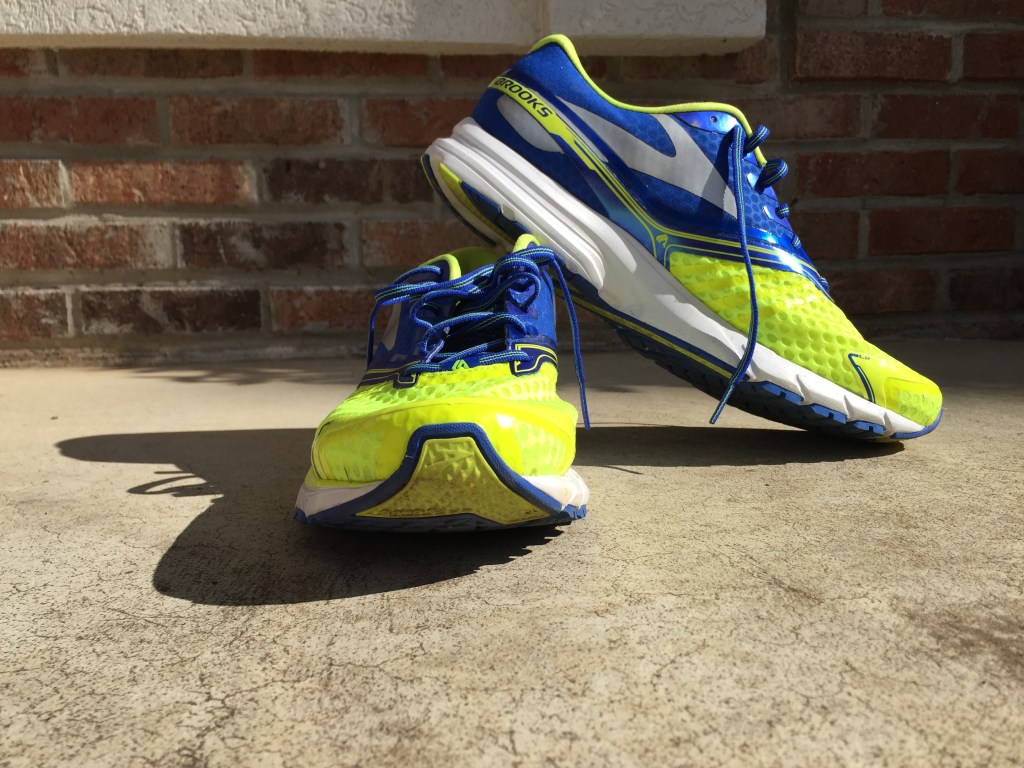
Loved the color way. The Launch have always felt perfect right out of the box. Unlike the last shoe I reviewed, there was no need to run a few miles to feel comfortable. Brooks has really done a nice job on the upper. It lacks the “new look” of the pure Project line and stains the “old school running shoe” form but it looks, for lack of a better term, sleeker. The toe box isn’t any narrower than the launch 1 but it looks like it is. Hard to express this with words, you have to see them side by side. It is a real comfortable upper.
The Launch 2 (L) just looks sleeker. Probably partly optical illusion given the lack of contrasting colors.
My first run was a 3 mile treadmill run at the baseball complex where my son takes individual instruction. They felt like Launches. Light, but some cushion, and they didn’t remind you that they were on your feet. It has been a long time since I had a shoe that really disappeared on my feet. The Launch 2 just kind of fade away as you run. I love that.
DNA logo in the heel.
Two days later I ran 21 miles in them along a paved rail-to-trail path. Again, they had enough to them that you could go for a few hours in them, but not so much to feel like you just had to get them off your feet after the run.
I set them aside for a week and ran in other shoes. Today I did a final 20 miler as I wrap up training to pace the 5 hour group at the Mercedes Marathon in a couple of weeks. Same result. A quality ride, nothing reminding me they were on my feet. A good day.
Launch 1 on the left. Launch 2 on the right
What’s new?
They’ve added BioMoGo DNA material in the sole. Here’s a great review that describes what the DNA stuff does, really kinda cool. It feel soft and cushy when walking, but not so much when running. And they’ve added more padding inside the shoe, especially the area around the heel counter. The mesh upper breathes a little better than the old Launch. There’s more cushion under the forefoot than I expected, but I liked it.
Details: Brooks launch 2. Size 11.5 D. 10MM offset
Weight: the Launch 2 weighs 11.2 ounces for my size 11.5. This is slightly heavier than my old Launch,which weight 10.8. But let’s be honest, most of us, especially me, will not notice the difference. And it shouldn’t affect my chances at winning my next marathon.
$100 at the Brooks website.
Colors:
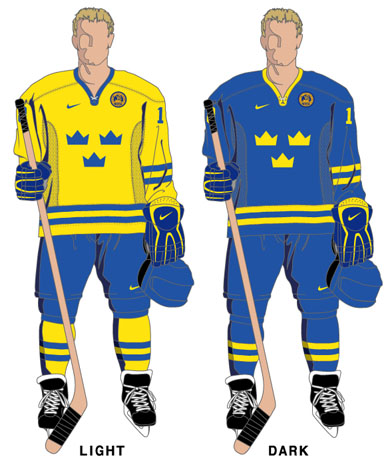
Men’s version: 1)what I call Sweden Hockey and 2)a charcoal gradient
these shoes remind me of the Swedish Hockey uniform. Love the color way
50 miles later I remember why I, like a lot of people, love this shoe. It has enough cushion for a long run and it has the responsiveness to be something I ould wear at the track or on faster, shorter runs. It is a solid update to what was an already solid shoe. And it is versatile enough to be your everyday trainer and maybe race shoe.
Provenance:
I received these free of charge from Brooks. The review is my own.
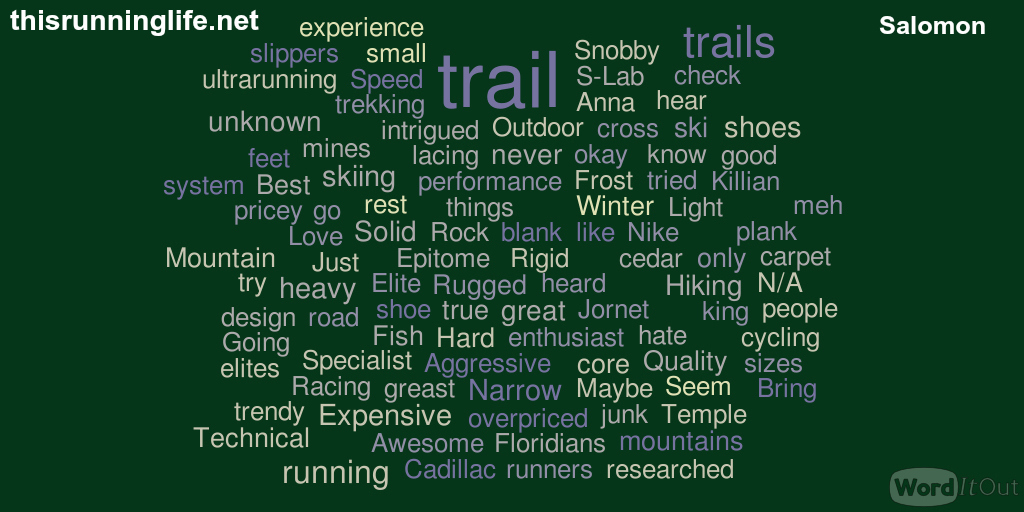
Few brands are so solidly identified with trail running as Salomon. As you can see from the responses this holds true here, too. Not only do you see trail specific responses, you also see brand identification with its highest profile Athlete, Killian Jornet. Other responses are more mysterious. Florida?
Just a reminder, if you haven’t already, please pop over and “like” the blog’s Facebook page: This Running Life on Facebook
Note about the survey: I conducted this survey from September 1 through December 23, 2014. I used a google sheets survey and publicized it on Twitter, facebook, and this blog. The survey garnered 198 responses.
There was a time when I knew my shoe. Without doubt or equivocation I could tell you exactly what I wore and how long I’d been running in it. I was a Brooks Ghost man through thick and thin. It took a lot to get there I started out as a much heavier dude in motion control shoes like the Mizuno Renegade and the Brooks Beast. Weight loss and increased running efficiency allowed me to move from those models into the Brooks Trance and then the Brooks Ghost and Launch as my trainers. I went through probably 8 pairs of the Ghost 4 and 5. No issues. At. All.
While training for the Fresno marathon in the summer of 2013, I was rotating through the Pure Project Pure Flows and the Ghosts 5s. Excited to purchase the new iteration of the Ghost that year, the Ghost 6, I laced up and out the door for a tempoo run one hot and humid summer morning. A few miles into my normal sweatfest my legs felt tired and fatigued and the shoes felt spongy. Like running in a thin layer of sand. I gave them a few more runs but had to pull the plug on the Ghost 6. Brooks had moved into the idea of runners “floating” in their ad campaigns and adding a bit more cushion to these shoes. They engineered me out of the 6. Panicked, I stockpiled the Ghost 5 and got through my race. Then I hit the trails and didn’t see a lot of pavement for the rest of the year and into February 2014 when I went down for 3 months recovering from bilateral inguinal hernia repair (with which I had run a hard 50K with in January. Pro tip: If you find yourself standing by the side of the trail pushing your gut back in it is a sign that you should consult a medical professional.)
When I returned to the roads I chose Mizuno as a possible replacement for my Ghosts. I recalled happy miles during my first marathon in the Renegades, so I bought the Precision 13, the Rider 17 and the Sayonara 1. All are fine shoes (issues with the Rider 17 notwithstanding) and I enjoyed my runs in each. The Sayonara took about 30 miles to feel right, and the Precision and the Rider were fine out of the box. But they had yet to give me that “Ghost feeling.” They didn’t feel like “home.” Mizuno gives me a responsive ride in most of their shoes. I’m not used to that and while I liked it for shorter efforts, my longer runs left me with more questions than answers. I had yet to find home.
What’s “home” for me in running shoes? Home is when you are on a run and you don’t think about your shoes or your feet. You don’t feel odd sensations that distract you from your run. You don’t wonder if that’s the shoe you feel or are you expereiencing the onset of a small issue that might become an injury. Home is the absence of attention to feelings in your feet or shoes.
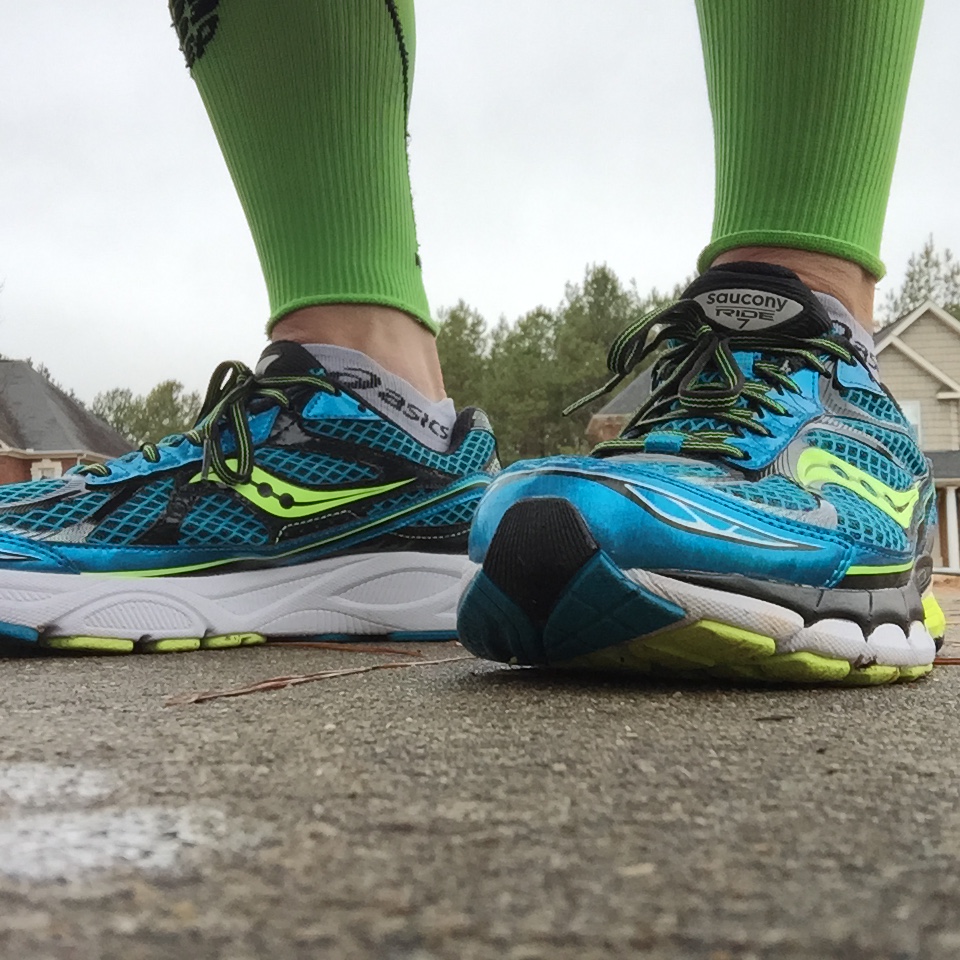
I’m nervous to give the Ghost 7 a try. I’m afraid there’s probably still too much floating going on there. I am excited that I will get to review the Launch version 2 soon. On a whim and desperate for a Home shoe, I purchased a pair of Saucony Ride 7. I need to up my mileage on roads so I can run a marathon with my brother (his first) in February. I was hoping that the Rides would, if not give me a new home, at least provide a nice long term rental.
Color ways: Viziglo; Orange/Citron/Red; Blue/Black/Citron; Grey/Yellow/Blue; Silver/Black/Slime; White/Black/Orange. I bought the Blue/Black/Citron. I wanted the orange, but was afraid it would be too crazy. Don’t get me wrong, I love crazy color ways. My Precision 13 is robin’s egg blue and canary yellow. But I got a glimpse of the orange Ride in a Saucony outlet store and really like it. Wish I had gotten that color. Next pair.
Mileage: 53 miles as of this post
Out of the box: A little stiff. First run was ok. Other reviews had mentioned that this shoe needed a few runs to come alive. I agree. Don’t judge this shoe on a single run. Give it 20-30 miles. I felt a little tingling in the forefoot under the ball of my foot late in the first run. I freaked a little thinking I was getting injured (this was on the left leg, which had been giving me issues in the calf and knee recently, so I thought it all connected somehow). But I read a review by Tyler Mathews on the Runblogger site. He felt the same thing and it went away for him, too. I had similar sizing thoughts as Tyler, as well. They felt slightly small out of the box, but after 20 miles they felt perfect.
Random thoughts: When I fatigue during a run, I tend to lightly scrape the the lateral side of my right heel. Over time, I’ve taken off a good amount of material from this area.
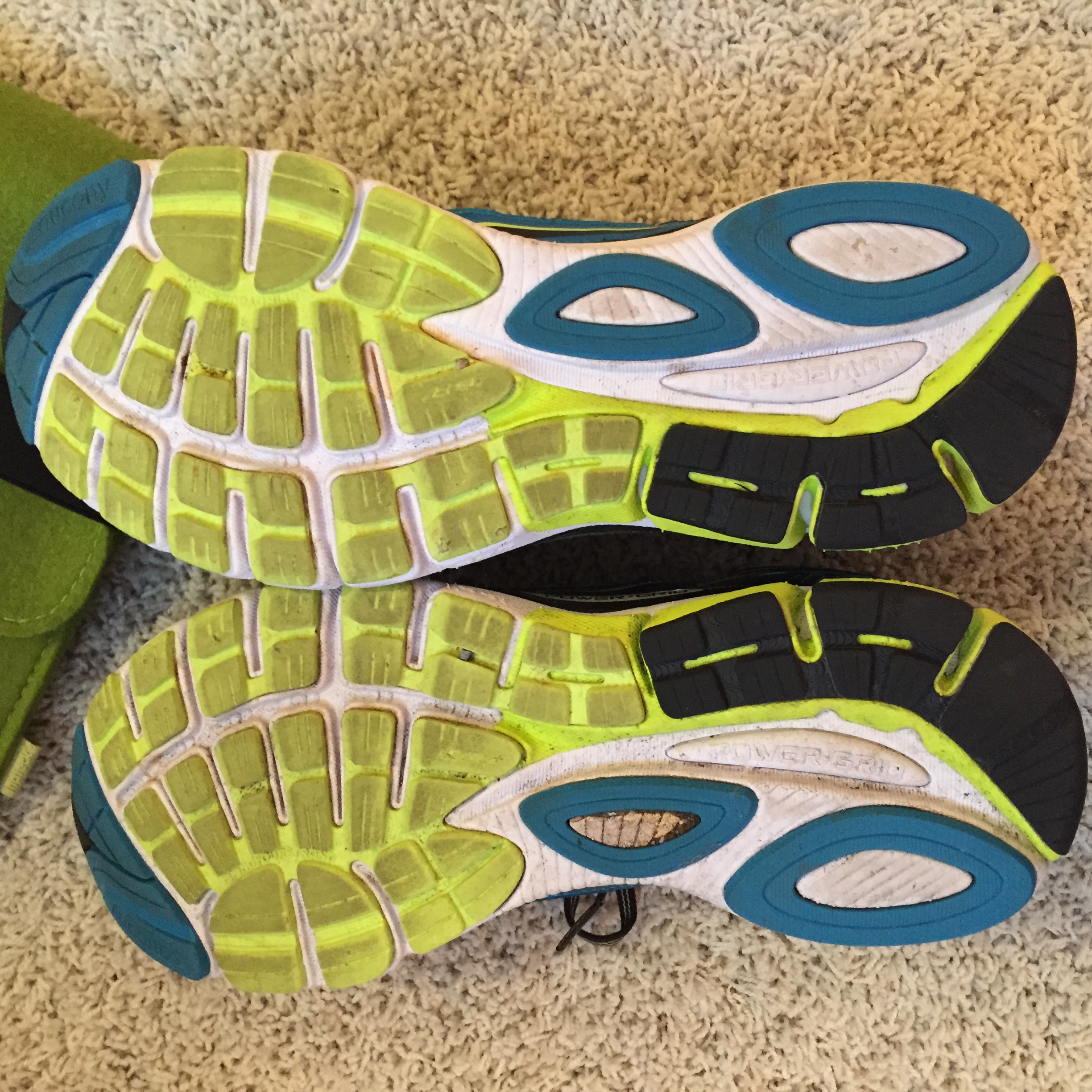
53 miles and little wear at all
A lot of shoes have flared heels and flatter heels near the edge. This shoe has a slightly upward curve and less flare than normal. I’ve not experienced any of the scraping that I would have seen by now on other shoes (even the Ghosts) 50+ miles. Of course materials differ from maker to maker, but I think the curvature in the heel edge reduces my scrape habit a little.
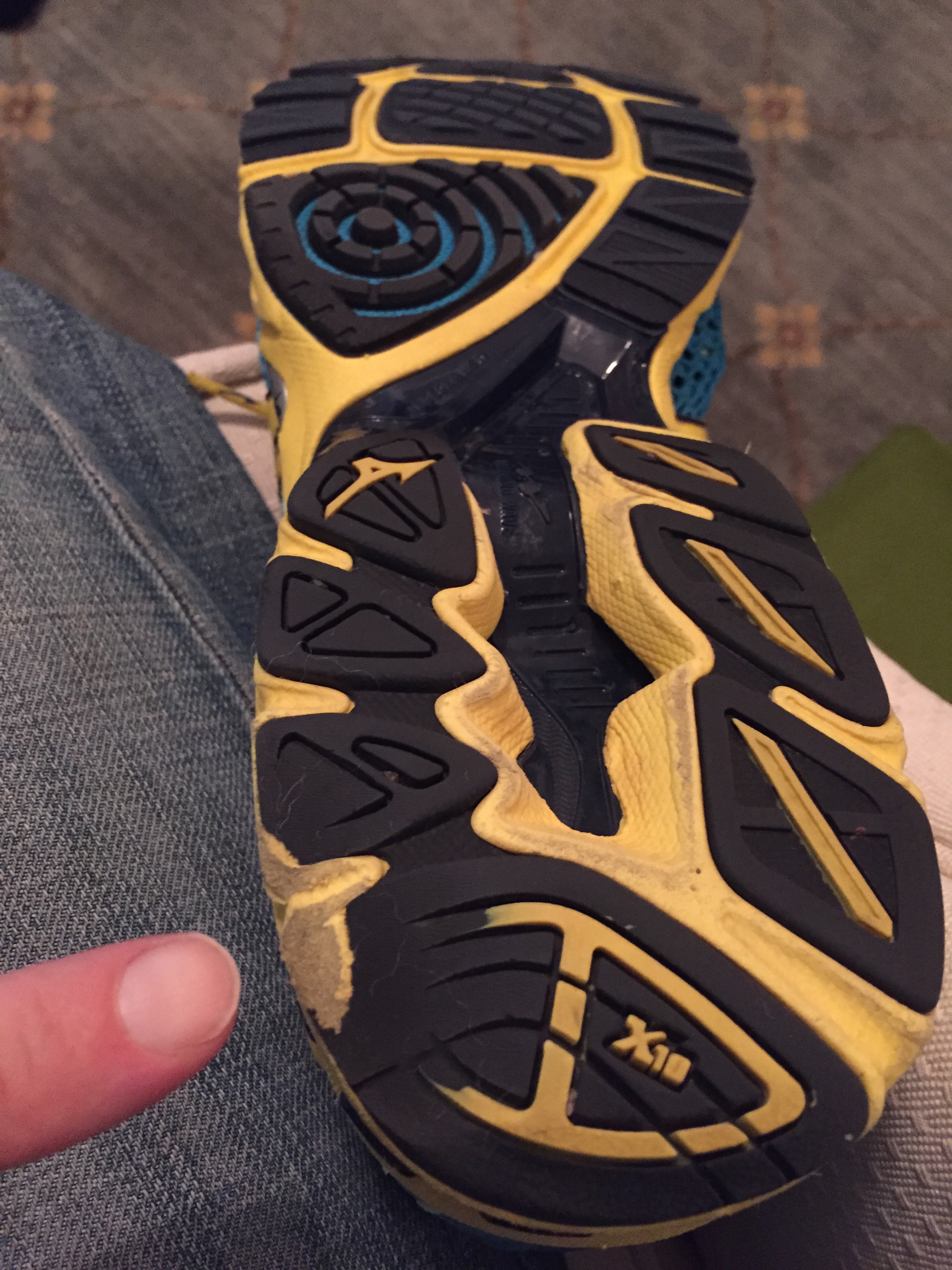
less than 75 miles in this Mizuno and you see the wear
Final thoughts: 53 miles later I believe I could run a marathon in these shoes. They don’t feel like home yet. I’m still looking at other shoes, but for the time being and for this training cycle, this is a good shoe for me. This shoe reminds me of the Ghost 4 and 5, which was my favorite shoe. I Ran several marathons in them. They passed the Goldilocks test. Not too cushy, not too responsive. They were just right. The Ride 7 reminds me of that shoe. This may not be home, but I’ve signed a 12 month lease.
Provenance: As much as I’d like to receive free review shoes, I bought these myself from RunningWarehouse.com
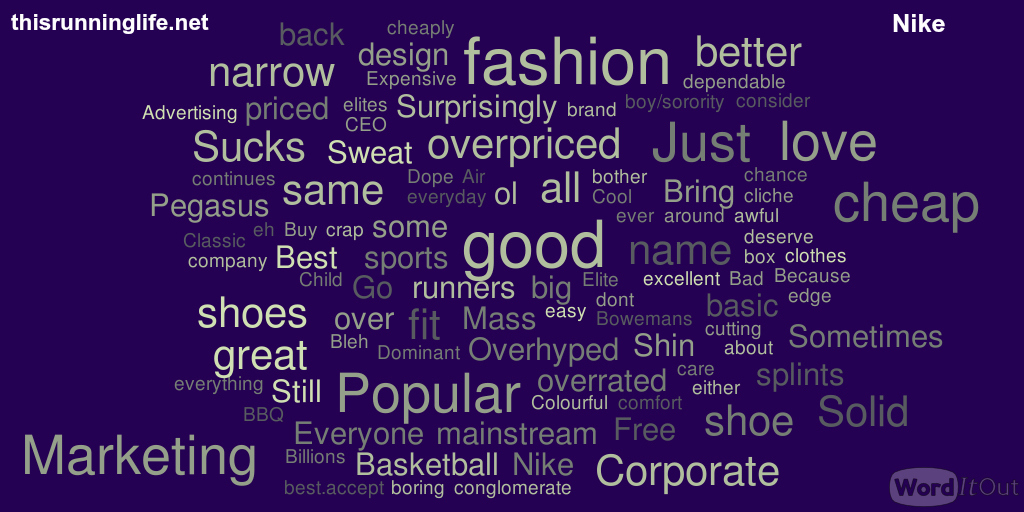
Few brands elicit responses such as the giant that is Nike. Whether the unabashed fan boy to the skeptical critic of seemingly unlimited marketing budgets, runners don’t hold back when it comes to this brand. Responses to Nike ran the spectrum from love to loathing.
Remember the larger the word the more often that response appeared in the survey of almost 200 runners.
Just a reminder, if you haven’t already, please pop over and “like” the blog’s Facebook page: This Running Life on Facebook
Note about the survey: I conducted this survey from September 1 through December 23, 2014. I used a google sheets survey and publicized it on Twitter, facebook, and this blog. The survey garnered 198 responses.
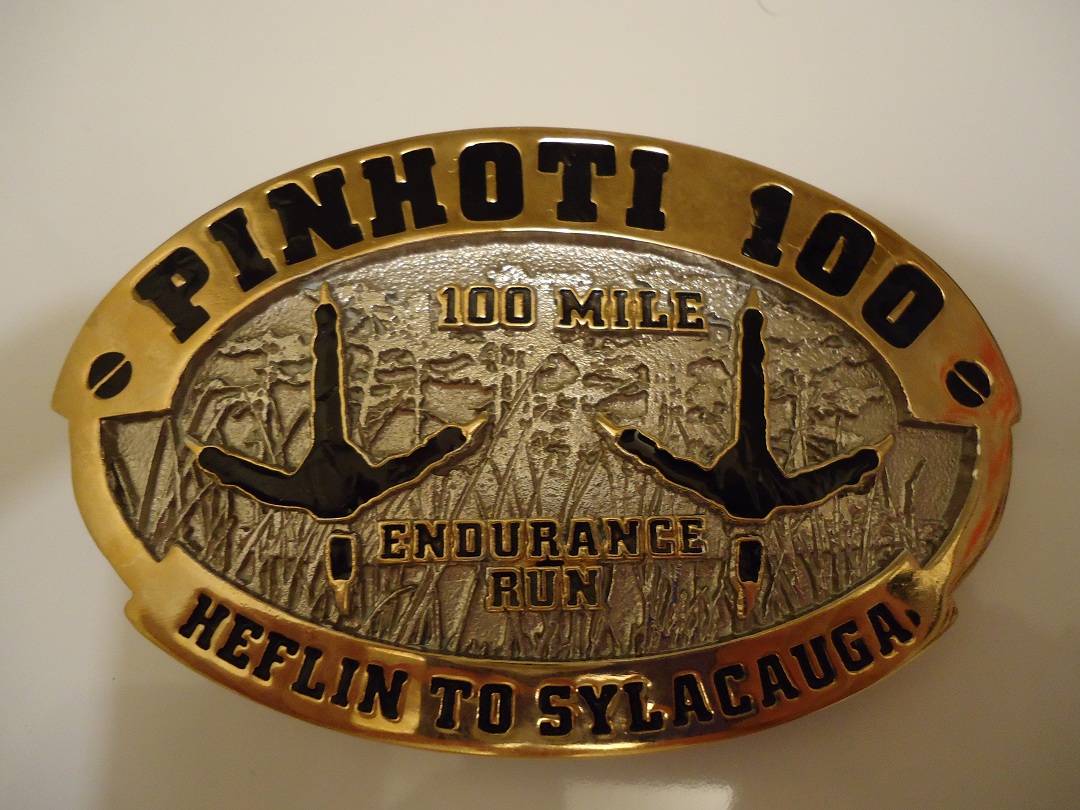
It takes a special kind of crazy to sign up for your first 100 miler. Some folks run one and then move on to other things after getting their buckle. For others, though, it can be the beginning of a love/hate relationship with the distance. At any rate 100-milers are at once inspirational and enigmatic. What possesses a person to sing up for one? What motivates them to commit to the possibility of pain and the potential of the glory of completion?
After my tremendous experience pacing my friend Lynde for 50 K of the course in the cold overnight hours of early November in Alabama, I wanted to get inside the mind and explore the motivation of first time 100-milers who raced at Pinhoti. Considering a 100 miler myself, I thought this was a good opportunity to let these amazing folks tell their story while also compiling advice and tips for my own decision making process.
Instead of publishing a book-length post with all the responses to each of my 5 questions, I’ll post one question/response per day.
Here is question 1:
1) Why 100 miles? What tipped you over the precipice that is the 100 mile race?
Kandy Frey Ferris
Why 100 miles? I’d done five 50 milers and felt like I had conquered that distance. Wanted a new challenge. I wanted to see if I could finish it and do it well. Messner, first person to climb Mt Everest, said “I don’t go up there to die, I go up there to live.” That’s how I feel. Society has become overly comfortable and most people are content to coast through life, moving from one day to the next in a comfortable coma. Everything comes so easy, that people are miserable, just going through the motions. People don’t realize that even though they are breathing, they aren’t truly living.
——–
Sean Eden
It was on my bucket list and to prove myself and others that I could do it.
——–
Caitlyn Manhart
I saw a documentary on Western States when I was 10 or 11 (I was 29 years old at Pinhoti, so it has been a dream for a long time) and was amazed that people pushed themselves to the extremes encountered during a 100 mile race for no prize money or fame, but to prove to themselves that they could do it. I decided at that moment I was going to do that when I grew up. The desire to do the race never left over the years, as I got older, it grew stronger.
——–
David Yerden
The 100 mile distance has been my mind for a long time. I was doing my long runs on trails, even when completing road marathons years ago, so it was natural to start considering trail races. Once I completed my first ultra, I started thinking more about the 100 mile distance but didn’t know if that would be possible for me, mostly because I was always fighting injuries. I have always read race reports, and this also kept the 100 mile distance on my mind. If you run ultras, the 100 mile distance is the Holy Grail of trail running races, and I knew I wanted to prove to myself I had what it took to complete a race of this distance. I knew others who had buckled, and I decided if they could do it, so could I. A year ago, I ran with a woman who was training for Pinhoti. We came to a clearing between the first and second aid station on the Pinhoti course, and you could see Mt. Cheaha far, far in the distance. Right then and there I said to myself that if I could stay healthy, I would run Pinhoti next year, and that is what I did!
——–
Josh Nichols
It seemed like an attainable goal. My father is a Western States finisher and a longtime ultra runner, so for me it seemed only natural to hit that mark.
——–
Mark Mehler
I swore off the 100-mile distance upon completion of my first 50-miler. “No way could I double that distance”, I said. I held pretty firm to that until after a weekend crewing/pacing for a friend at WS100 in 2014. His race did not go to plan, and he was stopped at 85 miles after missing the cutoff by 2 minutes. The next day, he was on the WS site looking at qualifying races, noticed that the Pinhoti 100 was a qualifier, and not until November. Naturally, we began throwing around the idea of doing this race. I was fresh off the Rock Creek Stage Race in Chattanooga, where I had heard a number of the participants saying positive things about the race. Two weeks post-WS, I find myself at another stage race in the Upper Peninsula of Michigan (Run the Keweenaw in Copper Harbor — if you ever get a chance to run this race, do it!! It is phenomenal!!) I’m there with a couple of very solid, accomplished runners, and the conversation turns to how much fun it would be to have a big group head down to Alabama for a 100-miler.
Needless to say, late July comes around, and the guy with the near-miss at WS sends out the email with the confirmation of his Pinhoti sign up. Shortly thereafter, another of our group does the same. It wasn’t long until the 3rd fell into line. I held out for a few more weeks before deciding to take the plunge. Finally, shortly before registration closed, we were shocked with a late sign up from a friend who we all considered a no-go.
So now we were 5. Game on
——–
Jay Rasch
I had a sinking feeling right after I ran my first 50k 2 years ago that I would find myself running a 100. I enjoyed running trail ultras enough that I escalated 50k to 50 miles the following spring to a 100k the next fall. I realized after the 100k that I’d probably run a 100 in the next year. After a challenging spring race schedule I set aside the time to trail all summer and felt comfortably trained up for a fall 100 which wound up being Pinhoti.
——–
Brad Addlink
Many of my athletic goals and bucket list items are based being able to say I accomplished something most people can’t or wouldn’t attempt. The feeling I get when I’ve pushed thru difficult times and finished a race is a type of adrenaline rush hard to find in shorter races.
A couple of months ago, I posted links to a running shoe brad tag survey I created. I was inspired to do this after listening to a design podcast that discussed a huge survey done on brand tagging in general that later spawned a website that allows you to participate yourself: http://www.brandtags.com.
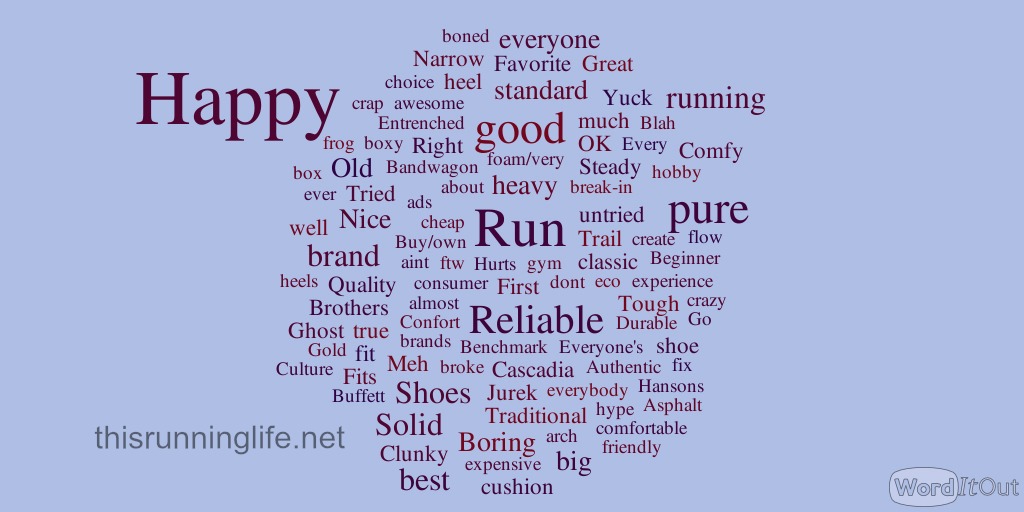
Here is the word cloud I generated using the responses (200 responses–Thanks!) you gave me about Brooks Running. I’ve got a lot more of these coming for more brands, so stay tuned. Remember, the more often a word appeared in the survey, the larger it is in this graphic.
The brooks “Run Happy” marketing campaign seems to have been successful since that is the most common response. They’ll also be happy to see “pure” for pure project, and “reliable,” “solid,” and “quality.”









 This Running Life